
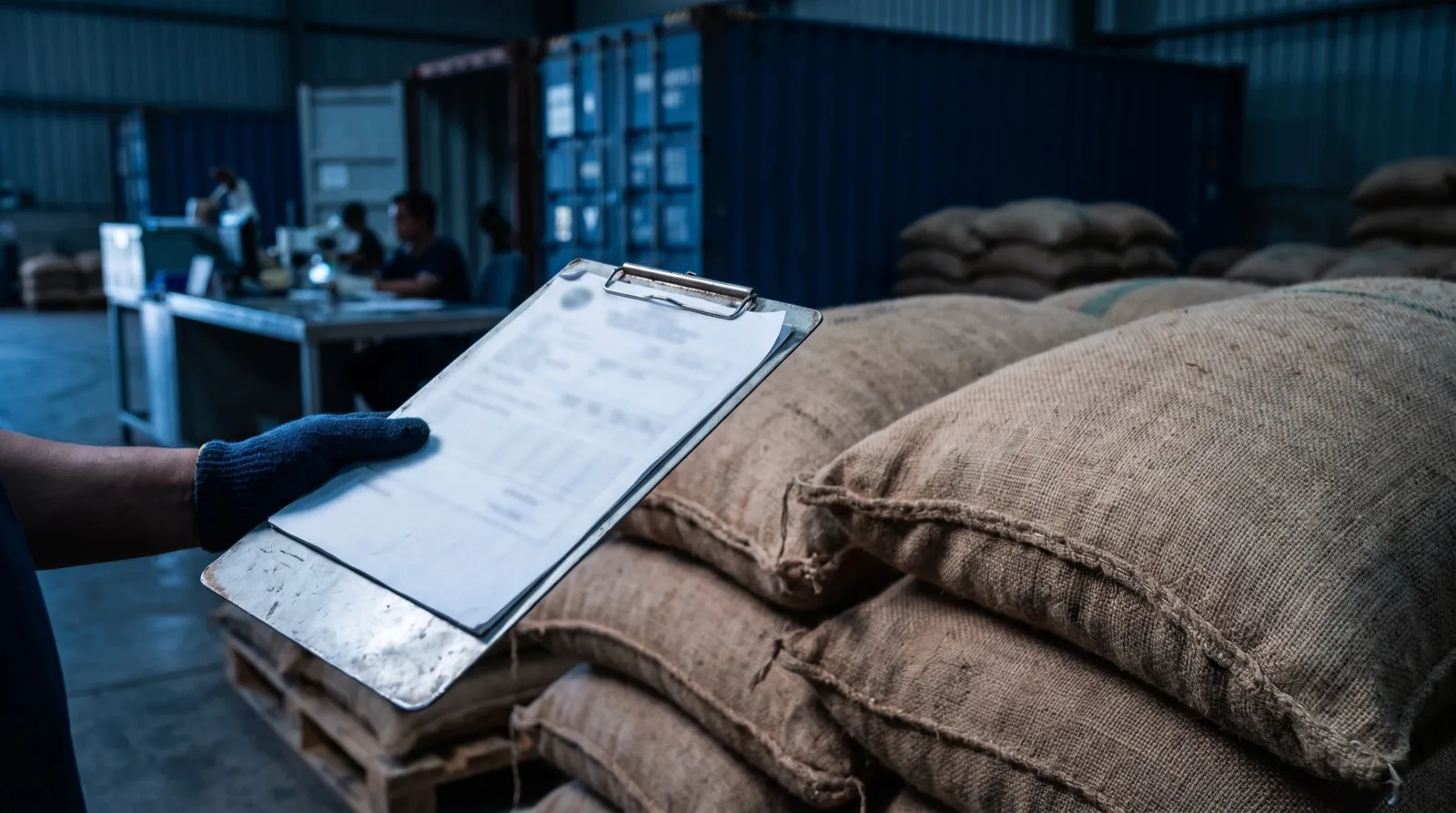
A buyer opening their first coconut import file usually assembles four documents by habit: a Certificate of Analysis, a phytosanitary certificate, a fumigation certificate and a health certificate. Only one of those is universal. The other three depend entirely on the product form and the destination market, and asking a supplier for the wrong one wastes a week and a courier fee for nothing.
Desiccated coconut, coconut oil and coconut milk powder are processed, dried or refined products. That single fact removes plant-health paperwork that would otherwise apply to raw agricultural cargo. What replaces it, in several markets, is a food-safety registration step that has nothing to do with pests and everything to do with who is allowed to sell into that country at all. Getting the document pack right means knowing which regime you are actually in.
What is a Certificate of Analysis, and why does it apply everywhere?
A Certificate of Analysis (COA) is a lab report against an agreed specification, issued per production lot, covering moisture, fat content, particle size or grade, and microbiological limits such as Salmonella and E. coli. It is a contract document, not a government one. No customs authority issues it, and no regulation makes it mandatory at the border, but almost no buyer will accept a container without one because it is the only proof that the lot matches what was ordered.
Because it is contractual, the desk specifies the testing lab, the parameters and the acceptance range in the purchase contract itself, not the reverse. A prior post works through the six numbers that matter most on a desiccated coconut COA and how to read them against Codex Alimentarius CXS 177-1991.
Does desiccated coconut need a phytosanitary certificate?
In most destination markets, no. A phytosanitary certificate exists to certify freedom from live pests and plant disease risk on raw or minimally processed agricultural material. Drying, shredding and heat treatment during desiccated coconut production is generally enough to remove that pest pathway, and several major markets say so directly rather than leaving it to interpretation.
The European Union exempts coconuts, fresh or dried, shelled or unshelled, from phytosanitary certification under Annex XII, Part C of Regulation (EU) 2019/2072, according to the Netherlands’ CBI market-entry guidance for the category. The United States runs the same logic through a different mechanism: APHIS lists dried, cured or otherwise processed fruits, vegetables and nuts among products generally authorized for import without a permit or phytosanitary certificate, which covers desiccated coconut as a dried processed product rather than a raw agricultural commodity.
This is not a blanket rule for every market on earth, and it is not permission to skip the check. Phytosanitary requirements are set country by country under each national plant protection organization, following the ISPM 12 framework for certificate issuance. A buyer bringing in a first shipment to a market outside the EU and US should confirm the position with that country’s plant health authority before assuming the exemption travels with the product.
What does a fumigation certificate actually cover?
Two different things travel under the same phrase, and mixing them up causes real delays. The first is treatment of wooden packaging, pallets and dunnage under ISPM 15, now required by close to 200 countries including the US, EU, China, Australia, India and Turkey, evidenced by the IPPC mark stamped on the wood itself, not by a separate paper certificate for the cargo.
The second is fumigation of the commodity in the container, usually with phosphine, aimed at insect infestation risk during transit through humid transshipment routes. This is less a legal requirement for desiccated coconut specifically and more a contractual one: many buyers ask for it anyway on bagged, dry cargo moving through tropical ports, because reinfestation risk in a sealed container sitting at ambient heat for three to five weeks is real and cheap to prevent up front.
The desk’s practice is to price fumigation into the contract explicitly rather than leave it as an assumed extra, because “who pays for the fumigation certificate” is a surprisingly common invoice dispute on FOB terms.
What is a health certificate, and which markets actually ask for one?
This is where 2026 has moved the most. A health certificate, in the sense most buyers mean it, is either an official export health certificate issued by the exporting country’s food safety authority, or proof that the manufacturer is registered with the importing country’s food safety regulator. It is a food-safety administrative step, separate from both the COA and the phytosanitary certificate.
China tightened this sharply. GACC Decree No. 280 takes effect on 1 June 2026, replacing Decree No. 248, and keeps overseas manufacturer registration mandatory for essentially all imported food, according to trade-compliance summaries of the decree from Reach24H and other China regulatory advisors. Products in GACC’s Authority-Recommended Registration Catalogue, a smaller list built around meat, dairy, seafood and infant formula, need a government recommendation letter before registration. Desiccated coconut and coconut oil sit outside that named high-risk group, which points to the self-registration pathway through GACC’s Single Window or CIFER portal rather than the recommendation-letter route, though a first-time exporter should confirm current classification directly with GACC rather than assume it from precedent.
Saudi Arabia’s SFDA runs registration through its Ghad portal, mandatory since 2026 for any company importing food into the kingdom, per compliance guidance published by regional advisory firms. Halal certification is required specifically for products containing meat, animal fat, gelatin, collagen or other animal-derived ingredients, or products carrying a halal logo, so a plain desiccated coconut or coconut oil shipment with no animal-derived processing aids generally sits outside that trigger. Where a free sale certificate is requested, SFDA has stated it will only accept one issued by the exporting country’s official health or food authority, not a chamber of commerce or notary.
The EU and US, by contrast, do not require a border health certificate for a plain coconut product with no meat or dairy content. FSVP obligations in the US sit with the importer of record, who must maintain written supplier verification records under 21 CFR Part 1, Subpart L, rather than present a certificate at the port.
Document pack by market
| Document | European Union | United States | China | Saudi Arabia / GCC |
|---|---|---|---|---|
| Certificate of Analysis | Contractual, always expected | Contractual, always expected | Contractual, always expected | Contractual, always expected |
| Phytosanitary certificate | Exempt for coconuts (Reg 2019/2072 Annex XII Part C) | Exempt, processed/dried product | Confirm with GACC per shipment | Confirm with plant health authority per shipment |
| Fumigation certificate | Not mandated; ISPM 15 covers wood packaging only | Not mandated; ISPM 15 covers wood packaging only | Contractual practice on bagged cargo | Contractual practice on bagged cargo |
| Health cert / registration | Importer FSVP-style records, no border certificate for plain coconut | FSVP records held by importer, 21 CFR Part 1 Subpart L | GACC overseas manufacturer registration mandatory from 1 Jun 2026 | Ghad portal registration mandatory; Halal cert only if animal-derived content |
What this means for buyers
- Persona B, importer or distributor: build the document checklist per destination market, not per product. The same desiccated coconut lot needs a different pack landing in Rotterdam versus landing in Shenzhen.
- Persona C, brand owner scaling past a co-packer: ask your supplier which registration number is on file with GACC or SFDA before you sign a contract that assumes it exists, and run it through the desk’s supplier qualification checklist first.
- Both personas: treat the COA as the one document that is always your responsibility to specify, since no regulator will define it for you.
- Confirm phytosanitary and fumigation positions with the destination country’s authority for any market outside the EU and US rather than assuming the exemption applies.
- Build fumigation cost into the FOB or CIF quote explicitly if you want it as standard practice, not as a line item that appears after the container has sailed.
FAQ
Does desiccated coconut need a phytosanitary certificate to enter the EU? No. Coconuts, fresh or dried, are listed as exempt from phytosanitary certification under Annex XII, Part C of Regulation (EU) 2019/2072.
Is a fumigation certificate the same as ISPM 15 wood packaging treatment? No. ISPM 15 covers pallets and dunnage, evidenced by a stamp on the wood. A cargo fumigation certificate treats the commodity itself and is usually a contractual, not legal, requirement for dry coconut products.
Does China require a health certificate for coconut imports from 1 June 2026? GACC Decree 280 makes overseas manufacturer registration mandatory for essentially all imported food from that date. Coconut products sit outside GACC’s named high-risk categories, pointing to self-registration rather than the recommendation-letter pathway, but classification should be confirmed with GACC directly.
Who is responsible for the Certificate of Analysis on a coconut shipment? The buyer, contractually. No government body issues or mandates a COA; the buyer specifies the testing lab and acceptance parameters in the purchase contract.
Does Saudi Arabia require Halal certification for plain desiccated coconut? Halal certification is triggered by meat, animal fat, gelatin or other animal-derived content, or a halal logo on packaging. A plain coconut product with no animal-derived processing aids generally falls outside that requirement, though SFDA Ghad portal registration still applies.
Building a document pack for a new market is exactly the check the desk runs before every new lane. Need a document pack locked across origins? Send the desk an RFQ.