
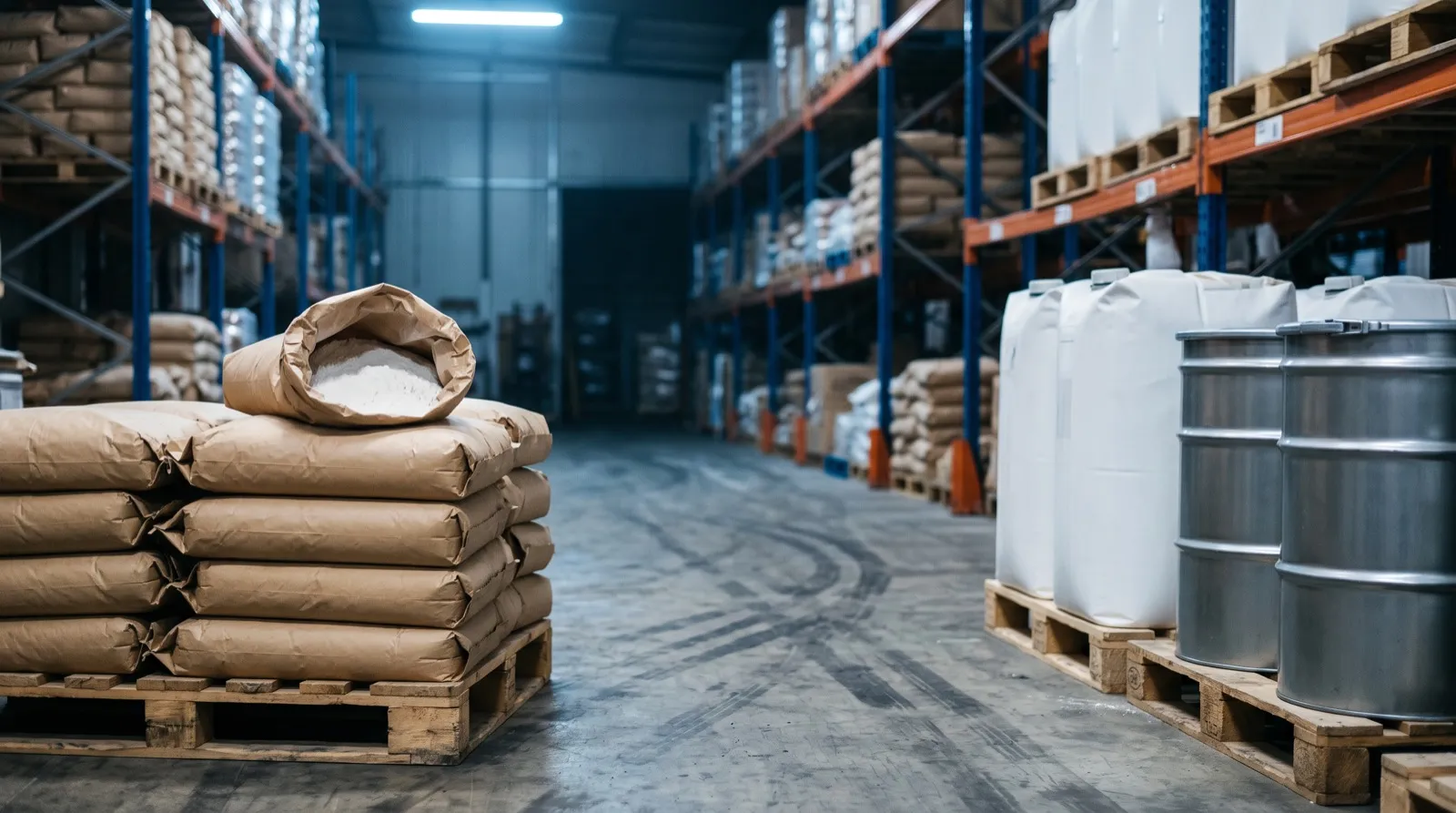
Coconut milk powder beats liquid coconut milk on freight by roughly $0.14 per kilo of finished product, and on ex-works cost by more again. One tonne of powder rehydrates to about 6.1 tonnes of standard-fat coconut milk. You are shipping the coconut solids and buying the water at destination.
That is the whole case for powder. The case against is equally concrete: you need mixing capacity at your plant, you must label the result as reconstituted, and the powder’s carrier system can push it into a tariff line costing five points more than liquid.
What do the Codex classes actually say?
Codex Alimentarius defines four classes of aqueous coconut product by fat and total solids. It does not define coconut milk powder at all.
| Codex class | Total solids (% m/m) | Fat (% min) | Moisture (% max) |
|---|---|---|---|
| Light coconut milk | 6.6 – 12.6 | 5.0 | 93.4 |
| Coconut milk | 12.7 – 25.3 | 10.0 | 87.3 |
| Coconut cream | 25.4 – 37.3 | 20.0 | 74.6 |
| Coconut cream concentrate | 37.4 min | 29.0 | 62.6 |
Source: Codex STAN 240-2003, Standard for Aqueous Coconut Products, §3.1.3. FAO records amendments in 2019, 2022 and 2024, which were not retrievable at the time of writing, so treat this as the 2003 baseline.
Two consequences. The trade’s familiar “17% fat” and “22% fat” grades have no standards basis, because the Codex cream class starts at 20% fat. And there is no Codex standard for coconut milk powder: CXS 240 mentions coconut cream powder only as a permitted input for reconstitution (§2.1(a)(ii)). Your purchase spec is the only document binding anyone.
The standard also requires reconstituted product to be labelled as reconstituted (§8.1.2). That obligation transfers to you the moment you buy powder.
How much liquid does one kilo of powder make?
Spray-dried coconut milk powder runs approximately 61% fat, 27% carbohydrate, 7% protein, 1.8% ash and 0.2–0.8% moisture, with maltodextrin and casein as carriers (Tetra Pak Coconut Handbook, Ch. 6, 2026). A UK tariff ruling describes a commercial powder as coconut extract 80% with hydrolysed starch, dairy protein and tricalcium phosphate (HMRC ATaR 600007997, 8 August 2023).
No technical source publishes a powder-to-water ratio. It derives from the Codex fat minima and the 61% figure. The results below are desk arithmetic, though each lands inside its Codex total-solids band independently.
| Target Codex class | Powder fraction by mass | Powder : water | Resulting total solids |
|---|---|---|---|
| Light coconut milk (5.0% fat) | 8.2% | 1 : 11.2 | ~8.2% |
| Coconut milk (10.0% fat) | 16.4% | 1 : 5.1 | ~16.3% |
| Coconut cream (20.0% fat) | 32.8% | 1 : 2.0 | ~32.6% |
Working figure for the rest of this post: 1 kg of powder yields about 6.1 kg of Codex coconut milk. Verify it against your supplier’s fat assay before costing.
Where does the container math favour powder?
ISO 668:2020 rates 20ft, 30ft, 40ft and 45ft containers at the same 30,480 kg maximum gross mass (Table 2). A 40ft carries roughly 1.4 tonnes more tare, so it offers less usable payload than a 20ft. Dense cargo is weight-limited, not cube-limited, so powder in sacks and canned liquid both belong in 20ft boxes. Payload is not in ISO 668, so read the CSC plate; an indicative 40ft payload is 26.6 tonnes.
Ocean freight is where the water shows up as money. Drewry’s World Container Index composite stood at $4,339 per 40ft on 13 August 2026, up 1% week on week (Drewry WCI). That index covers eight East-West lanes out of Shanghai, Rotterdam, Genoa, Los Angeles and New York. It excludes Colombo, Manila, Jakarta and Ho Chi Minh, so treat it as a direction-of-travel benchmark, not a quote. Our note on FCL versus LCL for coconut ingredients covers the box economics below full loads.
On a 26.6 t payload, a 40ft moves 26.6 t of finished liquid milk, or 26.6 t of powder that becomes about 162 t of finished milk. Freight per kilo of finished product: $0.163 for liquid, $0.027 for powder.
What does the landed-cost calculation look like?
The only public price comparison comes from Philippine export statistics. In March 2025, liquid coconut milk exports were 788 MT for $1.211 m, and coconut milk powder 178 MT for $938,725 (UCAP, citing PSA, 31 July 2025). That implies $1.54/kg and $5.27/kg.
Treat those unit values with caution. The categories are not matched on fat grade, the liquid line likely mixes bulk with canned retail, and 178 MT is a thin base. The freight line below is solid; the product line is an order of magnitude, not a market price.
| Per kg of finished coconut milk | Powder route | Liquid route |
|---|---|---|
| Product cost | $0.86 | $1.54 |
| Ocean freight (WCI composite proxy) | $0.027 | $0.163 |
| Subtotal | $0.89 | $1.70 |
Desk arithmetic on verified inputs. Excludes duty, destination water, energy, mixing labour, dosing loss, quality release and packaging. Those destination costs are what erodes the powder advantage, and they are plant-specific.
Directionally, the trade agrees. Sri Lanka’s coconut milk powder exports grew 61.47% in 2025 and coconut cream 93.16%, against 31.23% for liquid coconut milk (Sri Lanka EDB, 26 January 2026).
Which HS code applies, and why five points ride on it?
This is the largest single risk in the comparison, and the sources do not agree.
In the United States, HTS 2008.19.15.00 (coconuts, prepared or preserved) carries a 1% general rate. HTS 2106.90.99 (food preparations not elsewhere specified) carries 6.4% (USITC HTS). The maltodextrin and caseinate carriers are precisely what argue a powder out of heading 2008 and into 2106. A formulation choice becomes a 5.4-point duty choice.
Singapore appears in the Special Rate column for both lines, so US-Singapore FTA entry is duty free. That requires Singapore-origin goods under the agreement’s rules of origin. Transshipping Philippine or Sri Lankan product through Singapore does not confer origin.
In the UK, commodity 2106.90.92.85 carries a 12.00% third-country duty (UK Trade Tariff). The split between 2106.90.92 and 2106.90.98 turns on milkfat below 1.5% and starch or sugars below 5% (HMRC ATaR 600009963). Carrier loading drives the code again. EU rates are not the UK’s, and some EU 2106.90 lines carry an agricultural component.
Now the contradiction. CBI places liquid coconut milk in 2008.19.12 and 2008.19.91, with powder in 2106.90. HMRC’s own 2025 rulings put canned liquid coconut milk in 2106.90.92.85 and 2106.90.98.49, including one described only as coconut extract and water (ATaR 600013408, 23 July 2025). Both are official sources and cannot both hold generally.
So the honest answer is not a tidy table. Classification turns on additives and packing size, and you should hold a binding ruling before committing annual volume.
What about shelf life and storage?
Both routes ship ambient. Correctly aseptic-packed liquid coconut milk needs no refrigeration (CBI, 12 August 2025), and Codex §6.1 points to the aseptic and low-acid canning codes of practice. Neither format carries a reefer premium, which removes a cost line buyers often assume exists.
Shelf life is thinner ground than suppliers suggest. The circulating 24-month figure for powder traces to a 2013 trade article reporting Sternchemie’s own testing, with no storage conditions given. Peer-reviewed work from 1988 (Bakar & Hashim, JSFA 43:95) put it nearer four months in aluminium laminate, limited by lipid oxidation. Barrier films and nitrogen flush have closed part of that gap since, but nobody has published the number.
Ask for the data, not the claim: stability results, barrier structure, headspace oxygen and the peroxide-value trend, in the same way you would interrogate a desiccated coconut COA.
What this means for buyers
- Procurement (CPG): the freight saving is roughly $0.14 per kg finished. Model it against your own water, energy, mixing labour and dosing-loss costs. With no mixing line, powder is a capex decision, not a sourcing one.
- Procurement (CPG): get a binding tariff ruling in your destination market first. A 1% versus 6.4% US outcome, or the UK’s 12%, moves more money than the freight line.
- Brand owners: powder shifts the reconstituted-product labelling obligation onto you under Codex §8.1.2. Check label copy and your co-packer’s contract before changing format.
- Both: powder specs are contractual, and the 61% fat figure drives every number here. Write fat, moisture, carrier identity and carrier percentage into the spec, then confirm the assay.
FAQ
Is coconut milk powder cheaper than liquid coconut milk? Per kilo of finished product, yes, on the available data. Philippine export unit values imply $0.86 versus $1.54, and freight adds $0.027 versus $0.163. Destination water, energy and mixing costs offset part of that gap.
Does Codex Alimentarius have a standard for coconut milk powder? No. CXS 240-2003 covers aqueous coconut products only, and mentions coconut cream powder solely as an input for reconstitution. Powder quality parameters are set by your purchase spec.
How much water do you add to coconut milk powder? No technical standard publishes a ratio. Derived from Codex fat minima and 61% powder fat, roughly 1 part powder to 5.1 parts water gives standard coconut milk, and 1 to 2 gives coconut cream.
Do coconut milk powder and liquid coconut milk share an HS code? Not reliably. US and UK sources place them in different headings depending on carriers and packing size, and official sources conflict. The duty spread reaches five points, so obtain a binding ruling first.
Weighing powder against liquid on your own plant numbers, or locking one spec across Sri Lanka, the Philippines and Indonesia? Send the desk an RFQ and we will price both routes side by side. Origin and grade detail sits on our commodity pages.