
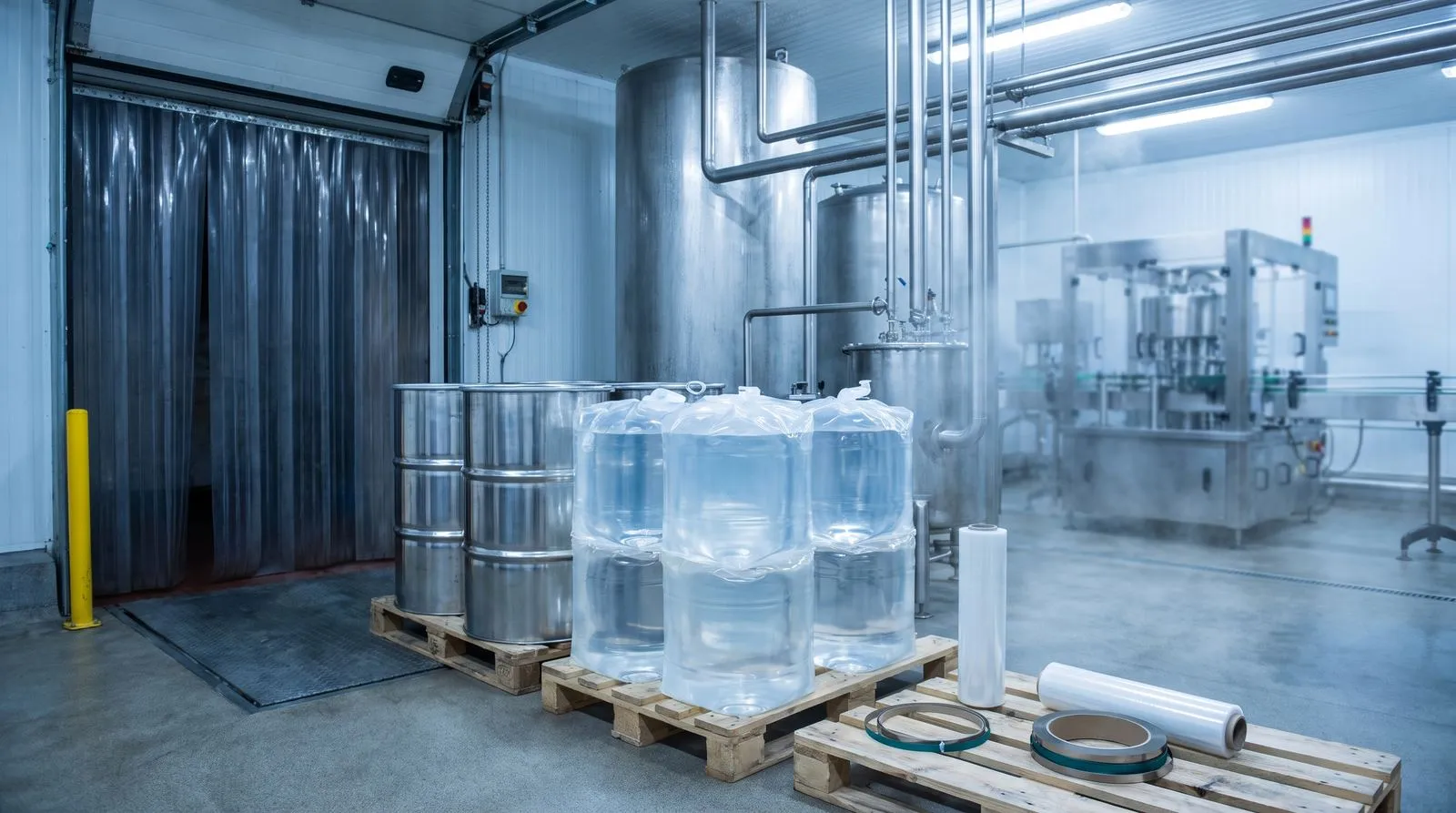
Coconut water sourcing comes down to one format decision: buy not-from-concentrate (NFC) water that already tastes like the finished drink, or buy concentrate and add the water back at destination. NFC protects the label claim and the flavour. Concentrate protects the freight budget. Most programs that pick the wrong side find out at the first landed-cost reconciliation.
This memo sets the two formats side by side for procurement teams: what each one ships as, what it costs to move, how long it keeps, and which paperwork each requires. For the concentrate spec itself, see our earlier note on Brix, clarity and cold chain.
What is NFC coconut water, and what is from-concentrate?
NFC coconut water is the liquid extracted from the nut, filtered and preserved without ever being evaporated down. It is sold at single strength. From-concentrate (FC) water is the same liquid evaporated to roughly 60 Brix, shipped, then reconstituted with water at the bottler.
Brix is the dissolved-solids reading on a refractometer. Single-strength coconut water sits far lower than concentrate. In a 2019 processing study in Food Science & Nutrition, the raw water measured 5.2 Brix at pH 5.5 (Ma et al.). Concentrate at 60 Brix is therefore more than ten times denser in solids, which is the whole freight argument.
How do the two formats compare on cost, shelf life and claims?
| Factor | NFC (single strength) | From concentrate (about 60 Brix) |
|---|---|---|
| What is shipped | Mostly water, roughly 5 Brix | Mostly solids, one drum yields about ten or more drums |
| Typical pack | Bulk aseptic bag-in-drum or tote, frozen, or chilled | Aseptic drum or frozen drum |
| Freight per litre of finished drink | High | Low |
| Flavour match to fresh nut | Closest | Depends on aroma recovery |
| Label claim | ”100% coconut water”, “not from concentrate" | "From concentrate”, reconstituted statement required in most markets |
| Main risk | Shelf life and cold chain | Clarity, pink colour, off-notes after reconstitution |
The freight line decides most programs. A container of single-strength water carries one drink-equivalent unit per litre. The same container of concentrate carries about ten. For long-haul lanes into the US, EU and Middle East, that gap is rarely closed by any price discount on the water.
Why does NFC shelf life drive the pack choice?
NFC water is a low-acid liquid, so thermal or non-thermal treatment has to carry the whole safety and shelf-life case. Format choice follows from that.
Heat treatment is the traditional route. In the same study, high-temperature short-time (HTST) treatment at 72 °C for 15 seconds gave 15 days of refrigerated life, while high-pressure processing (HPP) at 500 MPa for five minutes gave 25 days at 4 °C and kept more amino acids and phenols (Ma et al.). Those are laboratory figures on retail-style chilled water, not a commercial promise.
HPP also has a limit. Coconut water sits above pH 4.6, and researchers at the University of Santo Tomas and Cornell have noted that HPP alone does not deal with spore-formers such as C. botulinum. Their route concentrated the water by forward osmosis from 6.6 to about 23 Brix, acidified it to pH 4.6 with malic acid, then applied 600 MPa (UST). Buyers should ask any NFC supplier which kill step they run and what validation sits behind the shelf-life claim.
For export, that usually leaves two NFC formats: aseptic bulk for ambient shipping into a bottler, or frozen. Chilled HPP water suits short, controlled lanes.
When does concentrate win?
Concentrate wins when freight is the largest controllable cost and the finished product is a blend, a flavoured drink or a private-label bottle where the label allows reconstitution.
A buyer scenario: a bottler in Dubai fills 330 ml cartons weekly. Importing single-strength aseptic water means paying to move mostly water across the Indian Ocean. Importing concentrate and reconstituting locally cuts the number of containers sharply. The trade-off is a reconstitution line, a Brix control routine and a QA check for the aroma step.
Concentrate also stores better. An aseptic or frozen drum holds specification far longer than chilled NFC, which gives the buyer room to hold safety stock through crop dips.
When does NFC win?
NFC wins when the label says “not from concentrate”, when the brand sells on taste, or when the buyer lacks a reconstitution line. One short sentence settles it: the claim is binding.
Premium positioning is the commercial driver. One market report puts the NFC coconut water segment at USD 936 million in 2025, growing to USD 1.01 billion in 2026 (Intel Market Research). Treat that as a directional estimate from a paid report, not a hard trade statistic.
What goes into an NFC or FC specification?
A tight spec limits disputes. For either format, lock these items in the contract and the COA:
- Brix range at stated temperature, with the refractometer method named.
- pH, titratable acidity and colour (visual and instrumental).
- Microbiology at the point of fill: total plate count, yeast and mould, and the pathogens your market requires.
- Processing statement: HTST, HPP, aseptic or frozen, with the validated shelf life.
- Pack, fill temperature, lot coding and the retained-sample rule.
- For concentrate, the reconstitution ratio and aroma-recovery statement.
Origin matters as well. Philippines, Indonesia, Thailand and Vietnam all ship coconut water, and each origin carries a different cold-chain and lead-time profile. The desk quotes against the buyer’s destination, not the origin’s list price.
What this means for buyers
- Procurement manager (persona A): If the label says NFC, buy NFC and budget the cold chain. If it does not, price both formats on landed cost per litre of finished drink.
- Importer or distributor (B): Concentrate consolidates better across SKUs. NFC works for short-lane, high-turn programs.
- Brand owner (C): Decide the label claim before the supplier. Changing format later means relabelling and reformulating.
- Every buyer: Ask for the validated shelf-life data behind any NFC claim, not the brochure figure.
FAQ
Is NFC coconut water better than from-concentrate? Neither is better in general. NFC is closer to the fresh nut and supports a premium label. Concentrate is cheaper to ship and stores longer. The right choice follows the label claim and the freight lane.
How much freight does concentrate save? Concentrate at about 60 Brix against roughly 5 Brix single-strength water carries over ten times the finished volume per container. Actual savings depend on lane, pack and reconstitution cost.
Does HPP make NFC coconut water shelf-stable? Not on its own. Coconut water is above pH 4.6, so HPP is a chilled-life tool. Ambient shelf stability needs aseptic processing or an acidification step.
What should the COA show? Brix, pH, colour, microbiology, processing method and lot code. For concentrate, add the reconstitution ratio.
Need a coconut water spec locked across origins? Send the desk an RFQ at /contact/.