
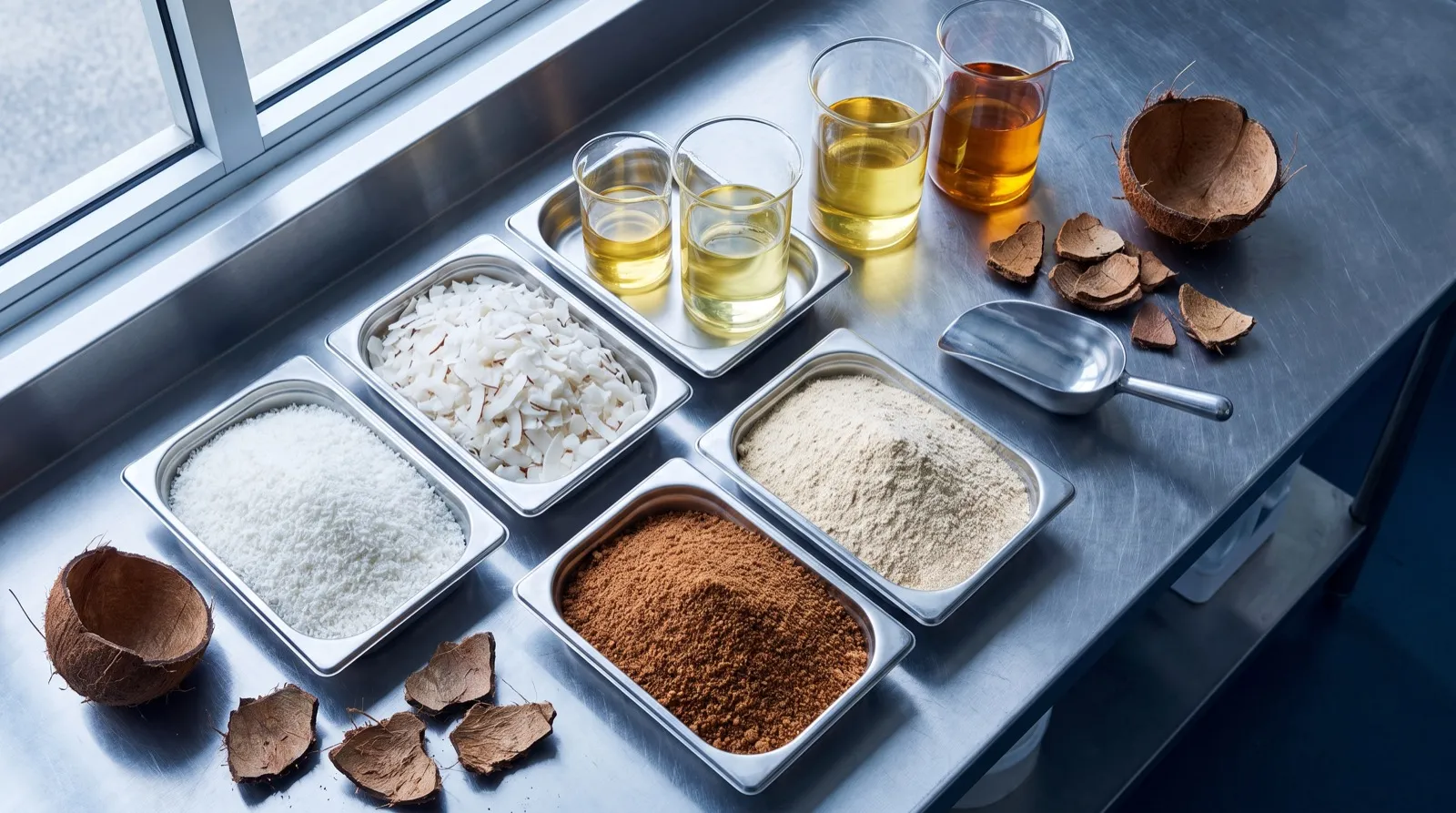
Your coconut contract is priced in US dollars. Your supplier’s costs are not. FX risk in coconut contracts reaches a foreign buyer through supplier performance rather than through the invoice, which is why it gets missed until a cargo slips.
You pay the USD figure you agreed. Whether the cargo ships on time and on spec at that figure depends on what the rupee, peso or rupiah did to the miller’s margin after signing.
All three origin currencies weakened in 2026. On BIS daily reference rates, each lost between 5.5 and 6.3 per cent against the dollar from 2 January to 15 September. The USD price of coconut oil fell about a quarter in the same window. Both legs moved against the processor at once.
Which currency risk is actually yours?
Split the exposure first, because the legs sit with different parties. A buyer who calls the whole thing “FX risk” finds nothing to do about it.
| Exposure leg | Who carries it | Effect on a USD coconut contract |
|---|---|---|
| USD invoice value | Buyer, if their home currency is not USD | Direct, and hedgeable in a liquid pair |
| Origin currency vs USD | Supplier | Arrives as delivery risk, spec pressure, repricing requests |
| Local input costs (nuts, copra, labour) | Supplier | Squeezes margin independently of the FX move |
| Export-proceeds conversion rules | Supplier | Timing and cash-flow risk, set by regulation |
| Payment tenor | Shared | Every extra week extends both parties’ exposure |
Row two is the one buyers underprice. A supplier whose margin has been erased has reason to ship late, ship to the bottom of the spec band, or reopen the price. None of that appears on an FX statement.
What did LKR, PHP and IDR do in 2026?
| Pair | 2 Jan 2026 | 15 Sep 2026 | 2026 move | Full-year 2025 |
|---|---|---|---|---|
| USD/LKR | 309.70 | 329.67 | +6.45% | +6.01% |
| USD/PHP | 58.85 | 62.80 | +6.72% | +0.80% |
| USD/IDR | 16,716 | 17,697 | +5.87% | +4.06% |
The peso is the one that changed regime.
It moved 0.80 per cent across all of 2025, then 6.72 per cent in the first eight and a half months of 2026. Sri Lanka and Indonesia roughly doubled their 2025 pace; the Philippines moved about eight times faster.
Intra-year range matters more than the year-end number on a 90-day contract. On the same series, USD/LKR traded a 10.3 per cent band in 2026, USD/PHP 9.2 per cent and USD/IDR 8.6 per cent. The widest band belonged to the most heavily managed currency of the three.
All three central banks tightened during 2026 as oil-driven inflation fed through, taking Sri Lanka to 8.75 per cent, Indonesia to 5.75 per cent and the Philippines to 5.00 per cent.
Why is a weaker producer currency not a discount?
Buyers sometimes read origin depreciation as a coming price cut. Sri Lanka shows why not.
Colombo’s weekly fresh coconut auction, run by the Coconut Development Authority, averaged LKR 114,341 per 1,000 nuts on 16 September 2026. The 2026 low was LKR 68,690 on 20 May, the high LKR 117,581 on 3 September. That is a 71 per cent swing in rupee raw-material cost inside nine months.
Supply explains most of it. CBSL reports production of 493.0 million nuts in May and June 2026, against 550.8 million a year earlier, a fall of 10.5 per cent.
Against that, the selling side. The World Bank Pink Sheet put coconut oil at US$1,853/mt in August 2026, against a 2025 average of US$2,480/mt. The dollar price fell roughly 25 per cent while the rupee input price rose 71 per cent off its May low.
A processor caught between those lines does not pass on a discount. They ask to renegotiate, or quietly stop offering the grade that has stopped paying.
Philippine copra tells it in pesos: farmgate near PHP 54.48/kg in February 2026, PHP 41.36/kg by mid-September. With roughly 80 per cent of production exported, the dollar price caps what a mill can pay farmers.
Can these currencies be hedged?
All three can. What differs is depth, and that belongs in the origin decision.
| Currency | Instrument | Settlement | Reach for a buyer |
|---|---|---|---|
| PHP | Deliverable forward and NDF | Pesos with residents | Available against a documented exposure |
| IDR | Offshore NDF and onshore DNDF | Cash, against the JISDOR fixing | Available, used by Bank Indonesia itself |
| LKR | Onshore deliverable forwards | Onshore | Available through licensed banks, but thin |
A non-deliverable forward is a forward settled in cash, usually in dollars, against the difference between an agreed rate and spot at maturity. No principal changes hands.
Under the BSP’s Manual of Regulations, Appendix 104, NDF contracts with residents settle in pesos, and the central bank reminded banks in June that non-deliverable derivatives must sit against a specific documented exposure. An importer with a real purchase order can hedge. A directional peso view cannot be dressed up as one.
Depth is where Sri Lanka differs. CBSL published a one-month USD/LKR forward at 331.89 and a three-month at 332.72 on 18 September 2026, so cover exists. Interbank forward turnover that week averaged USD 19.96 million a day. Singapore traded USD 1.485 trillion a day across all currencies in the BIS April 2025 survey, rupiah USD 64 billion, peso USD 20 billion.
Cost of cover follows the rate differential, not a view on direction. Against a Fed midpoint near 3.9 per cent, twelve-month peso and rupiah cover implies roughly one to two per cent a year. Sri Lanka’s is far wider, with the 364-day Treasury bill at 9.88 per cent. Both legs are rising, so the carry funding this cover is narrowing.
How do payment terms and conversion rules extend it?
Tenor is the quiet multiplier. Coconut oil forward bids in mid-September 2026 were quoted for January to April 2027 shipment, so four to seven months of exposure is normal. Add a usance LC and the supplier waits longer still for dollars it must convert. Our note on payment terms covers how LC, TT and DP shift that timing.
One trap deserves naming. Under BSP rules an NDF cannot be pre-terminated before its fixing date. If the shipment is cancelled, the hedge stays live.
Regulation adds a second clock. Indonesia’s export-proceeds regime, effective 1 June 2026, makes non-oil-and-gas natural-resource exporters park proceeds domestically for at least twelve months, with rupiah conversion capped at 50 per cent. It reaches the plantation sector, where coconut products sit, but the annex works by tariff line, so confirm your counterparty’s HS code. Indonesia also cut the no-documentation dollar-buying threshold to US$25,000 per party per month.
Sri Lanka moved the same way. Gazette Extraordinary 2492/10 of 9 June 2026 would require exporters to convert residual export proceeds into rupees by the tenth of the following month. The rules commence on parliamentary approval, so check status before writing them into a contract.
Neither rule changes your USD invoice. Both change when your supplier can reach dollars, which decides whether it can buy nuts next week.
What this means for buyers
- Traders and brokers (Persona D): price origin by hedging depth, not spot level. Peso and rupiah cover is liquid near one to two per cent a year. Sri Lankan cover trades in tens of millions a day, so size to the market you can exit.
- Procurement managers (Persona A): treat a supplier’s margin squeeze as a supply-continuity item. Ask what the contract assumes about input cost, and keep a qualified second origin live.
- Watch the input line, not the FX line. A 71 per cent move in rupee nut costs reaches your delivery schedule faster than a 6 per cent currency move.
- Match hedge tenor to expected shipment. A cancelled cargo does not release you from the forward written against it.
- Fix the price basis in writing. Name the benchmark, quotation date and currency of payment. Our guide to price benchmarks covers which references survive a dispute.
FAQ
Should I ask to pay in the supplier’s local currency? Rarely. Coconut trades in USD, including the settlement prices governing FOSFA outturn adjustments. Paying in LKR, PHP or IDR moves the exposure onto your books, into a pair you may struggle to hedge, without fixing the supplier’s input-cost problem.
Does a weaker origin currency mean I should wait for a lower price? No. Through 2026 origin currencies weakened while local input costs rose sharply and the USD price fell. Waiting mainly raised the chance of a supplier declining the grade.
Which of the three is hardest to manage? The Sri Lankan rupee, on depth rather than availability. Onshore forwards are published and tradable, but interbank forward turnover runs near USD 20 million a day and no offshore NDF market is documented.
Who carries a currency move if the contract says nothing? The affected party. Under the UNIDROIT Principles, where performance “becomes more onerous for one of the parties, that party is nevertheless bound to perform”. Silence favours whoever is not squeezed, which is why express clauses exist.
Currency risk here stays your supplier’s problem until the week it becomes your delivery problem. Pricing origins by hedging depth, and matching tenor to available cover, keeps it on their side of the table. Send the desk an RFQ to price a spec across Sri Lankan, Philippine and Indonesian origins.