
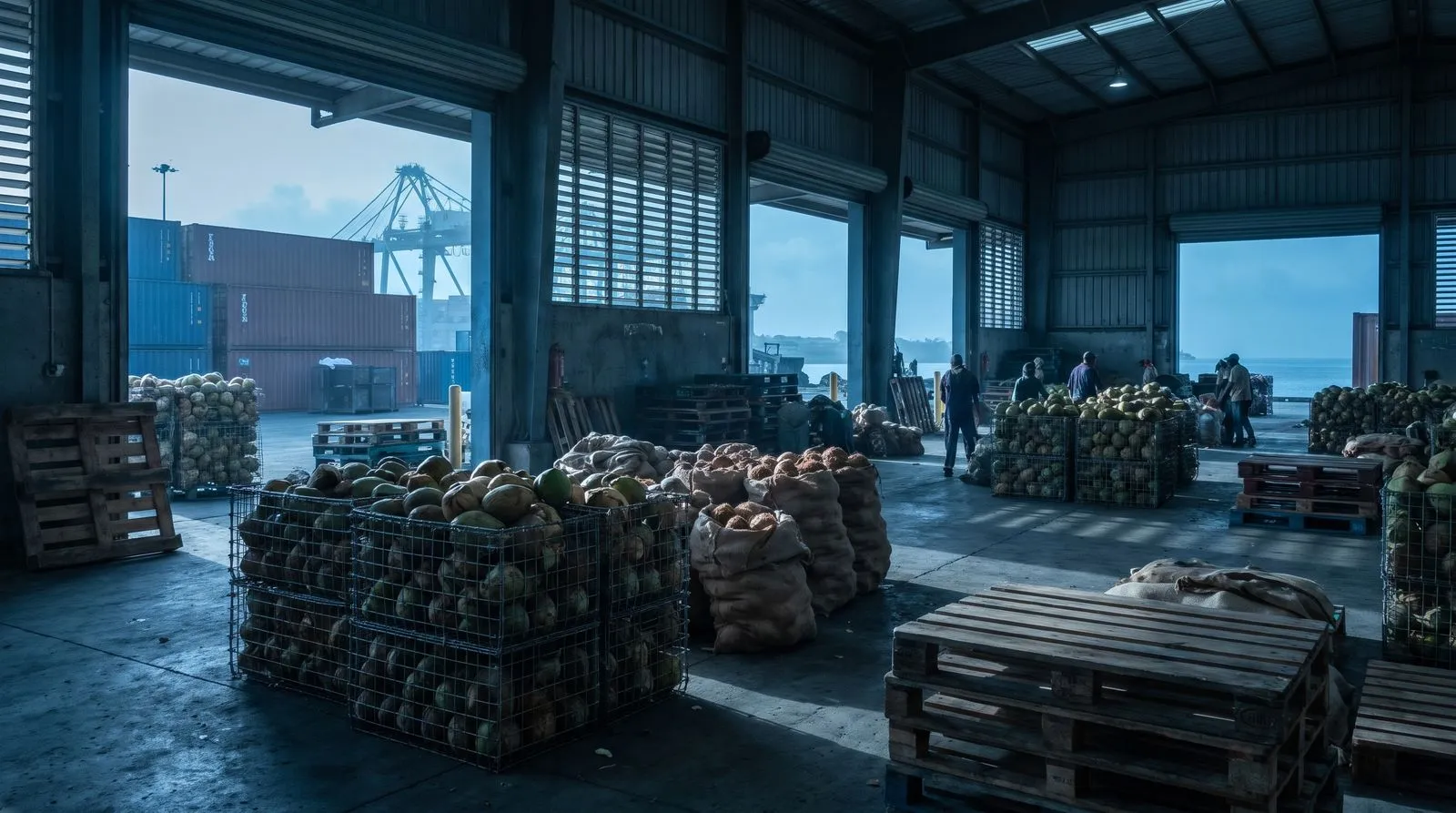
Sri Lankan coconut auction prices feed export quotes through the cost of the raw nut. A processor pays the auction or open-market price for nuts, converts them to desiccated coconut, and adds cost and margin to arrive at an FOB offer. The link is real but loose: it runs with a lag, and it can break when supply is rationed.
For a trader or broker, the practical question is how many weeks pass between a move at auction and a move in the quote, and when to stop trusting the link. This memo sets out the mechanism, shows the arithmetic, and flags what the public data cannot tell you.
What is the Colombo coconut auction, and who sets the price?
The Colombo coconut auction is a weekly sale run under the Coconut Development Authority (CDA), where estates and dealers offer nuts in lots of 1,000 and buyers bid. The result is quoted in rupees per thousand nuts. A thousand-nut lot is the unit, so Rs 140,000 means Rs 140 per nut.
Auction volume is small against national output, but it is the most visible price print in the country. Processors, dealers and the press all read it. That visibility is what turns a thin sale into a benchmark.
How does an auction price become an export quote?
It becomes one through three steps: nut cost, conversion cost, and margin plus freight. The first step moves fastest and carries the most weight.
Nut cost is the number of nuts needed per tonne of desiccated coconut, multiplied by the price per nut. Each processor has its own yield figure, shaped by nut size, kernel thickness and plant efficiency, so the desk should ask for it rather than assume one.
The table below uses a placeholder of 5,000 nuts per tonne to show sensitivity. It is an illustration of arithmetic, not a market quote and not any plant’s real yield.
| Auction move (per nut) | Nut cost change per tonne (at 5,000 nuts) | Approx. USD per tonne |
|---|---|---|
| Rs 10 | Rs 50,000 | about 250 |
| Rs 20 | Rs 100,000 | about 500 |
| Rs 40 | Rs 200,000 | about 1,000 |
The dollar column uses roughly Rs 200 to the US dollar, the rate implied by EconomyNext figures republished by FreshPlaza, which put Rs 140,000 per thousand nuts at about US$700. Check the live rate before using the table.
Why does the quote lag the auction?
The quote lags because processors hold stock and sellers hold offers. A plant with nuts bought three weeks ago has no reason to reprice the moment auction rates tick up.
Three delays stack. Stocks of nuts and finished product carry old cost. Forward contracts sit at agreed prices until they roll. And offers are usually valid for a set period, which is covered in our note on price validity and quote expiry.
Falling prices lag more than rising ones. Sellers move up fast and come down slowly, so a spread between auction movement and offers often persists after a peak.
What happens when the auction price is capped?
When the price is capped, the auction stops being a clean signal. In January 2025 the CDA fixed the auction price at Rs 140,000 per thousand nuts for a second consecutive week, after an average of Rs 145,687 on 9 January, according to the same FreshPlaza report. Nuts sold fell from 238,624 to 82,257 over the period, and no auction was held on 16 January because of a nut shortage.
The report notes that analysts expected farmers to prefer the open market under a cap. That is the point for a desk. When sales volume collapses at a fixed price, the printed number understates what a processor really pays to get nuts. An export quote built on the true cost will sit above one derived from the capped print.
Which other inputs move the export quote?
Several do, and they can offset the nut price or amplify it.
- Origin competition. Early September 2026 indications put Indonesian desiccated coconut at EUR 2.05 per kg FCA Netherlands and Philippine flakes at EUR 2.75, as listed by CMB News. Sri Lankan offers have to compete with those.
- Supply outlook. The same analysis says industry projections already embed a 14% fall in domestic nut availability in November and December 2026. That is a forecast, not a measured result.
- Regional tone. In February 2026, Mundus Agri quoted JCP International describing Sri Lankan prices as firmer, in line with tighter regional supply.
- Currency and freight. A weaker rupee lowers the dollar cost of nuts. Freight and insurance then sit on top of FOB.
For the wider set of drivers, see our 2026 desiccated coconut price drivers and the note on price benchmarks.
Where do the public numbers run out?
They run out at the plant gate. No public series gives Sri Lankan desiccated coconut FOB prices on a weekly basis, and the sources above do not publish one. A buyer or broker gets the quote from an offer sheet, not a statistic.
The auction print is therefore a lead indicator, not a pricing formula. Used that way it is useful. Treated as a formula, it will mislead whenever caps, shortages or stock positions distort it.
What this means for buyers
- Procurement managers (A): ask the supplier whether a quote reflects current nut cost or older stock, and for how long it holds.
- Importers and distributors (B): a sharp auction rise is a reason to cover the next two to three shipments early, since quotes tend to follow upward moves faster than downward ones.
- Brand owners (C): keep a second origin qualified so a Sri Lankan supply squeeze does not set your price.
- Traders and brokers (D): track auction volume as well as price. Falling sales at a flat price signals stress, not stability.
FAQ
Does the Colombo auction price set the export price directly? No. It sets the raw nut cost, which is one input. Stock, forward contracts, conversion cost, freight and competing origins all sit between the auction and the offer sheet.
How long does the lag last? No public figure exists. It depends on each processor’s stock and contract cover, so ask the supplier how many weeks of nuts are held at current cost.
Why did nut sales fall when the price was capped? Under a fixed price, sellers can do better in the open market. The January 2025 sales drop is consistent with that, according to analysts quoted in the report above.
Can a buyer hedge this? Not with a listed contract for desiccated coconut. Fixed-price windows and multi-origin cover are the usual tools, covered in our note on hedging coconut price risk without futures.
Need a spec locked across origins? Send the desk an RFQ.