
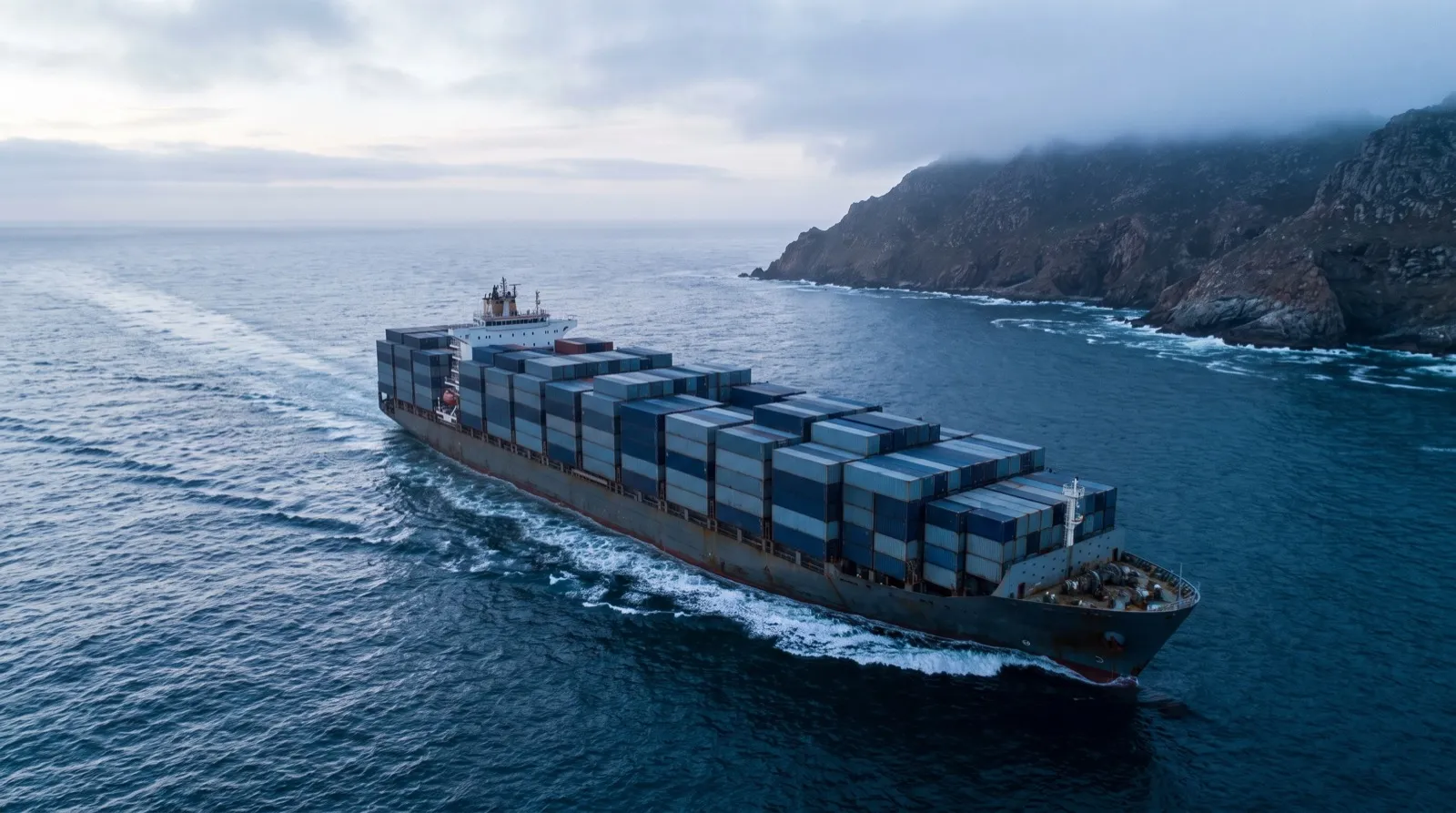
Red Sea rerouting is being partly reversed in September 2026, and the reversal is uneven. Container lines have put a large share of Asia–Mediterranean capacity back through Suez. Asia–North Europe capacity has mostly stayed on the Cape of Good Hope route. For coconut freight, destination port now decides both transit time and where rates are heading.
That split matters in weeks and dollars. Xeneta estimates a Red Sea routing saves about 11 days on a typical China–Genoa service against the Cape. A Genoa buyer of desiccated coconut or coconut oil may see that saving this quarter. A Rotterdam or Hamburg buyer, for now, mostly will not.
The route is also less safe than the carrier announcements suggest. Below is where routing, rates and risk sit as of 17 September 2026, and what importers and traders should write into contracts while it settles.
Are container lines back in the Red Sea in September 2026?
Partly, and the pace picked up in the last week. On 14 September 2026 Maersk announced that four more Gemini services with Hapag-Lloyd (AE5, AE11, AE12 and ME2) would return to Suez, joining AE15 and AE19. The first westbound AE11 sailing leaves Tanjung Pelepas on 19 September. Maersk made the change conditional on the Red Sea staying stable.
Others are moving too. COSCO’s 24,188 TEU OOCL Portugal made the line’s first southbound Suez transit since the crisis on 16 September, and gCaptain reported that CMA CGM, MSC and Hapag-Lloyd have returned to varying degrees. Container ship net tonnage through the canal ran 54.2% higher in January to August 2026 than a year earlier.
The recovery is still well short of the old normal. Xeneta’s Peter Sand put August container capacity through Bab el-Mandeb (the strait at the Red Sea’s southern mouth) at double the year before, but only 23% of pre-crisis levels.
Why is the Med back on Suez while North Europe is not?
Look at the split by lane. Sea-Intelligence figures cited by FreightWaves on 15 September put Red Sea routing at about 35% of Asia–Med headhaul capacity. On Asia–North Europe the headhaul share is about 6%. Headhaul here means the loaded direction, Asia to Europe, which is the direction coconut cargo moves.
Geography explains part of the incentive. Med ports sit just beyond the canal, while a Cape voyage to Genoa has to run back up the Atlantic and through Gibraltar. The day saving per voyage is largest there, so carriers get the most back for the risk they take.
| Lane | Red Sea share of headhaul capacity, Sep 2026 | Xeneta spot, $/FEU (early Sep 2026) | Change since 28 Feb 2026 |
|---|---|---|---|
| Asia–Mediterranean | ~35% | 4,764 | +43% |
| Asia–North Europe | ~6% | 4,333 | +95% |
| Asia–US East Coast | not reported | 10,955 | +313% |
Sources: Sea-Intelligence via FreightWaves (15 Sep 2026); Xeneta weekly update, September 2026. FEU means one 40-foot container.
For coconut cargo out of Colombo, Cochin, Jakarta or Manila, the practical read is simple. Med-bound contracts should start pricing in shorter transits. North Europe contracts should keep their Cape buffers.
What is coconut freight to Europe costing right now?
Rates are drifting down, and faster on the Med. Drewry’s World Container Index on 10 September 2026 had Shanghai–Rotterdam at $3,997 per 40ft (down 2% on the week) and Shanghai–Genoa at $4,216 (down 3%). Drewry said the partial return to Suez was restoring effective capacity and pushing rates down.
Freightos’ 8 September update shows the same shape. Asia–Med was about $4,700 per FEU, 37% below its peak. Asia–North Europe was about $4,500, only 23% below peak. Freightos suggested the Red Sea transit bump is behind the faster Med decline.
Two cautions for anyone building a landed-cost model. None of these indices quotes a coconut lane; they are Shanghai-based and directional. And the Red Sea is no longer the main thing moving rates. The Strait of Hormuz has been closed to container shipping since 28 February 2026, and Freightos puts bunker fuel about 60% above pre-war levels. Our Q4 market outlook covers that side, and the lane-by-lane freight guide covers reefer versus dry.
How durable is the return?
Not very, on current evidence.
The Houthis announced a naval blockade of Saudi Arabia on 20 July 2026. By 13 September, Al Jazeera reported, they had taken Mocha and Perim island and now hold Yemen’s whole Red Sea coast. They say the strait is safe for shipping and that they will honour their ceasefire with the US. They also say they keep the right to hit Saudi-linked vessels.
Insurers priced that in. Insurance Journal reported Red Sea war-risk premiums, charged as a percentage of the ship’s hull value, rising from about 0.3% on 17 July to about 0.75% after the blockade announcement. Carriers pass costs like that through as surcharges when they can.
The Suez Canal Authority has also withdrawn its sweetener. Its 15% toll rebate for large container ships ended early on 7 April 2026, according to Hellenic Shipping News.
A single serious incident could send services back to the Cape. A contract that assumes today’s routing for a December arrival is making a bet.
What would a full Suez return do to rates and ports?
Push rates lower, then cause a congestion wave. Sea-Intelligence estimated in October 2025 that a full return would free about 2.1 million TEU, or 6.5% of the global fleet, as reported by Maritime Standard. Switching overnight would bunch arrivals at European ports, a volume spike 39% above the previous record.
The supply picture points the same way. BIMCO’s March 2026 outlook had fleet supply growing 2.0–3.5% in 2026 while demand fell 0.5–2.5%. More ships chasing less cargo, plus shorter voyages, is a bearish mix for spot rates.
Colombo is the hub to watch for Sri Lankan and Indian coconut cargo. The port handled 4,444,034 TEU in the first half of 2026, up 11.9%, with transshipment at 84.7% of throughput, per SLPA figures reported by the Daily FT. If services reshuffle quickly, feeder connections through Colombo are where missed connections and rolled boxes show up first.
How should coconut contracts handle routing uncertainty?
Assign the routing risk explicitly, because the Incoterm already assigns it quietly. Under FOB, the buyer books the main carriage, so the buyer carries rate moves and transit changes. Under CIF or CFR, the seller books the vessel and freight is priced into the quote, so the seller carries the rate risk up to the fixed price. Our Incoterms guide for coconut buyers sets out the full split.
Four clauses do most of the work right now:
- Quote validity. Hold CFR and CIF freight components for days, not months, while Med rates are falling this quickly.
- Shipment date as the milestone. Tie performance to the bill of lading date, not ETA, so a Cape reroute does not become a delivery default.
- Named service or routing note. Ask the forwarder to record the service string at booking, so a Suez-to-Cape switch shows up before the box sails.
- Shelf-life clock. Longer transits eat into shelf life for desiccated coconut and packed coconut milk. Set a minimum remaining shelf life on arrival, not on production.
For longer programmes, a floating freight component inside an indexed contract spreads the rate risk more evenly than a fixed CIF price.
What this means for buyers
- Importers and distributors (Med): expect shorter transits and softer rates on Suez-routed services. Re-quote CFR freight now and plan safety stock for a return to Cape timings.
- Importers and distributors (North Europe): keep Cape buffers in lead times. The rate decline is real but slower, and routing has barely changed.
- Traders: the Med premium over North Europe has narrowed fast on Freightos data. Watch it as an early signal of Suez confidence, alongside war-risk premiums.
- Procurement managers: move delivery obligations to shipment date and set remaining-shelf-life minimums at arrival.
- Brand owners: a bearish freight outlook argues against locking long fixed-freight CIF contracts this month.
FAQ
Is Suez open for container ships in September 2026?
Yes, and traffic is rising. Maersk, Hapag-Lloyd, COSCO, CMA CGM and MSC have all routed some services through Suez by mid-September 2026. Bab el-Mandeb container capacity in August was still only about 23% of pre-crisis levels, per Xeneta.
How many days does Red Sea routing save on Asia–Europe?
About 11 days on a typical China–Genoa service, according to Xeneta in September 2026. The saving differs by origin and port rotation, so confirm transit time for your specific service at booking.
Will the end of Red Sea rerouting lower coconut freight rates?
Probably, if it holds. Drewry says the partial Suez return is already pushing rates down. Sea-Intelligence estimates a full return frees about 6.5% of fleet capacity. The Hormuz closure and high bunker costs limit how far rates fall.
Who pays if a coconut shipment is rerouted via the Cape?
It depends on the Incoterm. Under FOB the buyer contracted the freight and carries the change. Under CIF or CFR the seller carries the freight cost inside the agreed price. Under all three, risk passes to the buyer once goods are loaded, so delay costs usually land on the buyer.
Shipping to both the Med and North Europe and need freight quotes that match each route? Send the desk an RFQ.