
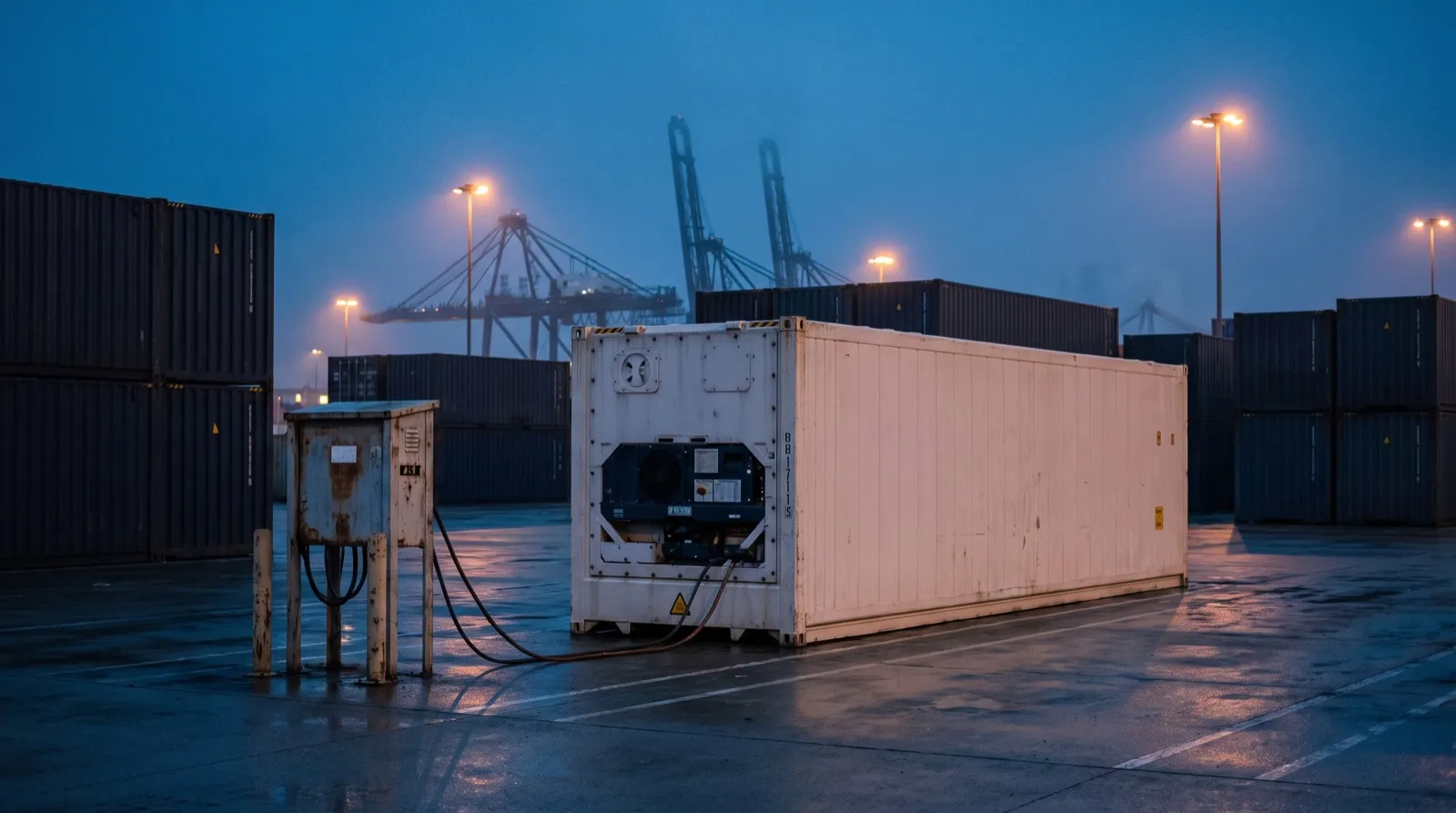
The reefer or dry container call for coconut milk and cream is settled by the packaging format, not the lane. Retort-sterilised cans and UHT aseptic packs are ambient-stable by construction. On an Asia to Europe or Asia to US voyage they do not need a refrigerated box, and buying one purchases a data trail rather than protection.
The expensive mistake runs the other way. Coconut fat begins crystallising at 6.37C and is not fully melted until 26.82C, measured by differential scanning calorimetry on virgin coconut oil (Srivastava et al., Journal of Food Science and Technology, 2016). A reefer set to a normal chilled-food temperature of 4C parks the cargo inside that window for the whole voyage. It arrives with a solidified fat layer and a QA query attached.
The premium is not fixed either. Far East to North Europe reefer spot averaged around USD 493 per FEU above dry after July 2022, and sat below dry through much of 2021 (Xeneta, 9 March 2023). Current 2026 spreads are not published, so treat any quoted multiple as a carrier quote, not a market fact.
Which coconut milk formats are stable at ambient?
The heat process buys the shelf life, and Codex requires one: an aqueous coconut product must be processed by heat before or after being hermetically sealed (CXS 240-2003). Coconut milk is low-acid at pH 5.95 to 6.30, so pasteurisation alone will not make it shelf-stable.
| Format | Heat process | Shelf life | Storage |
|---|---|---|---|
| Retort can, pouch or glass | 121C for 20 to 30 min | 2 years | Ambient |
| UHT aseptic carton, bag-in-box, drum | 140 to 145C for 8 to 15 s | 6 to 8 months | Ambient |
| Ultrapasteurised | 125 to 135C for 0.5 to 4 s | Weeks | Chilled |
| Pasteurised | 75 to 95C for 15 to 20 s | 1 week | Chilled, 4C |
| Frozen coconut cream | Blanch 70C, then -18C | 8 weeks | Frozen |
Sources: Tetra Pak Coconut Handbook; frozen figure from CORD 32(1), International Coconut Community, 2016.
Export volume sits in the top two rows. Liquid coconut milk and cream reach Europe in aseptic packaging: 20-litre bag-in-box, 200-litre bag-in-drum, 1,000-litre bag-in-tote, plus cans (CBI, 13 August 2025). If the supplier quotes any of those, the container question is answered.
What a hot dry box actually costs you
Not spoilage. Shelf life.
Measured climate inside a 40-foot high-cube dry container on a 68-day Hungary to India routing peaked at 35.80C and averaged 28.31C, with humidity to 81.79 percent (Csavajda and Borocz, Periodica Polytechnica Transportation Engineering, 2019). That logger sat on the floor, the coolest position in the box, so under-roof air ran hotter. Packaging standards assume worse: ISO 2233 and ASTM D4332 specify 40C at 90 percent RH, and ISTA 3E an extreme heat step at 60C.
Heat does not make a retorted can unsafe. It shortens the date. UHT dairy milk held 52 weeks lost shelf life from 34 to 36 weeks at 20C, to 20 to 32 weeks at 30C, to 16 to 20 weeks at 37C, browning visibly by week 16 (Karlsson et al., Heliyon, 2019). Canned foods failed sensory assessment at month 9 at 40C against month 21 at 25C (Sopik et al., Foods, 2022). Both are proxy products, but the magnitude is roughly a halving.
The second exposure is water. Container sweat condenses on the steel and drips onto the cargo; cargo sweat condenses on colder goods (Steamship Mutual, 7 April 2025). Neither reaches the product inside a hermetic can. Both attack the case around it, because humidity strips compression strength out of corrugated and softens the water-soluble adhesives on linerboard joints until the stack collapses.
Why a reefer set at 4C is the bigger risk
Exporter guidance circulating online recommends a reefer at plus 10 to plus 15C for long hauls. It is unsourced and it is backwards. Both figures sit above the 6.37C crystallisation onset and well below the 26.82C melting endset, so the fat spends the voyage partly solid. The result is a cream plug: a hardened layer at the top of the can or bag.
That is usually creaming, not emulsion breakage. Below about 80C the dominant mechanism in coconut milk is flocculation and creaming rather than coalescence (Tangsuphoom and Coupland, Journal of Food Science, 2005), and coconut fat re-melts at warm room temperature, so a plug is normally recoverable. It is still a rejected delivery when the receiving QA team opens a can on the dock.
Freezing is where the damage stops being recoverable. Homogenised coconut milk without additives is destabilised by freeze-thaw at -20C and -10C but not by chilling at 5C, and emulsions built on small-molecule surfactants coalesce and separate into an oil layer after thawing (Tangsuphoom and Coupland, Food Hydrocolloids, 2009). A reefer set to a frozen programme by mistake turns a two-year cargo into a claim.
When coconut cream genuinely needs a reefer
Two cases, and only two.
Chilled is one. Pasteurised coconut milk carries roughly a one-week shelf life at 4C, which rules out ocean freight from Asia altogether. It moves by air or it does not move.
Frozen coconut cream is the other. It is an 8-week product at -18C, and the ICC trial behind that figure still recorded visible fat-layer separation in frozen storage, with total plate count rising from 2.14 x 10^3 cfu/g at week zero to roughly 2 x 10^6 cfu/g at week eight. Free fatty acid stayed under 0.06 percent as lauric acid against a 1 percent limit. Freezing arrests microbial load, it does not remove it, and the clock starts at the plant.
An 8-week life against a 4 to 6 week Asia to Europe transit leaves the buyer two weeks of usable shelf life. That is why most programmes specify ambient formats.
What the reefer premium buys
A reefer is a temperature-control device and an evidence machine. Units hold set point in outside temperatures to 50C, control humidity between 50 and 95 percent RH, and record temperature, humidity, oxygen and carbon dioxide (Hapag-Lloyd specification). Maersk prices a single-shipment datalog at USD 250 (Captain Peter).
Two qualifications matter. A reefer holds temperature, it does not pull it down, so cargo must be pre-cooled or pre-frozen before stuffing. And set point is not cargo temperature everywhere in the box: a 20-foot reefer instrumented with up to 69 sensors showed internal differences of up to 8C, widest at the ceiling under solar load (Rodriguez-Bermejo et al., CSIC and UPM).
The equipment also fails. Across five years of claims, temperature variation accounted for 18 percent, poor monitoring 7 percent and mechanical failure 5 percent, with reefer causes making up 30 percent of all container claims (The Swedish Club, 19 October 2022; 2017 to 2021 data). Ambient cargo in a reefer gains a failure mode it did not have. Lane-level rate volatility is a separate question, covered in Asia-Europe and Asia-US coconut freight.
Writing the container call into the contract
Put the decision in the spec, not the booking email. State the format and its heat treatment on the contract face, since Codex already requires it on the label. State equipment as standard dry GP, ambient, no temperature control, so no forwarder helpfully upgrades it. Where a reefer is genuinely required, give the set point in figures and add a floor of plus 18C.
Then handle the dry-box risks: desiccant at roughly 500 g per cubic metre of enclosed air, export-grade corrugated with a stated edge crush test value, and a passive temperature logger, which costs a fraction of the reefer premium and produces the same evidence at claim time. Incoterms decide who carries the exposure, as set out in Incoterms for coconut buyers.
What this means for buyers
- Importers and distributors (Persona B): for retort and aseptic coconut milk, dry GP is correct. Spend the premium on a logger and better cartons, and write “no temperature control” into the booking.
- Brand owners scaling past a co-packer (Persona C): ask for the heat treatment and stated ambient shelf life before asking about freight. Those two numbers decide the container and the date code.
- Procurement at manufacturers (Persona A): treat prolonged heat as a shelf-life variable, not a safety one, and shorten the acceptance window on remaining shelf life for hot-leg routings.
- Frozen programmes: budget transit against an 8-week life from production, not from shipment. Switching to retort format is usually cheaper.
FAQ
Does coconut milk need a refrigerated container? No, for the formats that actually export. Retort-canned coconut milk is stable for two years at ambient and UHT aseptic for 6 to 8 months. Only pasteurised chilled and frozen coconut cream need temperature control, and chilled cannot survive ocean transit at all.
What temperature damages coconut milk in transit? Anything holding the fat below about 27C for long periods causes a cream plug, because coconut fat crystallises from 6.37C and melts fully only at 26.82C. Freezing is worse: freeze-thaw can coalesce the emulsion permanently and release an oil layer.
How hot does a dry container get on an Asia to Europe voyage? Floor-level measurement on a tropical routing peaked at 35.80C with humidity to 82 percent, and under-roof air runs hotter. Packaging standards test to 40C tropical and 60C extreme heat, the envelope the can and carton are designed against.
Is a reefer worth paying for on ambient cargo? Rarely. It adds temperature-variation and mechanical-failure exposure a dry box does not have, and those causes make up 30 percent of container claims. A passive logger gives the same evidence far cheaper.
Need a coconut milk or cream spec locked across origins, with the container call written into the contract? Send the desk an RFQ.