
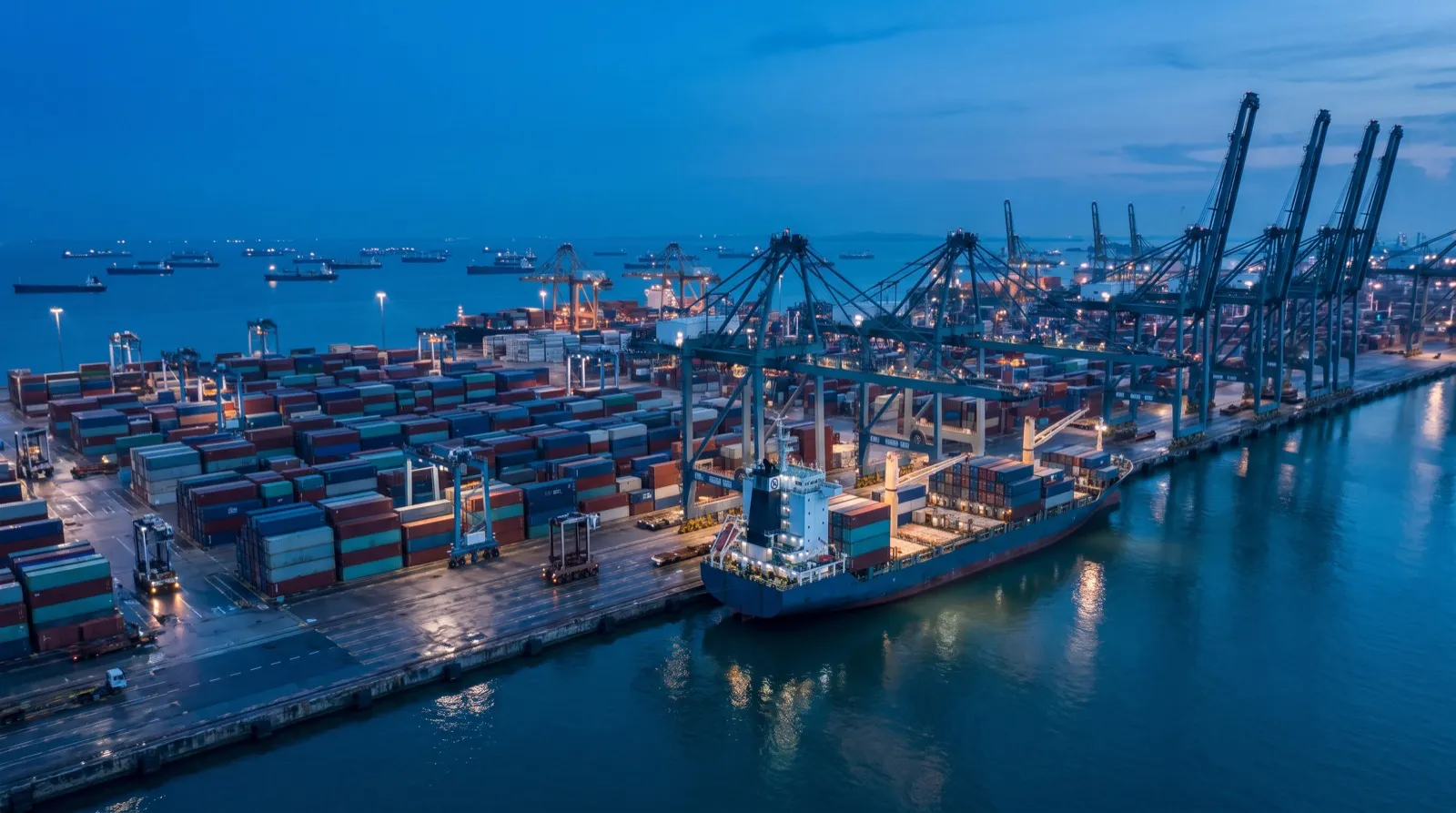
A Singapore trading desk changes three things: the contract you sign, how the cargo is financed and consolidated, and where a dispute lands. It changes nothing about where your coconut came from.
That distinction moves money in both directions. Buyers who understand it compress lead times and tighten payment terms. Buyers who misunderstand it assume transhipment rewrites origin, then lose a duty preference at the destination port.
What does a Singapore trading desk actually change?
Four things, and they are all contractual or logistical.
| Layer | What Singapore changes | What stays fixed |
|---|---|---|
| Origin | Nothing | Sri Lankan, Indonesian, Philippine or Vietnamese origin, with its own duty treatment |
| Duty and GST in transit | Suspended in a Free Trade Zone; re-export is outside GST scope | 9% import GST if goods enter Singapore customs territory |
| Contract and forum | Governing law and arbitral seat become a drafting choice | Standard-form defaults apply unless you override them |
| Consolidation and finance | Multi-origin cargo can be split, staged and re-invoiced in-zone | Physical quality, food safety and destination-market rules |
Read the right column first. It is the part most desks skip.
Does routing through Singapore change coconut origin?
No. Transhipment rules preserve the origin a good already has. They never create a new one.
The CPTPP puts it plainly. Under Article 3.18(2), a good moving through a non-Party keeps originating status only if it undergoes no operation “other than: unloading; reloading; separation from a bulk shipment; storing; labelling or marking” or work needed to preserve it, and it “remains under the control of the customs administration” there.
For EU-bound cargo the operative text is Article 43 of Commission Delegated Regulation (EU) 2015/2446. Goods released in the EU must be “the same products as exported from the beneficiary country in which they are considered to originate.” Article 43(3) permits storage under customs supervision. Article 43(4) permits splitting consignments, but only where the split is carried out “by the exporter or under his responsibility.”
That last clause is a real design constraint. Splitting a Sri Lankan container in Singapore is fine for GSP+ purposes. Splitting it outside the exporter’s chain of responsibility is not.
Origin only shifts on substantial transformation. The EU test, set out in DG TAXUD’s origin guidance of 16 July 2026, asks whether goods underwent their “last, substantial, economically justified processing or working, in an undertaking equipped for that purpose.” Warehousing, re-drumming, consolidating and re-invoicing do not meet it.
Nor does Singapore’s FTA network help third-country goods. Under the Sri Lanka–Singapore FTA, in force since 1 May 2018, Singapore origin requires 35% qualifying content or a change in the first four digits of the HS code. Warehousing achieves neither.
One practical warning. A free zone is not automatically a customs-controlled area. A WCO workshop paper from New Zealand Customs records a case where preference was refused because the transit free zone was managed by the port authority rather than customs. The importer won on appeal, but only on evidence. Keep the transit documents.
What does the Free Trade Zone do to duty and GST?
It removes both, conditionally. Singapore levies duty on four categories only: intoxicating liquors, tobacco, motor vehicles and petroleum. Coconut oil, desiccated coconut and coconut milk are non-dutiable.
The tariff position is locked open. World Tariff Profiles 2026 records Singapore’s MFN applied average at 0.0%, with 100% of tariff lines duty-free across oilseeds, fats and oils. GST is the live variable at 9%.
IRAS sets out the mechanics in its GST guide for Free Trade Zones and warehouses, fourth edition, 30 January 2026.
| Event | GST treatment | Reference |
|---|---|---|
| Overseas goods landed into an FTZ | No import GST | ¶5.1 |
| Title changes hands inside the zone | Supplies “disregarded for GST purposes” | ¶4.4 |
| Goods re-exported from the FTZ | ”Outside the scope of GST” | ¶5.3 |
| Goods removed into customs territory | 9% import GST, unless a suspension scheme applies | ¶4.3 |
Paragraph 4.4 is the one that matters for a trading desk. Cargo can be bought and sold repeatedly inside the zone without a GST event on each leg.
For longer storage outside an FTZ, the correct instrument is the Zero-GST Warehouse Scheme, which covers non-dutiable goods indefinitely. The Licensed Warehouse Scheme is for dutiable goods only, not food. Blogs conflate the two constantly.
Does the port itself matter?
Yes, for scheduling rather than paperwork. MPA reported 44.66 million TEU through Singapore in 2025, up 8.6% year on year. PSA states that roughly 85% of arriving containers are transhipped onward.
Be precise about the claim. Shanghai remains the busiest container port by volume, at 55.06 million TEU in 2025. Singapore is the busiest transhipment hub, ranked third on UNCTAD’s country-level connectivity index in June 2026.
Coconut origins are scattered, and Sri Lanka, Indonesia, the Philippines, Vietnam and India all feed Singapore on short-haul services. That is what makes multi-origin consolidation into one mother vessel practical. No public source publishes reliable feeder transit times, so ask for sailing schedules on your specific pairing.
Where does your dispute actually go?
Probably London, unless someone changed it.
FOSFA and GAFTA standard forms refer disputes to London arbitration under English law. FOSFA 54, the CIF form for vegetable oils, is the usual vehicle for crude and RBD coconut oil. A Singapore seat is an active drafting decision, not a consequence of buying from a Singapore entity. Our note on contract structures covers how those forms behave.
The case for switching is reasonable. SIAC recorded 886 new cases in 2025, 89% international, with parties from 79 jurisdictions. The 2025 Queen Mary and White & Case survey placed London first and Singapore second among preferred seats.
The Singapore Convention on Mediation is narrower than its billing. UNCITRAL lists 23 parties. Sri Lanka is one, in force since 28 August 2024. The United States, India, the Philippines and Australia have signed but not ratified; Indonesia neither. A mediated settlement is not directly enforceable in most destination markets.
Financing infrastructure is the quieter argument. After Hin Leong collapsed in 2020 with roughly US$3.5 billion of initial bank exposure, the Association of Banks in Singapore issued a Code of Best Practice for Commodity Trade Finance with 28 banks, and MAS indicated it may refer to the code in supervisory oversight. An industry Trade Finance Registry went live on 23 June 2023 to catch duplicate financing. Singapore also adopted the UNCITRAL model law on electronic transferable records in 2021, giving electronic bills of lading the same standing as paper.
What routing through Singapore does not fix
Three things, and buyers should price them separately.
Coconut is outside the EU Deforestation Regulation. Article 2(1) of Regulation (EU) 2023/1115 lists cattle, cocoa, coffee, oil palm, rubber, soya and wood. Coconut appears nowhere. Confusion arises because Annex I uses broad vegetable-fat customs codes that coconut oil can appear to match, which is why the Commission’s draft delegated act adds “ex” prefixes to narrow them. One genuine exception: a coconut and palm oil blend is caught through its palm content. After the December 2025 amendment, compliance runs from 30 December 2026 for medium and large operators and 30 June 2027 for micro and small ones.
Destination food-safety duties stay put. EUDR obligations sit on the EU operator placing goods on the market. US buyers keep their FSVP responsibility, covered in supplier qualification. DG TAXUD is also explicit that phytosanitary and health certificates are not proof of origin, and a certificate of origin alone is not sufficient either.
Cargo quality is unchanged by any of this. Moisture, free fatty acid, aflatoxin and microbiological risk belong to the shipment, not the invoicing entity.
What this means for buyers
- Procurement (CPG manufacturers): keep the origin-country exporter’s REX statement on origin in your file. The Singapore seller does not issue it.
- Importers and distributors: the FTZ lets you consolidate multiple origins and split consignments without a GST event, provided splitting stays under the exporter’s responsibility per Article 43(4).
- Brand owners scaling up: the real gain is payment terms and staged drawdown against one contract, not a tariff saving.
- All three: name your seat and governing law explicitly. Silence means London.
FAQ
Does buying through Singapore make my coconut Singapore origin? No. Transhipment preserves existing origin. Sri Lankan desiccated coconut stays Sri Lankan, keeping its GSP+ treatment in the EU. Origin changes only on substantial transformation, or by meeting an FTA’s product-specific rule, such as 35% content under the Sri Lanka–Singapore FTA.
Is coconut covered by the EU Deforestation Regulation? No. Regulation (EU) 2023/1115 covers cattle, cocoa, coffee, oil palm, rubber, soya and wood. Pure coconut products are out of scope. A blend containing palm or palm kernel oil is caught through the palm component.
Do I pay Singapore GST on cargo that only tranships? No. Goods landed into a Free Trade Zone attract no import GST, and re-export is outside the scope of GST entirely. The 9% applies only if goods enter Singapore customs territory without a suspension scheme.
Can the Singapore desk issue my certificate of origin? No. The EU statement on origin comes from the exporter registered in REX in the origin country. A Singapore seller supplies commercial and transport documents, which support the non-manipulation evidence trail but do not replace the origin declaration.
Need one spec held constant across four origins, with the seat and governing law written in? Send the desk an RFQ.