
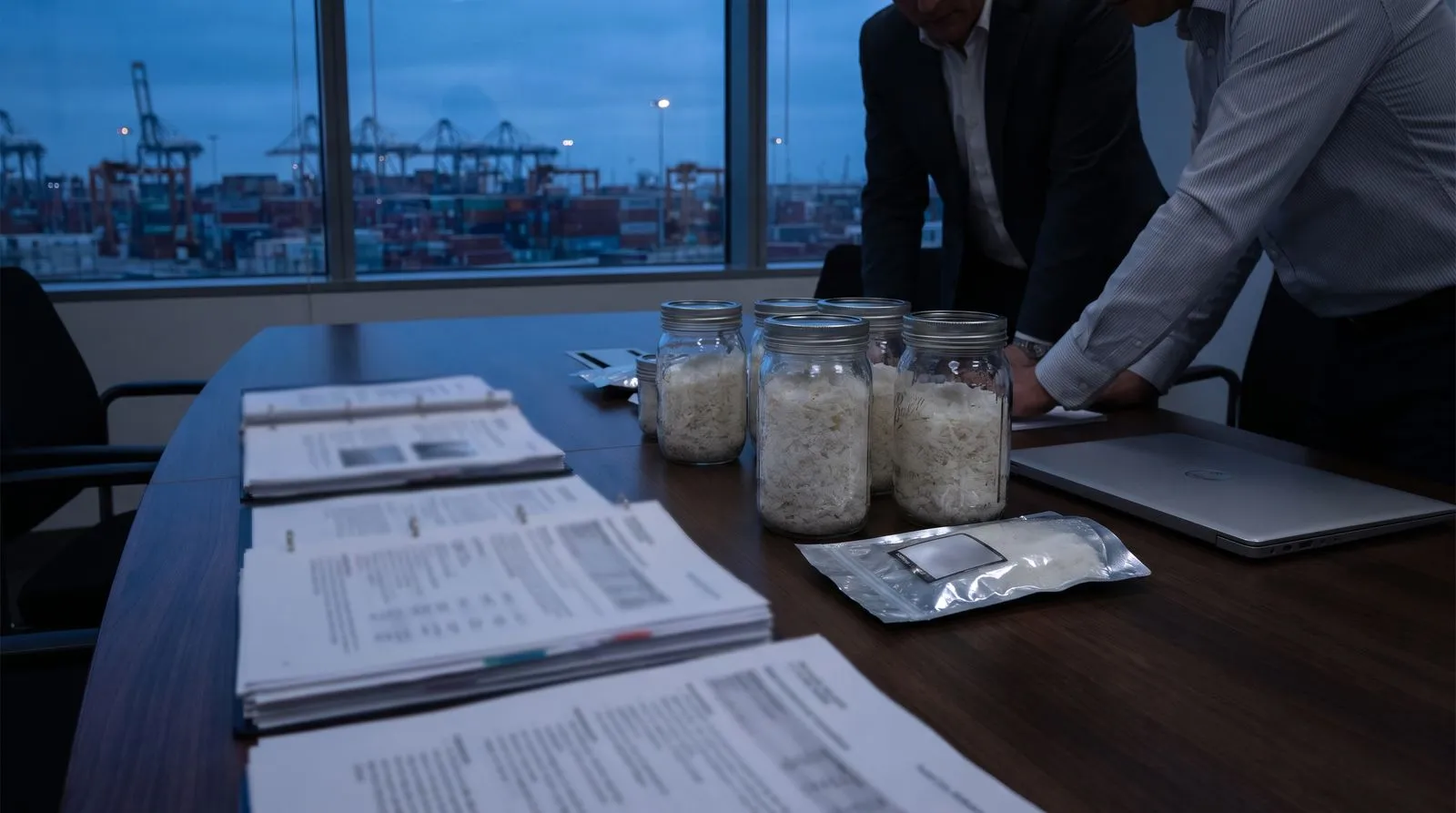
An annual coconut contract round works when the tender fixes four things before suppliers see it: the specification, the volume band, the price-review rule and what happens in a short crop. Leave any of the four open and the price you negotiate in December will not be the price you pay in June.
Most buyers start the round in November or December for a January start. That timing is a problem this year. Desiccated coconut fell 14% to 21% between January and May 2026, then flattened, and the 2027 supply picture is still unsettled. A tender written for a falling market can look expensive within a quarter.
This note sets out how a procurement team can prepare an annual coconut tender so that suppliers quote the same thing and the contract survives a price swing in either direction.
What should an annual coconut tender lock down first?
The specification comes first, because price comparisons mean nothing across different specs. Write the spec as a table with limits, test methods and the sampling plan, then attach it to the tender as a fixed document.
For desiccated coconut, the lines that move price are fat content, moisture, colour, particle grade and the micro limits. Our note on colour and whiteness in desiccated coconut shows how one loose colour line can pull in a cheaper, greyer grade. Buyers who quote the same grade name from two origins often receive two different products.
| Tender element | Fix it as | Common gap |
|---|---|---|
| Specification | Limits, test method, sampling plan | Grade name only, no limits |
| Volume | Annual total plus monthly or quarterly band | One annual figure, no call-off rhythm |
| Price basis | Fixed, indexed or reviewed, stated per band | ”Market price” with no reference |
| Allocation | Share of supplier output committed | ”Best efforts” wording |
| Exit | Triggers for quality or delivery failure | None, so the term is a year |
How should volume be written into the tender?
Give suppliers a band, not a single number. A band of, say, 80% to 120% of forecast per quarter tells the supplier what capacity to hold and tells you what you can actually draw.
Flat annual commitments suit few buyers. Food-service pricing guidance in 2026 points the other way, towards tiered volume brackets with price adjustments attached. The same logic applies to coconut ingredients, where a buyer’s own demand is rarely flat.
Call-off structure matters as much as the total. Our piece on blanket orders and call-off contracts covers how release schedules and notice periods interact with container sizes. State the minimum release in full containers, because a half-container commitment is not a shipment.
Which price mechanism fits a year-long term?
Pick the mechanism before you collect quotes, and ask every supplier to quote under it. Quotes under different mechanisms cannot be compared.
The Coconut Community’s June 2026 review shows why. Between January and May 2026 the Philippines moved from US$3,711/mt to US$3,197/mt, Indonesia from US$2,650/mt to US$2,095/mt and Sri Lanka from US$2,825/mt to US$2,365/mt. Indonesia fell furthest, 21%. The Philippines fell 14%. A fixed price signed in January would have overpaid by those margins within five months.
A fixed annual price transfers that risk to the buyer in a falling market and to the supplier in a rising one. Suppliers know this and price a premium for it. A quarterly review against a named reference, with a cap and floor, shares the risk. Spot, forward and indexed structures are compared in an earlier note.
Name the reference. “Market price” is not a reference. A published index, a stated origin quotation or a rolling average of three named quotes can be audited.
What does the tender say about short supply?
It should say who gets cargo first. A Tridge buying playbook for 2026 warns that 12-month deals often carry vague service terms, such as best-efforts language, loose lead times and no penalty for short shipments. The playbook concerns tomato paste, but the clause failure is the same.
Ask each supplier to state, in writing, the percentage of its output it commits to your programme and its remedy if it ships short. Then read the force majeure clause alongside it. Our note on force majeure clauses in coconut contracts shows how a broad clause can excuse a shortfall that a drought or typhoon only partly explains.
Short supply is not hypothetical. A single dry season in one origin can cut a supplier’s output, and a supplier with five customers will serve the one whose contract says it must.
How many origins should the tender cover?
Two qualified origins is the practical minimum for a programme that cannot stop. The tender should invite bids on both and state that the spec is identical across them.
Holding one spec across origins is the hard part. Multi-origin contracts that hold one spec explains how to word it. Split awards, for example 70% to a primary origin and 30% to a second, keep the second supplier warm without paying a premium for idle capacity.
What this means for buyers
- Procurement managers (A): issue a fixed spec table and a named price reference with the tender. Score bids on landed cost under the same mechanism.
- Importers and distributors (B): write volume bands in whole containers and agree call-off notice periods before you agree price.
- Brand owners (C): ask for an allocation percentage in writing. A small programme is the first to lose cargo in a short crop.
- Traders and brokers (D): expect buyers to ask for review clauses. Quote a reference-linked price alongside a fixed one.
FAQ
When should an annual coconut tender go out? Four to six weeks before the current contract ends. That leaves time for samples, spec confirmation and a second round. Starting later forces a rollover at the old price.
Should the contract be fixed price or indexed? Neither is always right. Fixed price buys budget certainty at a premium. A reference-linked price with a cap and floor shares movement. Choose before inviting bids so quotes compare.
How many suppliers should be invited? Four to six, from at least two origins. Fewer limits price discovery. More adds sample and audit work that rarely changes the award.
What exit clause should an annual contract carry? Name the triggers: repeated spec failure, missed shipment windows, or loss of a required certificate. Without them the buyer is committed for the full term.
Need a spec locked across origins before the round opens? Send the desk an RFQ through the contact page, and see the desiccated coconut range for current grades.