
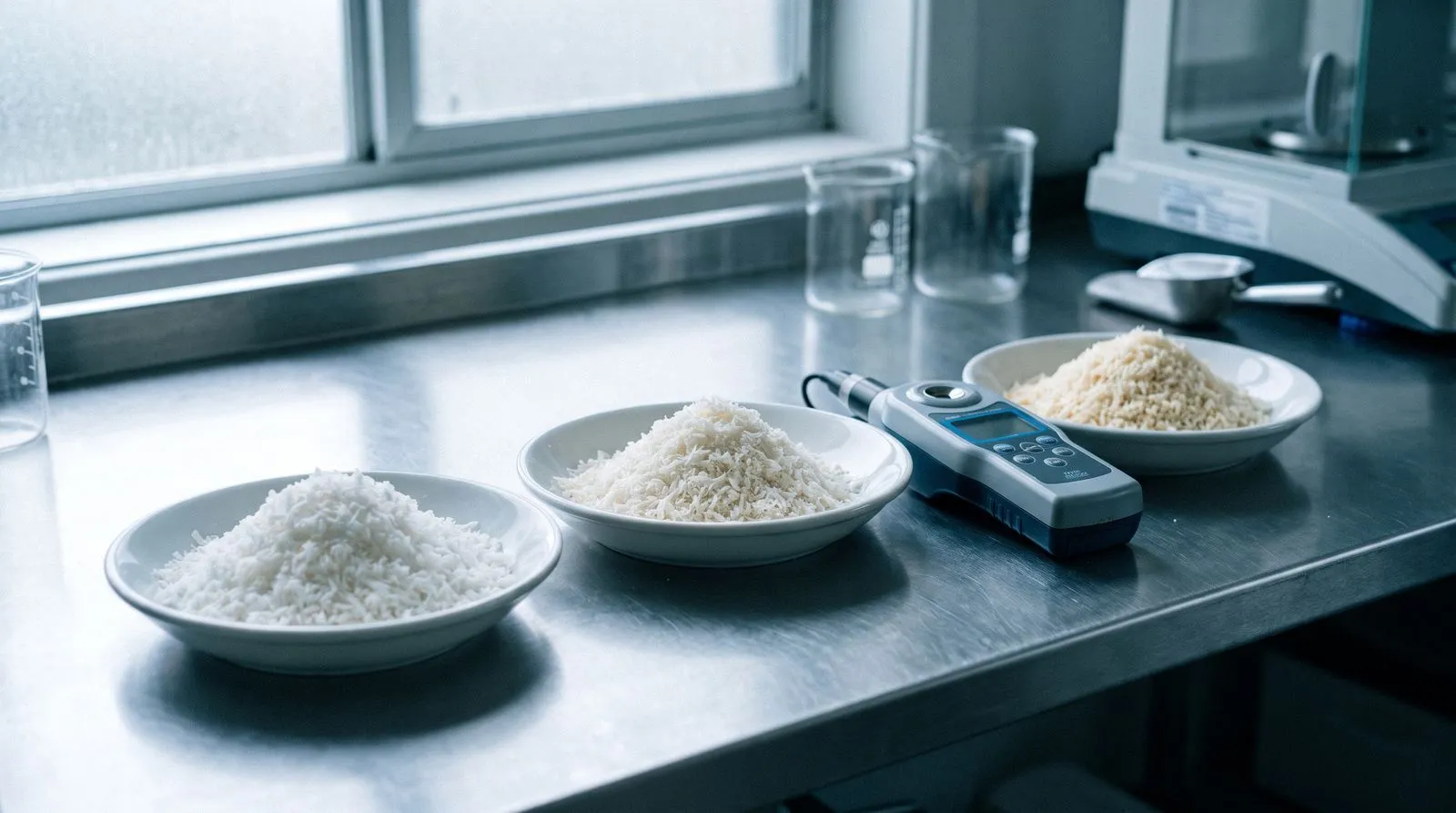
Colour in desiccated coconut is the spec line most buyers leave vague and most disputes start from. The Codex standard for grated desiccated coconut asks for a colour between natural white and light creamy white. It sets no instrument value. Two lots can both meet that wording and still look different enough in a filling to trigger a complaint.
That gap costs money. A container judged “too yellow” on arrival is a rejected lot, a re-test and a price argument settled weeks after the cargo has landed. This note covers what moves colour at the plant, what the published data supports, and how to write a colour spec that a lab can measure.
What does the Codex standard say about colour?
The Codex text for desiccated coconut says the colour shall be natural white to light creamy white, and the texture characteristic of the product. The APCC quality standard uses essentially the same wording. Neither gives a Hunter or CIELAB value.
Trade specifications add defect language. Supplier sheets describe product as white, free from yellow specks and free from dark particles. A Konica Minolta application note on measuring desiccated coconut colour recommends comparing each batch against a reference batch or colour standard with an instrument, rather than relying on the eye.
Natural white to light creamy white is a range, not a target. Without a reference sample and a tolerance, the buyer and the seller each read it their own way.
What turns desiccated coconut yellow or grey?
Four causes account for most colour complaints. Each leaves a different mark, which helps when diagnosing a lot.
| Cause | Typical look | Where it enters |
|---|---|---|
| Drying heat (Maillard browning) | Even cream to tan cast across the lot | Dryer set-point, residence time |
| Low or uneven sulphite | Yellowing that deepens in storage | Wet-meat treatment before drying |
| Brown skin (testa) carryover | Dark flecks, grey cast in fine cuts | Paring and washing |
| Immature or old kernel | Lot-to-lot shade shifts | Nut sourcing and sorting |
Heat is the best documented. A 2025 study in Research in Agricultural Engineering names Maillard reactions as the main cause of non-enzymatic browning during drying. Its optimum for low-fat desiccated coconut was about 62.5 °C with roughly 380 ppm sodium metabisulphite, which gave a whiteness index of 87.2. A separate infrared drying study found that drying temperature moved colour more than air velocity did.
Those figures come from trial conditions on low-fat product. They show direction, not a plant benchmark, and a buyer should not copy them into a contract.
Skin is a different problem. Supplier sheets trace black specks to residual brown skin from the grating and drying stage. Fine and extra-fine cuts show it most, because the particles are small and the flecks stand out against them.
How does sulphite change the colour picture?
Sulphite slows browning. An older US patent on desiccated coconut reports that sulphur dioxide treatment of the wet meat slows yellowing during storage, and that excess heat speeds the browning reaction. The patent also ties some yellowing to nut maturity.
So a sulphite-free lot carries more colour risk, mainly in storage. The desk has covered the commercial side in sulphite-free desiccated coconut: shelf life and price and the legal ceilings in SO2 limits for desiccated coconut in the EU, US and GCC.
A buyer who drops sulphite to meet a label claim should expect the colour spec and the shelf-life promise to change with it. Asking for the old whiteness and the new label in the same contract is where disputes begin.
How should a colour spec be written?
Three elements make a colour line enforceable.
- A reference sample. An approved lot, sealed and shared, as set out in golden sample approval for coconut buyers.
- An instrument method. A named colourimeter, a stated colour space (Hunter Lab or CIELAB), a stated sample presentation and an agreed number of readings.
- A tolerance against the reference. A permitted difference from the approved lot, not an absolute L value copied from another supplier’s sheet.
Defects belong on separate lines. Dark specks and yellow specks should carry a count per sample weight, because an average colour reading hides a few dark particles.
Absolute L values vary by instrument, geometry and cut size, so numbers lifted from one sheet will not transfer. Set the tolerance after both sides measure the golden sample on their own instruments.
How should colour be checked on arrival?
Check it against the retained sample, under the same light, within days of landing. Colour read three months later reflects storage, not shipment.
Ask the supplier for the colour reading on the certificate of analysis, and ask which instrument produced it. A reading from the plant’s colourimeter and one from the buyer’s lab can differ by several units on the same powder. The pre-shipment sample, drawn before sealing, is what lets the two readings be reconciled. See pre-shipment inspection for coconut for what to request.
If a lot fails, the order of evidence matters: retained sample, certificate reading, then arrival reading.
What does this mean for buyers?
- Procurement managers (persona A): Write colour as reference sample, instrument method and tolerance. Keep speck counts on their own line.
- Importers and distributors (B): Retain a sealed retained sample from each lot. It settles an arrival dispute faster than any argument over wording.
- Brand owners (C): If the product is white-on-white, such as a coating or a filling, tighten colour and speck limits before approving a new origin.
- Traders and brokers (D): Quote colour against a named reference, otherwise a price spread between origins may be partly a shade spread.
For multi-origin programmes the point repeats. A single colour tolerance applied across origins is easier to hold than origin-specific wording, as covered in multi-origin contracts holding one spec.
FAQ
Does Codex give a numeric whiteness limit for desiccated coconut? No. Codex requires natural white to light creamy white and sets no instrument value. A numeric limit has to come from the contract, measured against an approved reference sample.
Why is my desiccated coconut turning yellow in storage? Browning continues slowly after drying. Lots with low sulphite, higher moisture or warm storage yellow faster. Cool, dry storage and a retained sample help confirm where the shift began.
Are black specks a colour defect or a foreign matter defect? Specks from residual brown skin are usually specified as a visual defect, counted per sample weight. Foreign matter such as plastic or metal is a separate and stricter category.
Can a colourimeter replace visual inspection? It should lead, with visual checks beside it. An instrument gives a repeatable average, while the eye catches isolated specks an average can hide.
Need a colour tolerance locked across origins? Send the desk an RFQ, and see the desiccated coconut range for the grades we trade.