
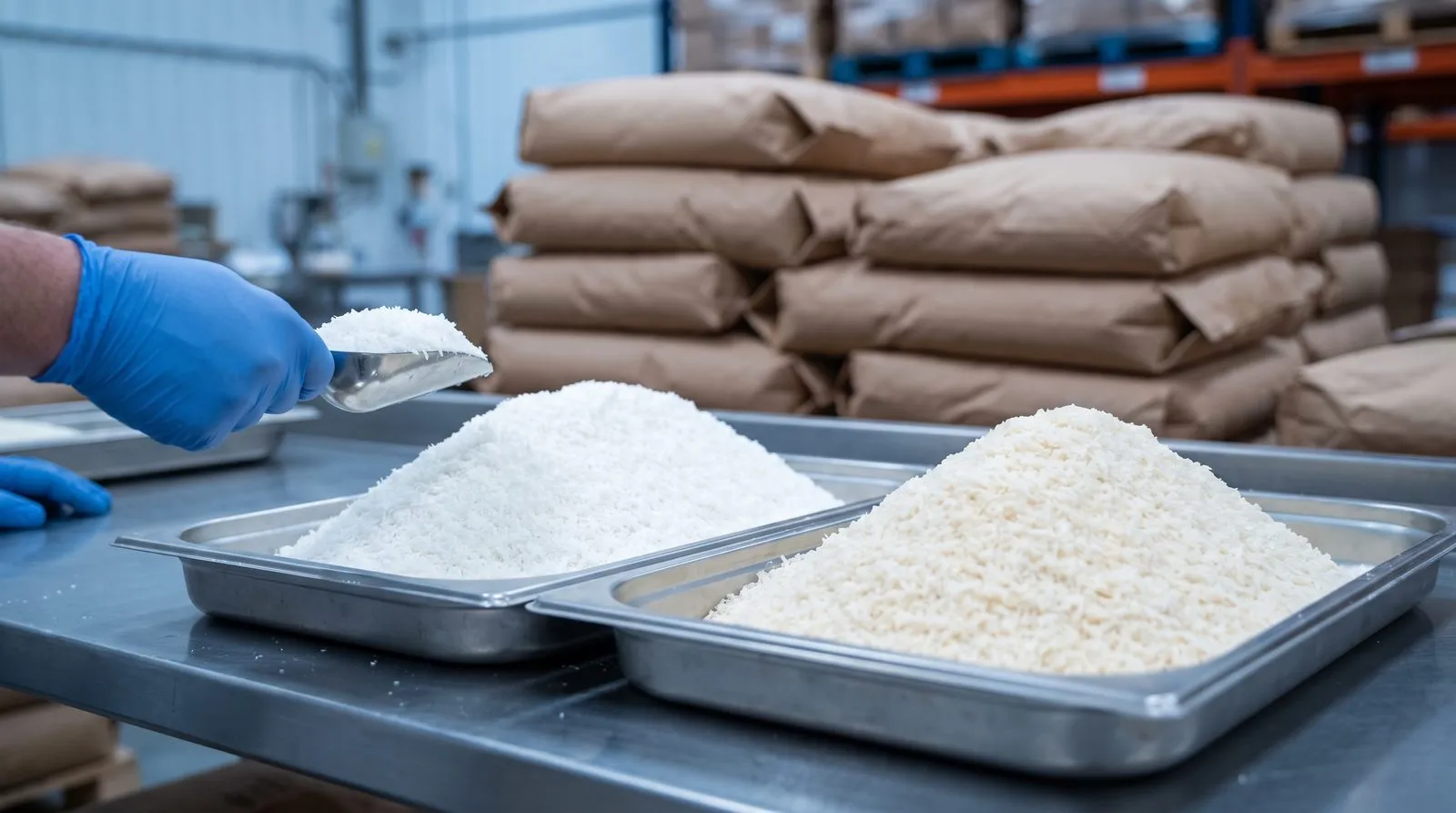
Sulphite-free desiccated coconut is safe for as long as the sulphited version. What it loses is colour. Untreated DC starts to yellow within one to three months of production, according to the process literature, while sulphited product can hold white well past a year. For a procurement manager, that gap is the whole trade-off: a cleaner ingredient statement in exchange for a shorter window in which the product still looks like the spec.
The money sits in that window. Buy sulphite-free on the same 12-month assumption you use for sulphited lots and you are carrying stock that may be off-colour before you use it. Buy it on a shorter clock, with tighter moisture and storage terms, and the premium you pay at origin is usually the smaller part of the cost.
Why does sulphite-free desiccated coconut yellow faster?
Because nothing is interrupting the browning chemistry. The yellowing in DC is non-enzymatic: reducing sugars react with amino groups in the kernel’s protein, the Maillard reaction, and the product drifts from white to cream to yellow. Sodium metabisulphite, the soak that leaves residual SO2 behind, blocks the carbonyl groups that start that reaction.
Remove the sulphite and the reaction runs at whatever rate temperature and moisture allow. A 1981 US patent on coconut processing, US 4,307,120, puts it plainly: untreated product “will usually begin to yellow in one to three months”, and shelf life “is thus dependent upon the temperature during storage”. The same filing describes treated, microwave-dried samples holding white for more than 18 months at ambient.
That is an old source, but the chemistry has not moved. It is also the widest spread in the table below.
| Attribute | Sulphited DC | Sulphite-free DC |
|---|---|---|
| Whiteness hold (ambient) | 18+ months reported (treated, microwave-dried) | Yellowing can begin at 1 to 3 months |
| Main failure mode | Hydrolytic rancidity, moisture pick-up | Maillard yellowing, then the same rancidity risks |
| EU residual SO2 limit | 50 mg/kg; allergen declaration above 10 mg/kg | Not applicable if genuinely untreated |
| US labelling | Declare sulphites at 10 ppm or more | No sulphite declaration |
| Organic eligibility | No | Yes, if certified |
| Contract risk sits with | Regulatory file and COA | Storage, turnover and colour tolerance |
What speeds up the yellowing?
Two things, and buyers control both more than the mill does.
Water activity. Water activity (aw) is the share of water in a product that is free to take part in reactions, measured from 0 to 1. A 2025 review of the Maillard reaction places its maximum rate at aw 0.6 to 0.8, with activity starting from around 0.3. Well-dried DC sits far below that range. The problem is humidity after drying: a torn liner or a humid warehouse lets the surface climb toward the zone where browning accelerates.
Temperature. Heat accelerates Maillard browning directly. A container sitting in a tropical port yard or an unconditioned warehouse in a hot climate spends weeks at temperatures that would never appear on the spec sheet. Our earlier note on what degrades in coconut shelf life covers the logger data on how hot a dry box actually gets.
The practical point: sulphite-free product magnifies every storage weakness that sulphited product quietly absorbs.
How much can sulphite be reduced without going to zero?
Further than many mills assume. A 2025 study by Cahyadewi and colleagues in Research in Agricultural Engineering optimised drying temperature against sodium metabisulphite dose for low-fat DC. The best result, at 62.5 °C and roughly 380 ppm metabisulphite in the treatment, delivered a whiteness index of 87.2 at 2.3% moisture.
Two cautions before you quote it to a supplier. That is a treatment concentration, not a residual SO2 reading on the finished product, and the paper did not report residuals. It also covers low-fat DC, which behaves differently from the 65%-fat product most bakery buyers specify.
Still, the direction is useful. Between full-dose sulphited and sulphite-free sits a reduced-sulphite option. It can land under the EU’s 50 mg/kg residual limit while keeping more of the colour life. For EU buyers, the allergen threshold of 10 mg/kg is what decides whether “reduced” helps the label at all. The full regulatory picture is in our SO2 limits comparison for the EU, US and GCC.
What does sulphite-free desiccated coconut cost?
There is no public price series that splits sulphited from sulphite-free DC. The desk will not invent a premium. What is published is the conventional benchmark, and it is high enough to make shelf-life losses expensive.
The International Coconut Community’s weekly update for 19 September 2026 quoted Philippine DC at USD 2,980/MT FOB and Indonesian fine high-fat at USD 1,775/MT FOB. Mundus Agri reported on 22 September 2026 that Philippine prices had firmed on raw-material and processing costs, with high-fat fine quoted at EUR 2,750/MT and Vietnamese high-fat medium at EUR 2,000/MT.
At those levels the origin premium matters less than the write-off risk. An illustrative case, using the ICC Philippine price:
| Line | Assumption | Cost |
|---|---|---|
| Lot size | 15 MT at USD 2,980/MT FOB | USD 44,700 |
| Share off-colour before use | 10% (stock held past its colour window) | USD 4,470 |
| Same loss as a per-tonne cost on the whole lot | USD 4,470 / 15 MT | USD 298/MT |
A 10% write-off costs the equivalent of a 10% price premium on the entire lot. Those are our assumptions, not market data. Run the same arithmetic with your own consumption rate and storage conditions before comparing supplier quotes.
How should the contract handle shelf life?
Write the clock into the spec instead of inheriting the mill’s default. Several clauses do most of the work.
- Colour life, stated separately. Ask for a whiteness guarantee by month (for example, colour within the approved golden sample for a stated period from production) rather than a single “shelf life 12 months” line that really describes safety.
- Moisture and aw at loading. Moisture of 3% maximum is common on spec sheets. Add water activity at dispatch; it predicts browning risk better than moisture alone.
- Production date, not dispatch date. The colour clock starts at the dryer. A lot that sat three weeks at origin has already spent part of its window.
- Packaging. Multiwall paper with a sealed PE liner is the minimum. Nitrogen flushing or vacuum packs buy time; see our note on bulk packaging, totes and nitrogen.
- Verification on the COA. For sulphite-free claims, require residual SO2 by a named method on every lot, so “free” means a number below detection. Our guide to reading a desiccated coconut COA lists what else belongs beside it.
Free fatty acid still matters. Tetra Pak’s Coconut Handbook notes that DC is commonly specified at a maximum of 0.2% FFA. Sulphite does nothing for that number.
When is sulphite-free the right call?
When the label is worth more than the months. Organic programmes have no choice, since preservative-free is a condition of certification. Clean-label and allergen-sensitive products gain a simpler ingredient statement in every market. Brands that can buy on a two- to four-month consumption cycle, and store below tropical ambient, lose little.
Sulphited or reduced-sulphite product fits better when stock turns slowly or when warehousing is hot and humid. It also suits programmes where visual whiteness is the specification that matters most, such as toppings and white confectionery coatings.
What this means for buyers
- Procurement managers (A): Price sulphite-free on consumption speed, not on the per-tonne quote. Model write-off at your real turnover before comparing offers.
- Importers and distributors (B): Shorter colour life means smaller, more frequent shipments. Build that into container planning and minimum stock levels.
- Brand owners (C): A sulphite-free claim is only as good as the lot COA. Make residual SO2 a per-lot line item.
- Everyone: Specify colour life separately from safety shelf life. They are different numbers with different owners.
FAQ
Is sulphite-free desiccated coconut less safe than sulphited? No. Sulphite in DC is used mainly to hold whiteness. Untreated product stays safe on the same moisture and microbial controls. The difference is cosmetic yellowing, which can begin one to three months after production at ambient temperature.
How long does sulphite-free desiccated coconut stay white? It depends on storage temperature and humidity. Process literature reports yellowing starting at one to three months for untreated DC. Cool, dry storage in sealed liners extends that; hot, humid warehousing shortens it.
Does sulphite-free DC cost more? Usually at origin, but no public price series separates it from conventional DC. The larger cost is often stock that yellows before use. Compare offers on landed cost plus expected write-off at your turnover rate.
What water activity should desiccated coconut ship at? Well below the 0.6 to 0.8 range where Maillard browning peaks. Ask the supplier to report aw at dispatch alongside moisture, and keep liners sealed to stop pick-up during storage.
Can a supplier offer reduced-sulphite DC? Often, yes. Research published in 2025 showed good whiteness at lower metabisulphite doses. Specify the residual SO2 ceiling you need, for example below the EU allergen threshold of 10 mg/kg, and verify it per lot.
If you are weighing sulphite-free against reduced-sulphite across origins, send the desk an RFQ and we will quote both against one spec. Current grades and specs are on our desiccated coconut page.