
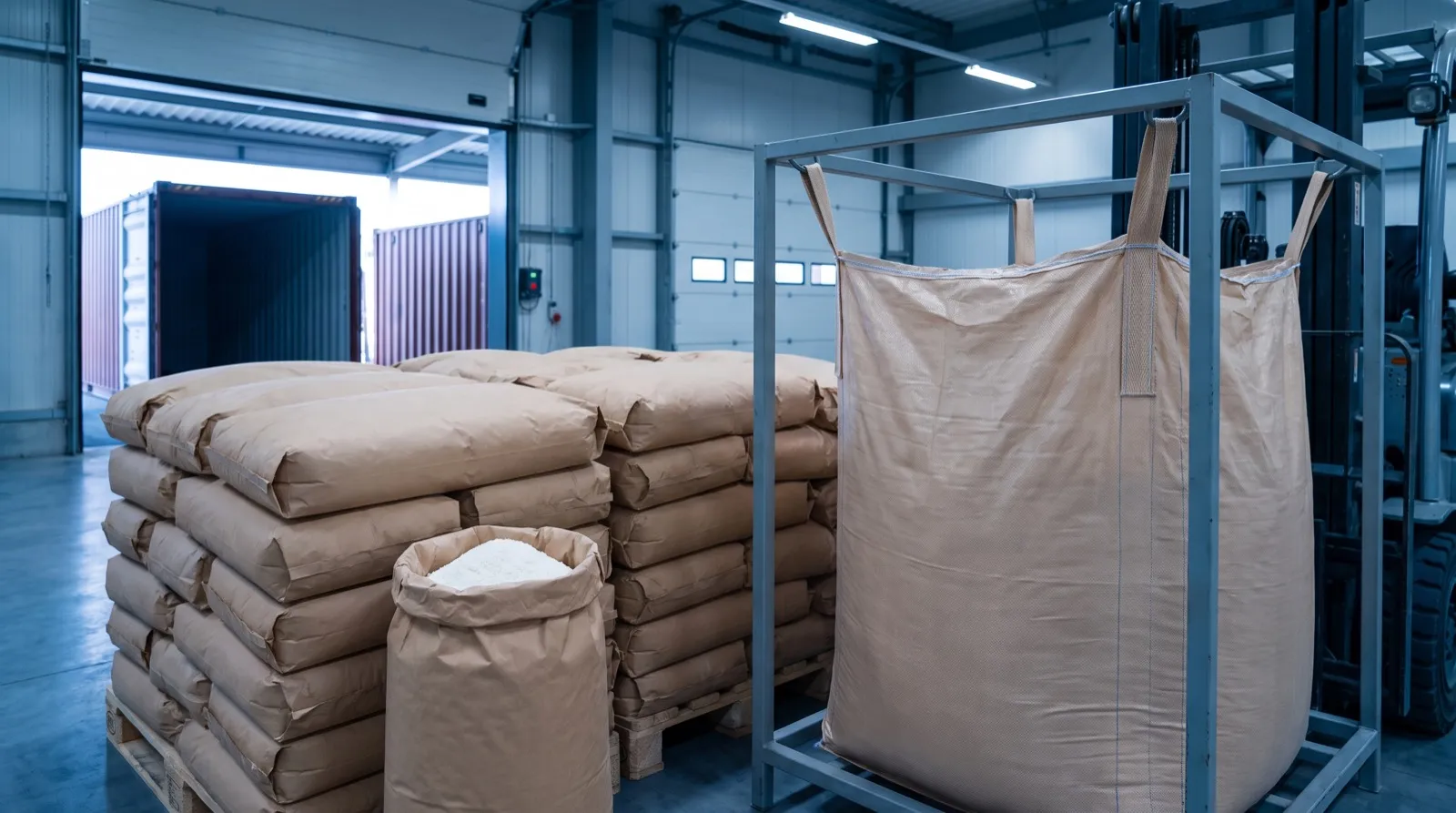
Coconut bulk packaging is a cost decision before it is a quality decision. For dry ingredients the 25 kg multiwall paper bag with a sealed polythene liner is still the default, and the reason is moisture rather than tradition. For oil the ladder runs from 200 kg drums to a 24,000 litre flexitank. One number frames the rest. A 20 ft general purpose container is rated for 30,200 kg of payload, per Hapag-Lloyd’s published container specification. A full load of bagged desiccated coconut in that box is about 12,500 kg. You pay for a container and use 41% of its weight rating.
That gap is where the pack format conversation actually lives.
What Codex specifies for coconut bulk packaging
Most buyer specs cite Codex CXS 177-1991 and stop there. Section 8 of that standard names no pack. It redirects to the Recommended International Code of Hygienic Practice for Desiccated Coconut, CAC/RCP 4-1971, and that hygiene code is where the only material Codex names appears: multiwall paper sacks with “fat- and moisture-resistant layers”, or aluminium lined cases. The barrier Codex asks for is against fat migration and water, not against oxygen.
The two documents also disagree on moisture. CXS 177-1991 sets a 4% m/m maximum; CAC/RCP 4-1971 sets its end-product figure at 3%; CBI, the Dutch government’s market-entry guidance, tells EU importers to expect 3%. A contract saying “per Codex” has imported both numbers and settled neither. Write the figure you want, and check where it lands on the desiccated coconut COA.
Why 25 kg bags stay the default
CBI’s guidance, updated December 2023, records the working reality: paper bags with polythene sealed inside, 25 kg standard, with 8 kg, 10 kg and 50 kg also in use. Storage at 26 °C or lower, and shelf life of 12 months for sulphited material, 9 months for organic.
| Format | Typical unit | Governing reference | Where it fits |
|---|---|---|---|
| Multiwall paper bag, PE liner | 25 kg | CAC/RCP 4-1971 §D(5) | Desiccated coconut, flour, sugar |
| Small or large bag | 8-10 kg, 50 kg | CBI, Dec 2023 | Pilot runs, manual tipping lines |
| FIBC tote | Not fixed by standard | ISO 21898:2024 | Single-SKU, high-throughput plants |
| Steel drum | 212-230 L capacity | ISO 15750-2:2002 | Coconut oil, small to mid volumes |
| Flexitank | 24,000 kg maximum | COA TG07, Oct 2021 | Coconut oil, single grade |
The 25 kg bag survives because it suits the plant, not the ship. It is liftable, it meters cleanly into a batch, and a damaged bag writes off 25 kg instead of a tonne.
Dry coconut cubes out, oil weighs out
Break-even density is payload divided by internal capacity. Above it a cargo runs out of weight allowance first; below it, the cargo runs out of space and you ship air.
| Container | Payload | Capacity | Break-even density |
|---|---|---|---|
| 20 ft GP | 30,200 kg | 33.2 m³ | 910 kg/m³ |
| 40 ft GP | 28,800 kg | 67.7 m³ | 425 kg/m³ |
| 40 ft HC | 28,650 kg | 76.3 m³ | 375 kg/m³ |
Container figures from Hapag-Lloyd. CBI puts 500 bags of 25 kg in a 20 ft and 1,000 in a 40 ft, so palletised bagged coconut stows at roughly 370-380 kg/m³ gross, close to the 40 ft high cube break-even and nowhere near the 20 ft one. A 20 ft uses 41% of its payload; a 40 ft GP carrying the same cargo uses 87%. When to consolidate at all is covered in FCL vs LCL for coconut ingredients.
Coconut oil is the mirror image. Codex CXS 210-1999 gives it a relative density of 0.908 to 0.921 at 40 °C, so about 913 kg per cubic metre at loading temperature. That is above the 20 ft break-even and roughly 2.1 times the 40 ft figure. Bulk oil ships in 20 ft boxes because a 40 ft would weigh out with a third of its cube unused.
When a tote beats bags
An FIBC, or flexible intermediate bulk container, is the woven bag on four lifting loops that most plants call a tote. It is governed by ISO 21898:2024, which replaced the 2004 edition in August 2024. The standard fixes no capacities. It fixes duty categories and safety factors, so quote those instead of a nominal tonnage: single-trip units carry a safety factor of 5 against safe working load.
Two clauses matter for coconut. ISO 21898 recognises an insect-repellent treatment category, which speaks to the infestation risk CAC/RCP 4-1971 flags for storage and transport. And it treats the inner liner as part of the specification while saying nothing about its material or thickness, so the liner spec is yours to write, in the same moisture-barrier language as the bag it replaces.
A tote earns its place when one grade moves fast enough that a tipping frame beats 40 bag cuts an hour. It stops earning it the moment you split grades.
Does nitrogen flush do anything for coconut?
Less than the marketing suggests, and nobody has published the trial. Desiccated coconut is at least 60% oil by mass under Codex, and that oil is 45-53% lauric acid, so oxidation is a fair worry in principle. But measured water activity in commercial material is 0.32 to 0.42, and at that level the product is stable (Kinderlerer and Clark, J. Hyg., 1986). Coconut’s documented spoilage route is ketonic rancidity from xerophilic fungi, and it needs water activity near 0.76 together with oxygen. Both conditions, not either one. The spoilt sample in that study had been packed in cardboard with a glassine lining, a pack that failed on water.
So the first job of a coconut pack is keeping water out, which is what Codex asks for and what nitrogen does not do.
No coconut-specific gas-flush trial appears in the peer-reviewed literature. The closest evidence is whole milk powder, where nitrogen slowed lipid oxidation volatiles across a year of storage yet optimum flavour shelf life was about three months either way (Lloyd, Hess and Drake, 2009). Treat that as a dairy analogue.
If you do buy gas-flushed material, specify the measurement rather than the gas. Conventional flushing leaves residual oxygen between 0.3% and 3.0% (Safaei et al., 2021), and the dairy work treated headspace above 6.5% oxygen as a failed seal. That gives you a line-validation spec and a rejection threshold. “Nitrogen flushed” with no residual oxygen number attached is not a specification.
Nitrogen does earn its place on the oil side, where CBI’s February 2025 guidance records nitrogen blanketing as standard on stainless steel sea tankers. Same gas, different scale.
Drums, IBCs and flexitanks for oil
CBI puts the coconut oil bulk range from 200 kg drums to over 20 tonnes in flexitanks, with drums and IBC tanks as the middle rungs. The drum spec hides a trap. ISO 15750-2:2002 defines tight-head steel drums at 212, 216.5 and 230 litres total capacity, treating “200 litre” as trade shorthand for the class. A quoted 210 kg net fill therefore implies roughly 229 litres, which is the 230 litre drum, not the 216.5 litre one you may have priced. Confirm the litre figure, not the nickname.
The same standard explains the 585 mm maximum outside diameter: it exists so drums stack four abreast inside an ISO container. Against a 20 ft’s 5,900 mm length and 2,393 mm height that gives four across, ten rows and two tiers, so 80 drums with no dunnage allowance and near 15 tonnes of oil at brimful capacity. Brimful is not fill, so treat that as a ceiling.
A flexitank in the same box carries more. The Container Owners Association caps one at 24,000 kg in a 20 ft, non-dangerous liquids only, under COA TG07 dated October 2021. At 0.913 kg per litre that is about 21,900 kg of oil, roughly six tonnes more than the drum stow. The trade-off is one grade, one discharge, no partial draw.
What this means for buyers
- Procurement, CPG: state moisture as a number, not “per Codex”, and put the liner spec in writing for bags and totes alike. If a supplier offers nitrogen flush, require a residual oxygen figure and a seal-failure threshold, or decline the premium.
- Importers and distributors: book bagged coconut in 40 ft equipment where the lane allows. A 20 ft leaves roughly 17 tonnes of paid payload unused, the largest recoverable cost in the pack decision.
- Oil buyers: flexitank for single-grade, fast-drawdown programmes; drums when you need to split grades or hold stock.
FAQ
Does Codex require a specific bag for desiccated coconut? No. CXS 177-1991 refers packaging to CAC/RCP 4-1971, which names multiwall paper sacks with fat- and moisture-resistant layers, or aluminium lined cases, as acceptable material. That is guidance on barrier properties, not a mandated bag format.
Is nitrogen flushing worth it for desiccated coconut? There is no published coconut-specific trial. Coconut’s documented spoilage route needs both moisture and oxygen, and commercial material sits at a stable water activity of 0.32 to 0.42. Prioritise the moisture barrier. If buying gas-flushed, demand a residual oxygen specification.
How many 25 kg bags fit in a container? CBI records 500 bags in a 20 ft and 1,000 in a 40 ft, so 12.5 and 25 tonnes. The 20 ft uses about 41% of its rated payload; the 40 ft about 87%.
Locking a pack and liner spec across more than one origin is harder than locking the product spec. If that is the problem in front of you, send the desk an RFQ through our contact page.