
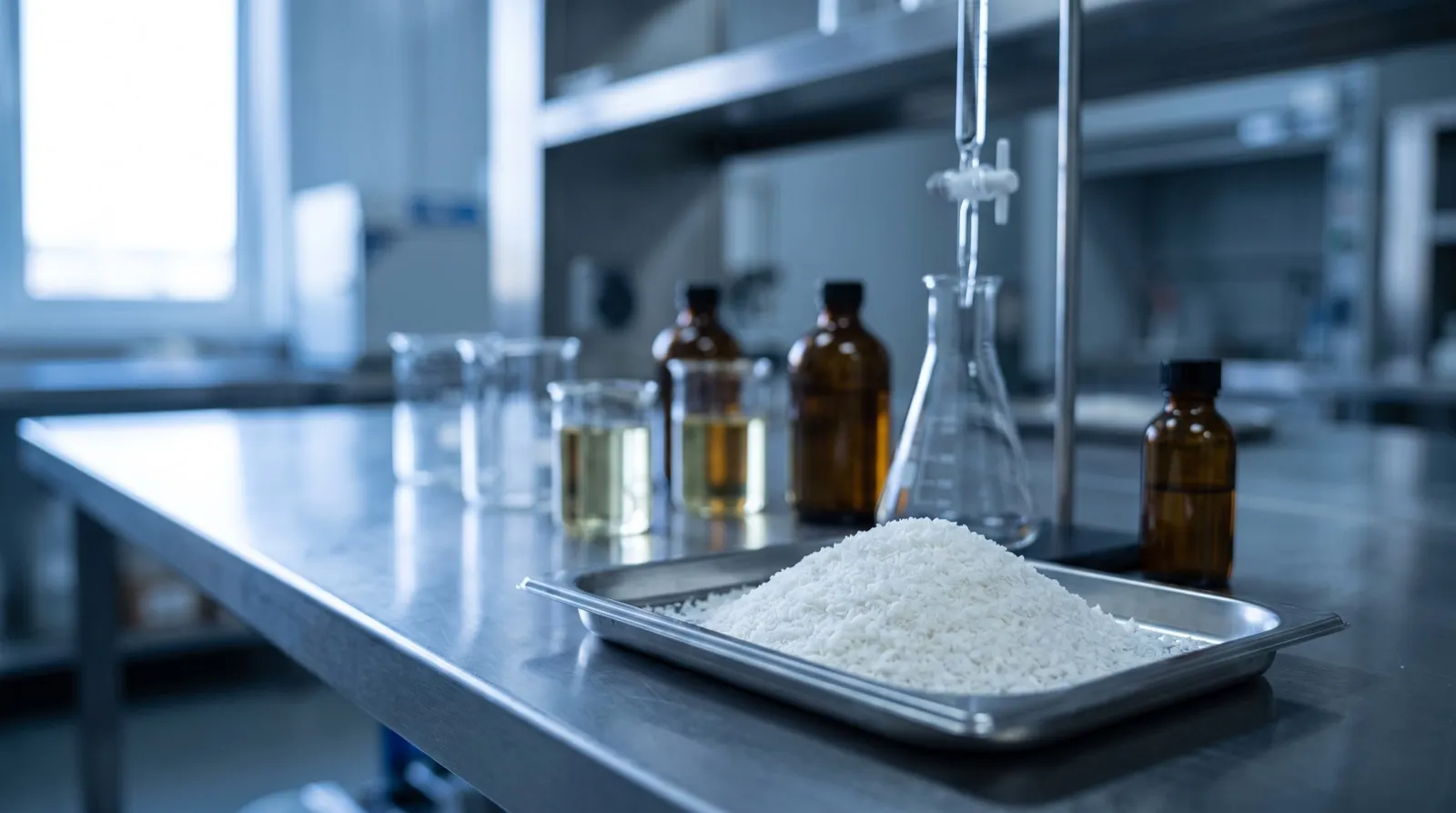
No international standard sets a coconut shelf life. Codex Alimentarius publishes a standard for desiccated coconut, one for coconut milk and cream, and one covering coconut oil. Read all three end to end and none of them carries a durability period. The 12, 18 or 24 months printed on a supplier’s spec sheet is a commercial declaration, not a compliance figure.
The number still travels with the cargo, and the buyer usually ends up owning it. Under Regulation (EU) No 1169/2011, the food business operator responsible for the information on the pack is the one whose name it carries, or the importer where that operator sits outside the Union. An EU buyer inherits a coconut shelf life that a mill in Manila or Colombo generated and never had to justify to a regulator.
Second: coconut rarely fails the way buyers plan for. Most shelf life clauses are written against oxidation. The chemistry says water does more of the damage.
What is a coconut shelf life actually based on?
Usually the supplier’s own storage history, and little else. Food Standards Scotland’s 2025 shelf-life guidance opens by stating there is no standard method for setting one, and that the operator must validate and document their own before the food is marketed. For an ambient dried commodity it points to accelerated shelf-life testing: store hot, watch the product fail, extrapolate back.
Extrapolation is where the number goes soft. The rate acceleration per 10 °C, written Q10, has to be measured across two storage temperatures rather than assumed. A 1979 US Office of Technology Assessment review tabulates the spread: a product surviving two weeks at 50 °C projects to 16 weeks at 20 °C if Q10 is 2, and to roughly 250 weeks if Q10 is 5. Same experiment, sixteen-fold difference in the answer.
For a fat-bearing product the assumption is worse than arbitrary. Heat drives oxidation, Maillard browning and lipase-driven hydrolysis at different rates, so the failure mode you observe at 50 °C may not be the one that ends the cargo at 25 °C.
One figure is worth carrying into a negotiation. The only coconut shelf lives we could tie to dated manufacturer technical documents were both 12 months: bulk aseptic UHT coconut milk, and spray-dried coconut milk powder. The 18 and 24-month claims circulating in the trade traced back to marketing pages.
Coconut fails by hydrolysis, not oxidation
Coconut oil carries an iodine value of 6.3 to 10.6 and 1.0 to 2.5% linoleic acid, per Codex CXS 210-1999. There is very little unsaturation for oxygen to attack.
Experiment agrees. A Kasetsart study induced all three rancidity pathways in coconut oil separately and found the hydrolytic and ketonic types dominant, the oxidative odour “mild”, and coconut’s oxidative stability 4.8 times that of rice bran oil.
Hydrolysis runs on water. The Philippine Bureau of Agriculture and Fisheries Standards grades copra on moisture in its 2021 technical bulletin, and free fatty acid tracks it directly.
| Copra grade | Moisture (%) | FFA max (% as oleic) | Aflatoxin max (ppb) |
|---|---|---|---|
| Grade 1 | 6.0 to 7.9 | 0.5 | 5 |
| Grade 2 | 8.0 to 10.9 | 4.0 | 20 |
| Grade 3 | 11.0 to 13.9 | 5.0 | 20 |
Moisture rises by about six points and free fatty acid goes up tenfold. Oxygen plays no part in that table. It is the clearest argument for buying on moisture and water activity rather than peroxide value alone.
Why a Codex-compliant cargo still gets rejected
Because the Codex acidity ceiling sits well above the point where a person can taste the defect. Codex allows an acid value of 4.0 mg KOH/g on virgin and cold-pressed oils, roughly 1.43% free fatty acid expressed as lauric. The same Kasetsart panel put the sensory detection threshold at 0.26% FFA, with more than 60% of tasters rejecting the sample. A cargo can clear Codex by a factor of five on paper and still come back off a production line.
Two further traps sit in the same clause.
Basis. Codex CXS 177-1991 expresses desiccated coconut acidity as lauric acid. The wider oils trade defaults to oleic, and the same titration reads about 1.41 times higher on the oleic basis. A COA reporting “FFA 0.35%” without naming the basis has told you nothing.
The defect peroxide value cannot see. CXS 177 rejects desiccated coconut that is “mouldy, cheesy, smoky, fermented or rancid”. Cheesy is specific. Xerophilic fungi of the Eurotium and Penicillium genera convert coconut’s C8 to C12 fatty acids into methyl ketones, a pathway Kinderlerer documented in the 1980s. It runs at low water activity and low oxygen, exactly the conditions where a peroxide value stays clean. PV is a rise-and-fall marker in any case: ISO 3960 runs 0 to 30 meq/kg, and a deeply aged fat can read low as its hydroperoxides break down.
Anisidine value and TOTOX are the wrong tools here. Codex applies them to fish oils, where secondary aldehydes from polyunsaturated fat are the real risk. On coconut they are money spent on the wrong test.
What the voyage takes off the clock
Measured, not modelled. A logger study on door-to-door container shipments recorded 35.8 °C and 81.8% relative humidity inside a 40 ft dry box on a Europe to India routing, with 33 to 36 °C and 69 to 82% RH held for a continuous 72 hours. The largest single swing, 15.28 °C in under six hours, happened in a port yard rather than at sea. Roughly half of the maximum temperature and humidity shifts occurred on the land legs.
Packaging is what stands between that and the cargo, and the trade-standard pack is thin. Desiccated coconut moves in five-ply kraft sacks with a polythene liner. A 12 micron LDPE film passes on the order of 8,470 cc of oxygen per square metre per day; a metallised PET laminate passes about 0.11 cc on the same basis. Five orders of magnitude, on a product that is at least 60% oil.
GCC standard GSO 150 put numbers on the same relationship for shelled roasted nuts: 18 months in a foil bag with vacuum or nitrogen, 12 months in foil, six months in a plastic bag, all at 25 °C or below. Three times the declared life for the barrier and the flush. Bulk packaging formats are covered separately.
Over-drying is not a free win. Lipid oxidation slows as water activity falls, then begins rising again below aw 0.40, per Virginia Cooperative Extension’s 2024 water activity guidance.
What to write into the contract
Rancidity is not a food safety matter and does not appear in regulatory alert systems. Nobody polices it for you. If oxidation and hydrolysis are not in the contract with a method number and a limit, they are not in the deal.
| Marker | Method | What it catches |
|---|---|---|
| Moisture | AOAC 925.40 | The driver behind FFA rise |
| Water activity | ISO 18787:2017 | Mould above roughly 0.60; oxidation turning back up below 0.40 |
| FFA / acid value | ISO 660:2020 or AOCS Cd 3d-63 | Hydrolytic rancidity. Name the basis, lauric or oleic |
| Peroxide value | AOCS Cd 8b-90 or ISO 3960 | Primary oxidation. Absent from CXS 177, so the buyer must add it |
| Sensory panel | Contractual, against CXS 177 §3.2.3 wording | The cheesy ketonic defect that PV misses |
One drafting note. CXS 177-1991 caps desiccated coconut moisture at 4% m/m, while the older hygiene code CAC/RCP 4-1971 says 3%. Both are live Codex texts. Writing “Codex compliant” without a figure hands the mill the choice. Our guide to reading a desiccated coconut COA covers the rest of the certificate.
What this means for buyers
- Procurement, CPG and food manufacturing: treat the supplier’s declared shelf life as an unvalidated claim until you see the study behind it. Specify moisture, water activity and FFA with a stated basis, and add peroxide value yourself.
- Importers and distributors: in the EU the date on the pack is your legal responsibility once the processor sits outside the Union. Price that risk, or contract for the underlying data.
- Both: the remaining-life clause matters more than the headline figure. A 12-month declaration with 10 months left on arrival beats a 24-month claim with six.
- Shipping to the GCC: production and expiry dates must be printed by the producer on the original pack. Date stickers applied downstream are not permitted under GSO 9/2013.
- Buying oil rather than kernel: aflatoxin risk sits in the copra and crude oil chain, not in desiccated coconut made from fresh kernel. Put the clause where the exposure is.
FAQ
Does coconut oil go rancid quickly? Not by oxidation. Its iodine value of 6.3 to 10.6 leaves little for oxygen to attack, and measured oxidative stability runs several times that of common seed oils. The realistic failure is free fatty acid rise from residual moisture, reading as a soapy or cheesy note.
Is there a legal shelf life for desiccated coconut? No. Codex CXS 177-1991 sets moisture, oil, ash and acidity limits but no durability period. The declared shelf life is set by the manufacturer and, in the EU, becomes the responsibility of whoever’s name appears on the pack.
Should we specify TOTOX on coconut? Generally not. TOTOX and anisidine value target secondary aldehydes from polyunsaturated fats. Coconut has very little polyunsaturation. Moisture, water activity, FFA and a sensory clause do more work for the same spend.
What actually shortens shelf life in transit? Heat and humidity in port yards and on land legs more than at sea, combined with a pack that has no barrier. Measured dry-container interiors have held above 33 °C and 69% RH for days at a time.
Need a shelf life spec and remaining-life clause that survives three origins? Send the desk an RFQ.