
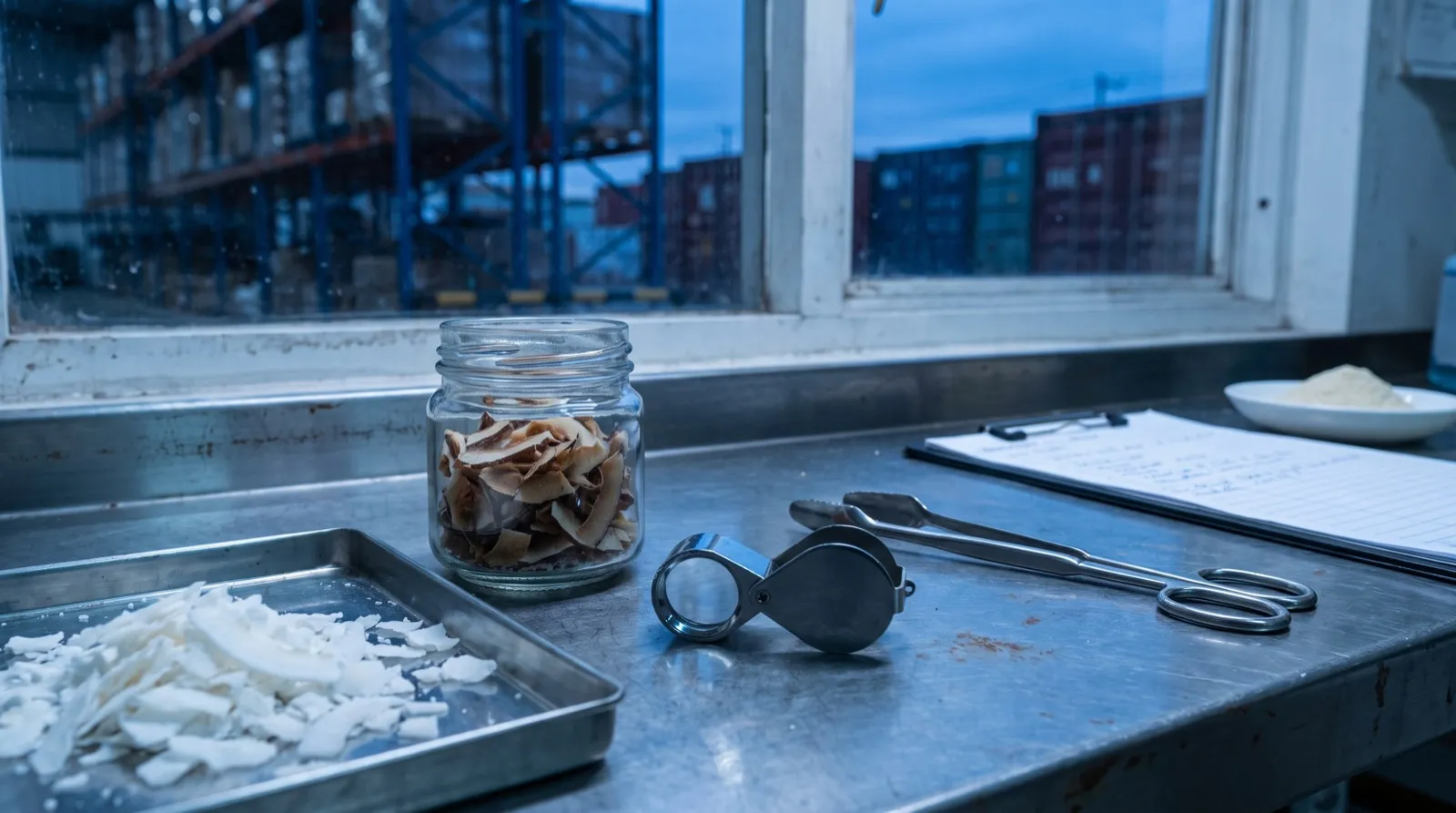
A certificate of analysis confirms a number on paper. It does not confirm what a bag of desiccated coconut actually looks, smells or feels like on the production line six months later. That gap is what a golden sample closes, and buyers who skip the step find out the hard way when a “spec-compliant” shipment still fails on the factory floor.
A golden sample is a physical reference unit the buyer approves before production, kept on file, and used to check every later shipment against. It is not a formality. It is the one document a lab report cannot replace, because moisture percentage and fat content say nothing about colour consistency, particle size feel, or the faint rancidity a trained nose catches before an instrument does.
What is a golden sample, and why doesn’t a COA replace it?
A golden sample is the physical standard both parties agree defines “correct” for a given spec. Once approved, it becomes the reference point for every dispute, every incoming inspection, and every renewal negotiation. A COA states numeric limits; the golden sample shows what compliant product actually looks like.
The two serve different failure modes. A COA catches a moisture reading outside spec or an aflatoxin result over the limit. A golden sample catches the failures numbers miss: uneven particle grading in desiccated coconut, an off colour in coconut milk powder, a texture shift in coconut flour that a spec sheet never described because nobody thought to write it down. Buyers relying on paper alone are blind to exactly the defects that end up on a customer’s desk.
Pre-production sample, pre-shipment sample, counter-sample: three different checkpoints
These get used interchangeably in casual buyer conversation, but they approve three different things at three different points in the order.
A pre-production sample is pulled and approved before the supplier commits raw material to the buyer’s order. This is where the golden sample gets locked. Nothing ships against a spec until this sample is signed off.
A pre-shipment sample or inspection happens once goods are packed, checking that the finished lot in the warehouse matches what was approved, plus carton count, seal condition and labelling. A pre-shipment inspection can confirm packaging and documentation, but on its own it cannot prove microbiological safety or allergen absence; that still depends on the COA and, where warranted, independent lab testing.
A counter-sample is a portion split at the point of pre-shipment inspection and held by a neutral party or the buyer, specifically to resolve a dispute if the arrived goods don’t match what was inspected. Without one, a disagreement after arrival comes down to one side’s word against the other’s, with no physical evidence from the shipment date to settle it.
What sampling standard actually applies to a coconut lot?
For desiccated coconut, Codex Standard CXS 177-1991 sets quality provisions and references the Codex Recommended Methods of Analysis and Sampling, CXS 234-1999, for how a lot should be sampled and how many defective units a lot can carry before it fails acceptance. That is the baseline reference a buyer can cite in a spec document rather than inventing sampling language from scratch.
For the physical container inspection layer, third-party inspectors such as SGS and Bureau Veritas typically apply Acceptable Quality Limit sampling under ISO 2859-1: commonly AQL 1.0 for critical defects, AQL 2.5 for major defects and AQL 4.0 for minor defects. This governs how many units get pulled from a container and how many defective units trigger a fail, independent of the chemical spec entirely.
Running both together, Codex-referenced lab sampling for the chemistry and AQL-based physical sampling for the container, gives a buyer two independent checks rather than one number standing in for the whole shipment.
How long should a retention sample be kept?
Long enough to outlast any claim the product’s stated shelf life could generate. Standard retention practice keeps a sample for the product’s full shelf life, with many quality programmes adding a buffer of roughly ten percent on top to cover a customer consuming close to the stated expiry date. For dietary-supplement-grade material moving through FDA-regulated channels, the pattern is closer to one year past shelf life, or two years from the date the final batch was distributed, whichever governs the specific product category.
For coconut ingredients, that retention period should track the same shelf-life figures used elsewhere in a buyer’s documentation; see the desk’s note on what actually degrades in coconut commodities and how to buy around it for the underlying numbers by product type. A retention sample with no traceable link to the shelf-life claim on the label is a sample kept for the wrong length of time.
What happens when a shipment doesn’t match the golden sample?
Act immediately, and document before using or incorporating the material. Under standard commercial-goods principles, a buyer who wants to reject a nonconforming shipment must notify the supplier promptly; using or processing the goods first risks losing the right to reject them at all. That single procedural point costs a buyer more negotiating ground than any spec dispute itself.
A pre-shipment inspection with a counter-sample pulled at load port catches most mismatches before the container leaves origin, which is the cheaper failure point by a wide margin. A mismatch discovered only after arrival forces a choice between accepting a shipment that doesn’t match spec, or rejecting it and absorbing demurrage, re-testing and replacement lead time on a container already at sea. The golden sample, the counter-sample and prompt notification are the three pieces of evidence that determine which side carries that cost.
Sample checkpoints compared
| Sample type | When taken | What it approves | Who holds it | Typical retention |
|---|---|---|---|---|
| Golden sample | Before first production run | The physical reference standard for the spec | Buyer (and often supplier) | Life of the contract/relationship |
| Pre-production sample | Before raw material commitment | This specific order’s intended output | Buyer, for sign-off | Until pre-shipment approval |
| Pre-shipment sample | At packing, before container seal | The packed lot matches the approved standard | Inspector, buyer, supplier | Through dispute window |
| Counter-sample | Split at pre-shipment inspection | Neutral evidence if a dispute arises | Neutral third party or buyer | Through claim resolution |
| Retention sample | At production/release | Shelf-life and quality claims over time | Supplier (and buyer, if required) | Shelf life plus buffer |
What this means for buyers
- Persona C (brand owners): lock a golden sample before the first commercial order, not after a complaint. Retrofitting a reference standard once a customer has already flagged an issue means negotiating from a weaker position.
- Persona A (procurement, CPG): write the sampling standard into the spec document itself, naming Codex CXS 234-1999 for lab sampling and an explicit AQL level for container inspection, so both sides are working from the same acceptance rule before a shipment is even booked.
- Insist on a counter-sample at every pre-shipment inspection. It costs little and is the only piece of physical evidence that survives a transit dispute.
- Tie retention sample duration to the actual shelf-life claim on file, not a generic default across every product.
- A golden sample matters most when sourcing runs across multiple origins on one spec; see the desk’s guide to holding one spec across three origins for how that discipline scales.
FAQ
Is a golden sample a legal requirement? No. It is a commercial best practice, not a regulatory one. Buyers who skip it lose their strongest evidence when a delivered lot is challenged on quality grounds that a COA doesn’t cover.
Who should physically hold the golden sample? The buyer, at minimum. Many contracts also require the supplier to retain an identical unit, so both sides are checking future shipments against the same physical object rather than a written description of it.
Does a pre-shipment inspection replace lab testing? No. It confirms packaging, count, seals and a visual/physical match to the approved sample. It cannot confirm microbiological safety or allergen status; that still requires COA data and, where warranted, independent lab analysis.
What AQL level should a coconut ingredient buyer specify? AQL 1.0 for critical defects, 2.5 for major and 4.0 for minor is the common industry default under ISO 2859-1. A buyer with tighter risk tolerance can specify stricter levels in the inspection contract.
How often should a golden sample be renewed? Whenever a spec, origin or process changes materially. A golden sample approved for one crop season or one mill should not be assumed valid once either changes without a fresh sign-off.
Need a spec locked across origins, with the sampling standard written in from day one? Send the desk an RFQ.