
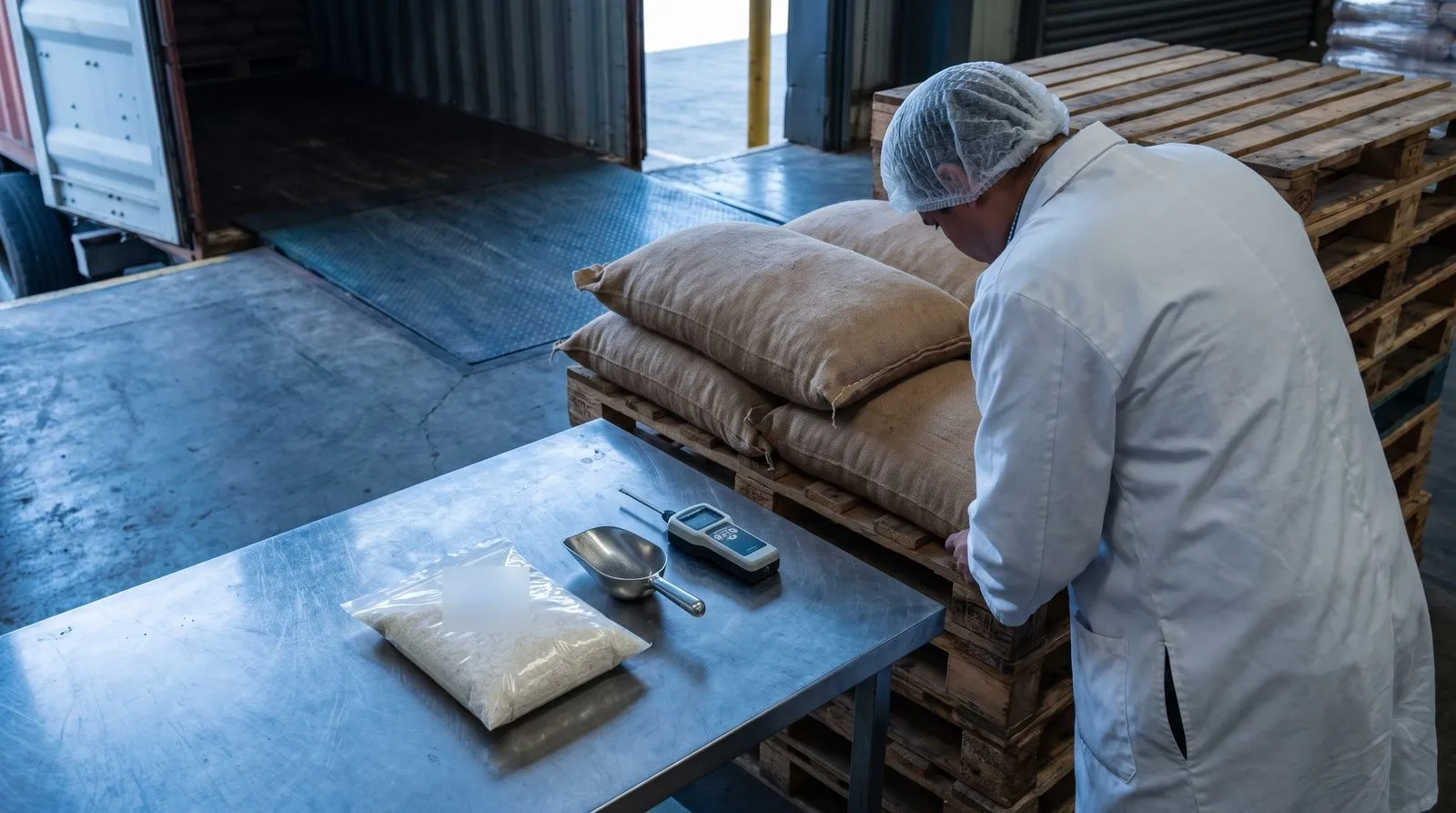
A pre-shipment inspection protects a coconut buyer exactly as far as its written scope, and no further. Appoint an inspection company with a one-line brief (“inspect before loading”) and you get a certificate confirming that cartons were counted. Appoint it with a sampling plan, a seal protocol, a named laboratory and a photo list, and you get evidence that survives a claim.
A pre-shipment inspection (PSI) is a third-party check of goods, packing and container carried out at origin before the box is sealed. The fee difference between a thin brief and a full one is a few man-days. The difference in what you can recover when the container is rejected at destination is the invoice.
What should a pre-shipment inspection for coconut cover?
Five blocks, in the order the inspector works. TÜV Austria’s food PSI scope is a fair template: document review, physical count and weight check, visual quality and package integrity, random sampling for laboratory analysis, then loading supervision with container condition and sealing.
| Block | What the inspector does | What to ask for in writing |
|---|---|---|
| Documents | Checks packing list, COA, health and phytosanitary certificates against the order | Spec sheet attached to the order; every mismatch listed |
| Quantity and weight | Counts bags or cartons; check-weighs a sample | Scale calibration date; net weights per bag, not just gross totals |
| Quality and packaging | Visual check for discolouration, lumps, torn liners, odour | Golden sample held by the inspector for side-by-side comparison |
| Sampling | Draws, blends and seals contractual samples | Number of bags, increment size, number of sealed sets, who keeps which |
| Container and loading | Checks the empty box, supervises stuffing, applies seal | Photo list, seal number, loading start and end times |
The two blocks buyers most often leave blank are sampling and container condition. They are also the two that decide a moisture or contamination claim later. The golden-sample process covers how to give the inspector a physical reference for the quality block.
How many bags should the inspector sample?
Codex does not say. CXS 177-1991, the standard for desiccated coconut, passes a lot when the number of defective containers does not exceed the acceptance number of “the appropriate sampling plan”, then lists analytical methods rather than a plan. The plan has to come from your contract or your inspection order.
The most widely used written plan for bagged agricultural goods is the GAFTA 124 Sampling Rules, October 2025 edition. GAFTA is the Grain and Feed Trade Association. Its rules apply by default on GAFTA contracts, but any buyer can write them into a coconut inspection order. Rule 6.3.3 sets the floor for goods in bags.
| Bags in the consignment | Minimum bags sampled (GAFTA 124, 6.3.3) | How each bag is sampled |
|---|---|---|
| Under 100 | 20 | Speared three times: top, middle, bottom |
| 100 to 10,000 | 50 | Same |
| Over 10,000 | 0.5% of bags (1 in 200) | Same |
Every 20 ft or 40 ft box of 25 kg desiccated coconut bags falls in the middle band, so the floor is 50 bags per consignment. Each increment should not exceed 1 kg (6.2.5), and the blended bulk is divided into contractual samples of not less than 3 kg each (3.8.4).
For cartons of coconut milk or cream, the reference is ISO 2859-1, the attribute sampling standard behind every AQL table. An AQL (acceptable quality limit) is the worst defect rate a buyer will tolerate in a lot. General Inspection Level II is the default, and at that level a 5,000-unit order gives a 200-unit sample. The special levels S-1 to S-4 exist for slow or destructive tests and for container-loading checks. Ask the inspector to state both the level and the AQL on the report.
Who seals the samples, and who keeps them?
The seal is the evidence. GAFTA 124 defines “sealed” as jointly sealed by buyer’s and seller’s superintendents, in a way that prevents access without breaking the seal (3.10). A superintendent is the inspection firm acting for one party. If your supplier’s inspector seals alone, you hold the supplier’s sample.
Every contractual sample must carry the vessel name, the quantity it represents and the date of sealing (8.1). Analysis samples go to the laboratory within 14 consecutive days of sealing (9.1.3). Samples not used for analysis or arbitration are retained for 3 months from sealing, then disposed of (9.3.1). Three months is shorter than most coconut shelf-life disputes, so instruct a longer retention in writing if your claim window runs past it.
Coconut oil follows the same logic through FOSFA, the Federation of Oils, Seeds and Fats Associations. FOSFA contract terms have both sides’ superintendents draw samples jointly before loading, with at least five sealed pre-shipment samples per tank retained at origin. Inspection firms such as Intertek hold both FOSFA superintendent and analyst membership and run crude and RBD coconut oil analysis under that system. For a drum or flexitank shipment of coconut oil, ask for the same discipline: joint draw, sealed, labelled, retained.
Which laboratory, and which method?
A result without a method is an opinion.
Codex CXS 177 section 10 names the methods: moisture by AOAC 925.40, oil content by AOAC 948.22, ash by AOAC 950.49, acidity of the extracted oil by ISO 660 or AOCS Cd 3d-63. GAFTA 124 requires the superintendent to state the analyst’s name and the methods used on the certificate (9.1.5). Your inspection order should say the same.
Two accreditations matter. For the laboratory, ISO/IEC 17025. For the inspection body, ISO/IEC 17020 Type A, which means an independent third party. The GAFTA Approved Register of Superintendents admits firms that hold either ISO 17020 Type A accreditation with the right scope or GAFTA’s own standard for supervision, sampling and check weighing. Ask for the certificate number. A firm that cannot show one is a person with a clipboard.
What the certificate must report for desiccated coconut is covered in the six numbers on a desiccated coconut COA. List those six plus your commercial spec, sulphur dioxide and Salmonella in the order.
What goes in the container loading report?
Loading supervision decides carrier and condition claims. A typical container loading supervision scope checks the condition of the container, the quantity and assortment loaded, the condition of export cartons and shipping marks, stops loading in bad weather, applies the seal and records the seal number in a report issued within 24 hours.
For coconut, add the dry-box check. Desiccated coconut ships at 3% moisture or less and picks up water from a wet floor or a pinhole in the roof. Ask the inspector to record floor dryness, a light test for holes with the doors closed, gasket condition, odour, residue from the previous cargo, and the number and position of desiccant bags.
Fix the photo list in the order: empty interior from the door, floor close-up, the box at one quarter, half and full, stacking pattern, doors closed with the seal visible, and a seal close-up readable enough to match the bill of lading. A seal number on the report that does not match the bill of lading is both a letter of credit discrepancy and a chain-of-custody gap in a rejection claim.
Does the inspection certificate satisfy the letter of credit?
Only if the credit asks for it in the right words. ICC’s ISBP 745, the practice guide banks use to examine documents under UCP 600, treats an inspection certificate as evidence of a pre-shipment event only when the credit requires that evidence, in which case the certificate must show inspection on or before the shipment date. It may state that only a sample was inspected. If the credit names no issuer, any party may issue it, including the seller.
The practical reading: name the inspection company in the credit and require the inspection date to precede the bill of lading date. Otherwise the seller’s own certificate satisfies the bank, and the bank pays.
Who pays, and whose certificate is final?
The party that appoints pays. Inspection firms quote per man-day at origin plus laboratory fees, and there is no published tariff, so ask for a quote against the written scope.
The larger cost sits in the contract. On “quality (certificate) final at loading” terms, GAFTA 124 states that arbitration samples cannot be used to challenge the specifications covered by that certificate (9.1.8). If the seller appointed the inspector and the certificate is final, the buyer’s quality claim route closes the moment the seal goes on. The desk handles this one of two ways: appoint the buyer’s own superintendent, or make the inspection joint with GAFTA-style sampling, so sealed sets exist for both sides. The contract structure post covers where that clause sits.
What this means for buyers
- Procurement managers (Persona A): write the five blocks into the inspection order, cite GAFTA 124 Rule 6.3.3 for bags and ISO 2859-1 Level II for cartons, and require the certificate to name laboratory and methods.
- Importers and distributors (Persona B): fix the photo list and the dry-box check for every container; the seal number must match the bill of lading before documents go to the bank.
- Brand owners (Persona C): if your co-packer’s supplier ships on “certificate final” terms, you have no sampling evidence of your own. Ask for a joint sealed set at origin.
- Traders and brokers (Persona D): retention is 3 months under GAFTA 124 unless instructed otherwise; extend it in writing when your back-to-back buyer’s claim window runs longer.
FAQ
How many bags of desiccated coconut should be sampled? Under GAFTA 124 Rule 6.3.3, a minimum of 50 bags for any consignment of 100 to 10,000 bags, each speared three times at top, middle and bottom. Codex CXS 177 gives no bag count, so the plan has to be written into the order.
Who should seal the pre-shipment samples? Both parties’ superintendents, jointly, with a tamper-evident seal and a label showing vessel, quantity represented and sealing date. A sample sealed only by the seller’s inspector is the seller’s evidence.
How long are pre-shipment samples kept? Three months from sealing under GAFTA 124, after which the superintendent must dispose of them. Instruct a longer retention in writing if your claim window runs past that.
Does a PSI certificate clear a letter of credit? Only when the credit names the issuer and requires evidence of inspection on or before the shipment date. Without that wording, a seller-issued certificate satisfies the bank.
Need an inspection scope written into the contract before the next container loads? Send the desk an RFQ.