
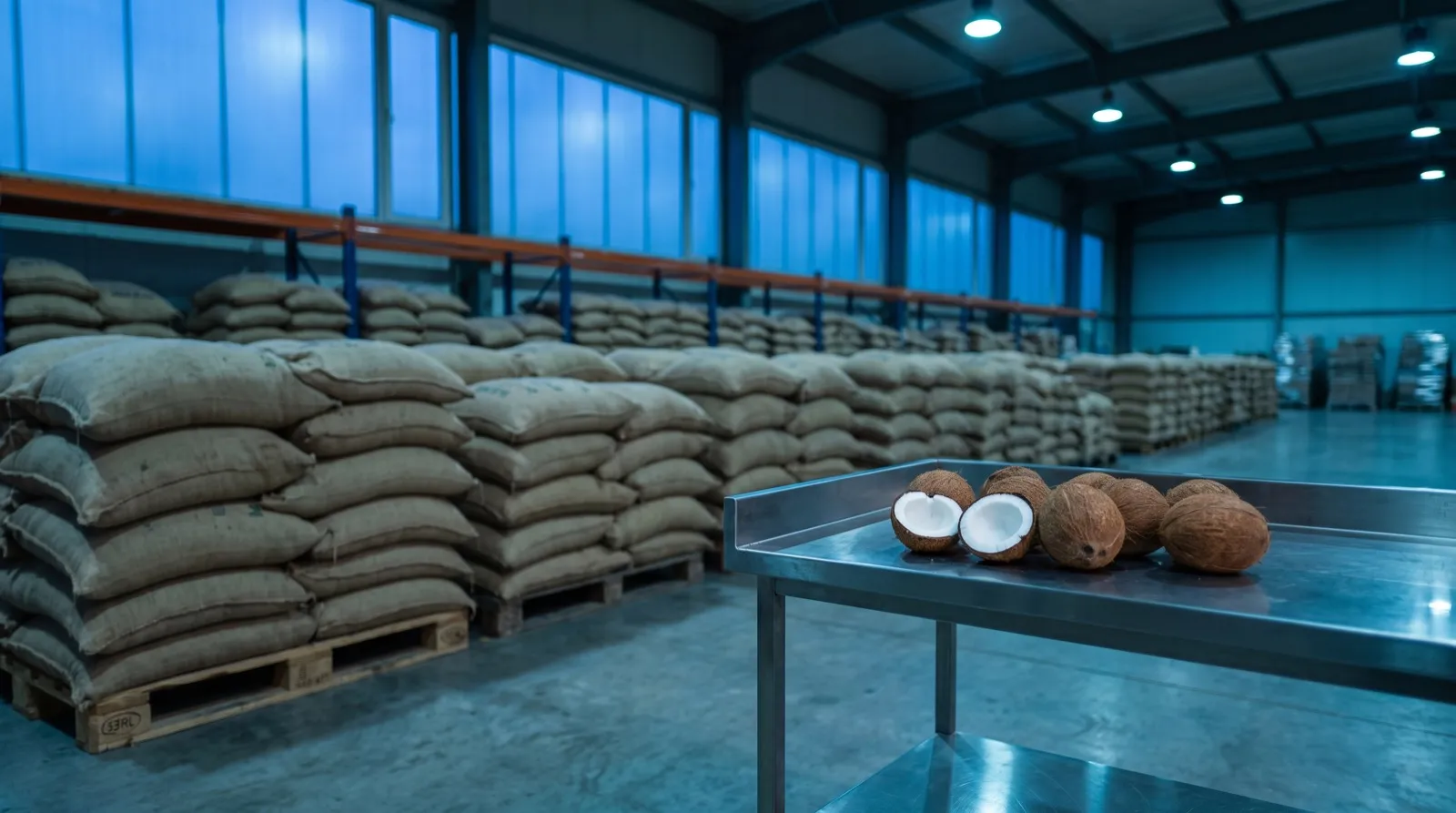
For processed coconut, the certification premium is not a published number. Fairtrade International’s price table carries no line for coconut oil, desiccated coconut, coconut water, milk or sugar, and sets no minimum price for coconut from Southern Asia. A buyer asking what organic or Fairtrade costs per tonne is asking for a figure no scheme prints.
What can be priced is the cost of being certified, and that splits three ways: the certificate itself, the control system underneath it, and the premium obligation on top. Most buyers budget for the first and get surprised by the second. Published fee schedules put organic audit work in the coconut origins at a few hundred euros a day. The system that produces auditable records at farm level runs roughly ten times that, per farmer, per year.
What does organic certification actually cost?
Audit day rates are public and origin-banded. CERES, a German control body certifying to EU organic, NOP and JAS, charges EUR 300 per audit day in Sri Lanka, the Philippines, Indonesia and India, and EUR 250 in Vietnam (CERES price list, 31 August 2026). An audit day is eight working hours; Singapore sits a band higher at EUR 400. Travel time bills at half rate, with flights, accommodation and laboratory work at cost.
The certificate of inspection bills separately. CERES charges EUR 63 for an EU e-COI covering one to five purchase documents, rising to EUR 200 past thirty. The Commission charges nothing for the COI itself; every coconut shipment into the EU still needs one in TRACES before release at the port (European Commission, organic trade).
Sri Lanka, the Philippines and Indonesia are not on the EU’s equivalence list, so those origins certify under the compliance regime of Regulation (EU) 2018/848. That routing decides which paperwork survives a repack, which is where the organic chain of custody usually breaks.
On the US side, a certifier’s annual fee scales with organic sales. MOSA’s 2026 schedule runs from USD 1,250 a year under USD 15,000 in sales to USD 3,784 at USD 1 to 1.5 million (MOSA 2026 fee schedule). USDA reimburses up to 75% of eligible costs, capped at USD 750 per scope, running the 2025 and 2026 programme years concurrently to a 31 December 2026 deadline (Federal Register, 6 July 2026). At the small end that cap covers most of the bill. At USD 1.5 million it covers about a fifth.
Why is the certificate the cheapest part of being organic?
Most coconut origins certify smallholders as a group, under an Internal Control System. The ICS is the group’s own inspection apparatus: field officers who visit every member farm, keep the grower register, and produce the records the external auditor samples. FiBL’s survey of group certification put the split plainly.
| Cost line, per farmer per year | Asian group, ~1,000 farmers | African group, ~600 farmers |
|---|---|---|
| ICS operating cost | EUR 85 | EUR 140 |
| External certification cost | EUR 8 | EUR 17 |
| Certificate as share of total | 9% | 11% |
Source: FiBL, Group Certification: Internal Control Systems in Organic Agriculture, 2019. Figures are not inflation-adjusted.
Field staff account for 75 to 85% of that ICS cost, at roughly one field officer per 75 farmers. External certification for an Asian group under 100 producers runs EUR 35 to 70 per farmer, falling to EUR 5 to 8 once the group passes 500. Scale collapses the certificate line and barely touches the ICS line.
Hold that ratio when a supplier quotes an organic differential. Anything paid above the conventional price is mostly funding field officers, not auditors.
Does Fairtrade set a price for coconut?
Partly, and not where most coconut trades. The current Fairtrade Minimum Price and Premium table, version 7 September 2026, carries coconut under the oilseeds standard in raw nut forms only.
| Origin and form | Minimum price | Fairtrade Premium | Valid from |
|---|---|---|---|
| Southern Asia, whole dry nut in shell, EXW | none, commercial price | 15% of commercial price | 13/07/2015 |
| South-Eastern Asia, fresh whole dry nut, EXW | none, commercial price | 15% of commercial price | 13/04/2018 |
| Western Africa, whole dry nut in shell, FOB | USD 377/MT conventional, USD 414/MT organic | USD 30/MT | 09/05/2011 |
| South America, whole dry nut in shell, FOB | USD 428/MT conventional, USD 471/MT organic | USD 30/MT | 09/05/2011 |
| Coconut oil, desiccated, water, milk, sugar | no entry | no entry | not applicable |
Source: Fairtrade Minimum Price and Premium Table, version 07/09/2026.
Three things follow. For Sri Lanka and India there is no floor price, so the obligation is a negotiated commercial price plus 15%, uncapped and moving with the market. For West Africa and South America the premium is a flat USD 30 per tonne whether the lot is organic or conventional, because the organic differential sits inside the minimum price. Most of these lines carry validity dates between 2004 and 2018, carried forward unchanged into the September 2026 table.
No processed coconut form has a line at all.
Where the scheme prices only the raw input, the Fairtrade Trader Standard requires the price to cover the minimum price of all certified inputs plus processing costs, and the premium to equal the sum of the input premiums (clauses 5.2.5 and 5.2.9, Trader Standard v3.0, 30 June 2026). The buyer builds that from nut-level figures. Two obligations new in 2026 hit cash flow rather than price: premium and differential must reach the producer within 15 calendar days of payment, and first buyers must pre-finance at least 60% of a contract on request.
The premium sits outside the price. It is paid on top, into a fund the producer organisation controls and spends on projects its members vote for. Discounts cannot be taken from it.
What does each mark cost to carry on pack?
| Scheme | On-pack cost to the brand owner |
|---|---|
| USDA Organic | No licence fee for the seal. Certifier fees only, up to 75% reimbursed to USD 750 per scope |
| Rainforest Alliance | Volume royalty: USD 10.00/MT crude coconut oil, rising to USD 10.50 from 28 October 2026 |
| Fair Trade USA | Premium USD 40/MT coconut water, USD 90/MT other processed by-products, FOB, no floor price |
| Fair for Life | Sales price at least 10% above conventional where also organic, 5% where not, plus a development fund of at least 5% of FOB |
| Fairtrade Mark | Licence fee to the national Fairtrade organisation. Rate not published |
Sources: Rainforest Alliance certification costs; Fair Trade USA prices and premiums; Fair for Life pricing guidance.
Coconut is in scope of the Rainforest Alliance standard, so premium payment is mandatory. The amount is not: RA publishes a minimum premium for cocoa and none for coconut, leaving the figure negotiated. Fairtrade’s licensing pages disclose no rate, no minimum and no tiers, and the percentages circulating online trace to Wikipedia rather than any scheme document.
Who captures the premium?
Nobody publishes enough to say for coconut specifically. There is no tier-one price series for organic versus conventional coconut oil or desiccated coconut. USDA’s own organic price data product was discontinued, with published tables stopping at 2013 (USDA ERS). Any organic coconut spread quoted as a percentage is a vendor estimate.
Volumes give a sense of scarcity. Around 2% of EU crude coconut oil imports are organic, against above 10% for virgin coconut oil, where Sri Lanka is the strongest competing origin (CBI, 5 February 2025).
One origin detail complicates the argument. Fairtrade’s own work on Sri Lankan coconut records that organic practices are already predominant on farms there, and sets a living income reference price of LKR 108 per nut, about USD 0.29 at farmgate (Fairtrade, November 2022). Where practice already complies, the premium buys documentation of what the farm was doing anyway. That cost is administrative.
Does certification pay back?
The evidence disagrees with itself. Worth knowing before repeating a supplier’s claim.
| Outcome for certified producers | Oya et al. 2018, 43 studies | Meemken 2020, 97 studies |
|---|---|---|
| Price received | +14% | +20 to 30% |
| Income from certified production | +11% | not separated |
| Total household income | +6%, not statistically significant | +16 to 22% |
| Yields | −20%, not significant | not separated |
| Wages of workers in certified production | −13%, significant | not separated |
Sources: Oya, Schaefer and Skalidou, 3ie Systematic Review 34, published in World Development 112; Meemken, Global Food Security, 2020.
The 2018 review found certification lifts the price a farmer receives and the income from the certified crop, while the effect on total household income is not statistically distinguishable from zero. Worker wages came out significantly lower. A 2020 meta-analysis of a larger body reached materially higher income figures. Both are peer-reviewed. Neither has settled it.
Recent work adds a trade-level finding. Across ten schemes and seven tropical commodities, a one-point rise in certified area share raised bilateral trade volumes by 1.17 to 2.24% while cutting export unit prices by 0.11 to 0.52%. Premiums appeared for RSPO, IFOAM, UTZ and Fairtrade at 0.61 to 1.4%, price penalties for GlobalGAP, ProTerra, Rainforest Alliance, 4C and Bonsucro (Bemelmans et al., Nature Communications 17:4752, 2 April 2026).
Demand is still growing. US organic sales reached USD 76.6 billion in 2025, up 6.8%, against 3.4% for the wider market (Organic Trade Association, March 2026). Volume growth and compressing differentials run together.
What this means for buyers
- Brand owners (C): budget the mark as well as the certificate. USDA charges nothing for the seal, Rainforest Alliance USD 10 per tonne of crude coconut oil, Fair Trade USA USD 90 per tonne on processed by-products. Fairtrade will not quote a licence rate until you apply.
- Procurement (A): for processed coconut there is no scheme rate to benchmark against. Ask the supplier to show the input-level calculation under Trader Standard 5.2.5, and check the organic differential against a conventional quote for the same spec.
- Both: treat a quoted organic premium as a claim about the ICS at origin. Ask for group size and field-officer ratio. A 1,000-farmer group carries a far lower certificate cost per farmer than a 100-farmer group.
- Both: if your origin is Sri Lanka or India, Fairtrade sets no floor price for coconut. Your exposure is the negotiated price plus 15%, and the 2026 Trader Standard adds 15-day pass-through and 60% pre-finance on request. Price the working capital alongside the premium.
FAQ
Does Fairtrade publish a minimum price for coconut oil? No. The September 2026 price table covers coconut only as whole nuts and by-products. Oil, desiccated coconut, water, milk and sugar have no entry. Processed products are priced from the sum of certified inputs plus processing costs, under Trader Standard 5.2.5.
What is the Fairtrade Premium on Sri Lankan coconut? 15% of the commercial price, with no minimum price behind it. The rate has been in force since July 2015, and is paid on top of the negotiated price into a fund the producer organisation controls.
How much does an organic audit cost in a coconut origin? EUR 300 per eight-hour audit day in Sri Lanka, the Philippines, Indonesia and India under the CERES 2026 schedule, and EUR 250 in Vietnam. Travel time bills at half rate; flights, accommodation and laboratory work are charged at cost.
Does certification raise farmer incomes? The research is split. A 2018 review of 43 studies found prices up 14%, no significant effect on total household income, and significantly lower wages for hired workers. A 2020 meta-analysis of 97 studies found household incomes 16 to 22% higher.
Certification changes the cost stack before it changes the price. Pricing a certified programme across origins? Send the desk an RFQ with the spec and the mark you need, and we will show the calculation behind the differential.