
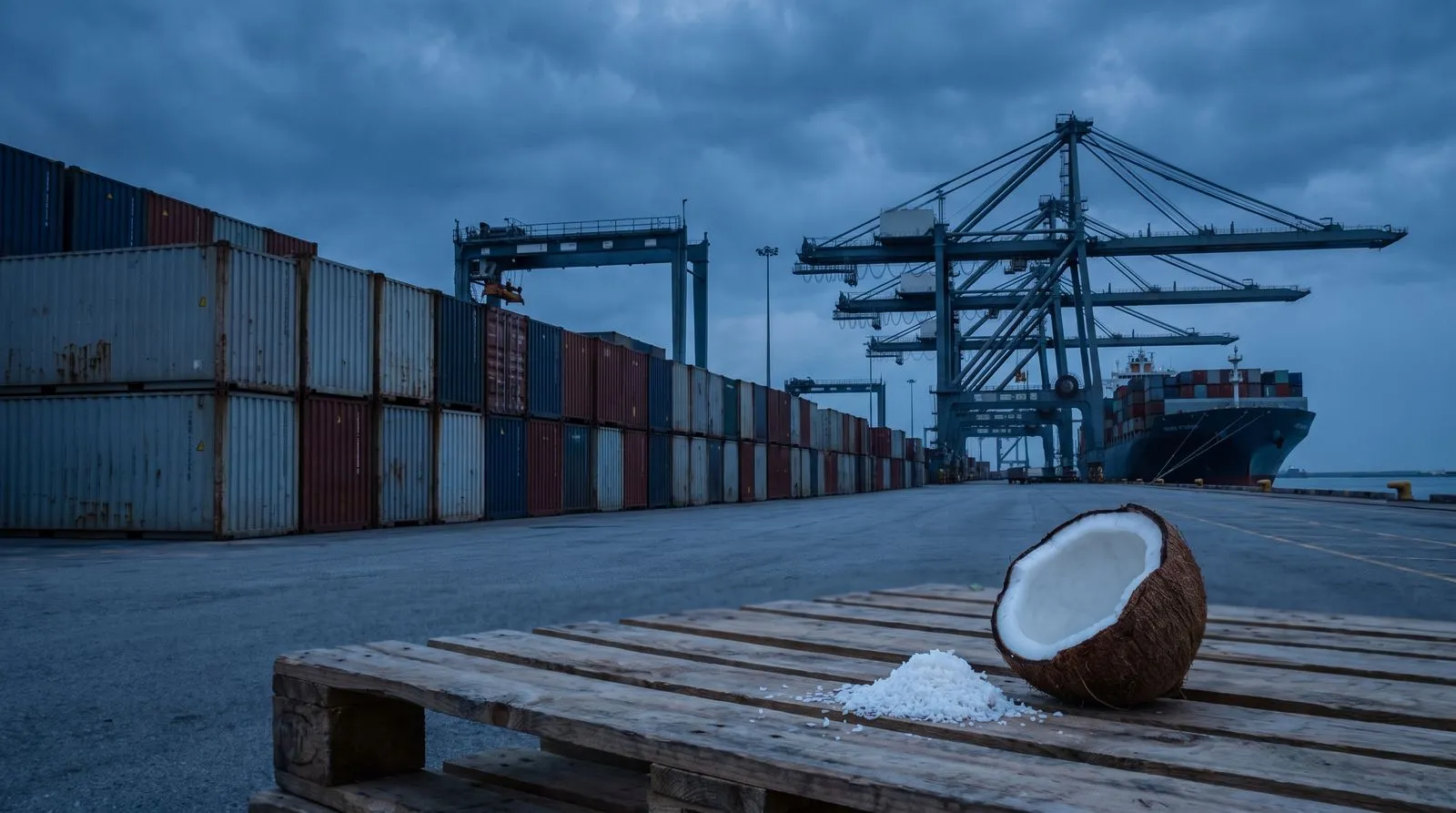
In 2027, Chinese New Year and Ramadan land in the same week. Lunar New Year falls on 6 February 2027, and Ramadan is expected to begin around 8 February. For coconut shipping, that stacks two separate shocks on one calendar: carriers pull capacity out of Asia just as Middle East buyers want their pre-Ramadan stock landed.
The practical answer for buyers is to treat mid-December 2026 to mid-March 2027 as one long risk window, not two short ones. Orders for February and March arrivals need to be placed and slotted with mills by late November. Anything left to January will compete for fewer vessels, tighter equipment and origin plants running short shifts.
Why does Chinese New Year matter if coconut isn’t shipped from China?
Carriers run Asia as one network. When Chinese exports collapse over the holiday, lines cancel whole voyages, and those loops also call at Southeast Asian and South Asian ports. A blank sailing is a scheduled voyage the carrier cancels to cut capacity. In February 2026, carriers blanked 107 sailings, 38% more than first projected, according to SEKO Logistics’ Lunar New Year 2027 planning guide published in August 2026.
Coconut cargo out of Colombo, Tanjung Priok, Manila or Ho Chi Minh City rides on those same services or on feeders connecting to them. A cancelled mainline voyage out of Singapore or Colombo rolls feeder boxes by a week or more.
Vietnam adds a direct origin effect. Tết shares the Lunar New Year date, and Vietnamese processors close for it. Buyers sourcing Vietnamese desiccated coconut or coconut milk lose both production and trucking for the core holiday weeks.
The 2027 holiday also arrives early. SEKO notes it falls 11 days earlier than the 17 February 2026 date, which compresses the production weeks after Christmas. Its guide puts the full factory shutdown at roughly 30 January to 14 February 2027, with recovery running into mid-March.
How does Ramadan change coconut demand and shipping?
Ramadan pulls demand forward. Coconut is a staple ingredient in Ramadan sweets, baked goods and drinks across the Gulf, North Africa and South Asia, and importers stock ahead of the fasting month. DP World data cited by The Media Line in February 2026 shows Gulf food imports surging six to eight weeks before the holy month.
For a Ramadan starting around 8 February 2027, that surge runs from mid-December 2026 into January 2027. It sits directly on top of the pre-Chinese New Year export rush.
European trade press flags the same pull on price. A Mundus Agri report from July 2026 noted that coconut production usually dips seasonally while demand rises towards year end and in the run-up to Ramadan, with low inventories in consumer markets adding support.
Supply-side effects follow at the end of the month. Indonesia, a major coconut origin, closes for Idul Fitri (Lebaran), expected around 10 March 2027 and confirmed by moon sighting nearer the date. Indonesia also restricts heavy trucks during the holiday exodus. In 2026, trucks with three or more axles were barred from key roads for 17 days, from 13 to 29 March, per Bisnis.com in February 2026. Container haulage to port uses exactly those trucks.
What does the 2027 holiday calendar look like for coconut buyers?
| Event | Expected 2027 dates | Origins or markets hit | What tightens | Buyer action by |
|---|---|---|---|---|
| Pre-holiday export rush | Early to late January | All Asian loading ports | Vessel space, empty containers, rates | Book space 3–4 weeks before ETD |
| Chinese New Year / Tết | Shutdown ~30 Jan to 14 Feb | Vietnam origin; Singapore and regional hubs | Blank sailings, feeder rollovers, Vietnamese production | Mill slots confirmed by late November 2026 |
| Pre-Ramadan import surge | Mid-December 2026 to early February | Gulf, North Africa, South Asia | Arrival demand, port and warehouse capacity | Cargo on water by mid-January |
| Ramadan | ~8 February to ~9 March | Indonesia and Malaysia; MEA markets | Adjusted shift patterns at some plants, slower document turnaround | Allow extra days on COA and phyto issuance |
| Idul Fitri / Lebaran | ~10 March, plus collective leave | Indonesia above all | Plant closures, heavy-truck bans to port | No Indonesian loadings planned for the Lebaran fortnight |
| Post-holiday recovery | Late February to mid-March | China-linked loops; Vietnam | Staff returning, schedules rebuilding | Add a week to ETAs through mid-March |
Dates for Ramadan and Lebaran shift by a day or two on moon sighting. The shape of the window does not.
Where do the delays actually land in the chain?
Delay usually shows up in three places, and only one of them is the ship.
At the mill. Holiday weeks mean fewer production shifts, and plants prioritise buyers who confirmed slots early. A late order can wait behind the queue for two weeks before it is even packed.
On the paperwork. Phytosanitary and fumigation certificates depend on government offices and third-party labs that also close or run reduced hours. Build in extra days for issuance rather than assuming the normal turnaround.
At the port. Blank sailings roll boxes to the next available voyage. On a weekly service, one cancellation adds seven days. Two consecutive cancellations, common in the week after Chinese New Year, add fourteen.
Stack those and a four-week door-to-door shipment becomes six or seven.
How should buyers adjust orders and contracts?
Work backwards from the date stock must be on the shelf.
Start with the arrival need for February and March 2027. Subtract transit, then add at least one extra week for rollover risk. That gives the latest safe ETD. Subtract production time plus one more week for holiday slowdowns. That is the date the mill needs a firm order, which for most February arrivals lands in late November 2026.
Contract terms matter as much as timing. On FOB terms the buyer’s forwarder owns the booking risk, so space must be secured early. On CIF the supplier books the vessel, but the buyer still carries the arrival risk if a sailing is blanked. The FCL vs LCL note covers when splitting a lot into earlier partial shipments is worth the extra per-tonne cost.
Buffer stock is the other lever. Buyers should consider lifting cover through Q1 2027 by at least the extra rollover weeks added to lead time. The safety stock guide sets out how to size that buffer from lead-time variability.
Multi-origin sourcing helps too. Sri Lankan and Philippine plants are less exposed to Tết than Vietnamese ones, and less exposed to Lebaran truck bans than Indonesian ones. Splitting a Q1 programme across two origins spreads the holiday risk.
What this means for buyers
- Procurement managers (EU, US, AU): confirm February to March 2027 volumes with mills by late November 2026. Plan no Vietnamese loadings in the Tết fortnight and no Indonesian loadings around Lebaran.
- Gulf and North Africa importers: your Ramadan stock must be on the water by mid-January. Treat any January booking as at risk of one rollover.
- Importers running multi-SKU programmes: consolidate early. A mixed container that misses one component waits for all of it.
- All buyers: add a week to every ETA through mid-March and brief customers now, not in February.
- Contract holders: check force majeure and late-shipment clauses. Public holidays are foreseeable and may not qualify.
FAQ
When is Chinese New Year 2027? Lunar New Year falls on Saturday, 6 February 2027. Factory shutdowns across China and Vietnam typically run from about 30 January to 14 February, with production and shipping schedules recovering through early to mid-March.
When does Ramadan start in 2027? Ramadan 2027 is expected to begin around 8 February and end around 9 March, with Eid al-Fitr on about 10 March. Exact dates depend on moon sighting and can shift by a day in each country.
Do blank sailings affect coconut shipments from Sri Lanka and the Philippines? Yes. Carriers cancel voyages across whole Asian networks after Chinese New Year, and coconut cargo from Colombo, Manila or Indonesian ports rides on those services or their feeders. Expect rollovers of one to two weeks.
How early should coconut buyers order for Q1 2027? Confirm mill slots by late November 2026 for February arrivals. Book ocean space three to four weeks before departure, and aim to have Ramadan-bound cargo on the water by mid-January 2027.
Does Lebaran affect Indonesian coconut exports? Yes. Plants close for Idul Fitri and collective leave, and Indonesia restricts heavy trucks on key roads. In 2026 the ban on three-axle trucks ran for 17 days in March.
Planning a Q1 2027 programme across more than one origin? Send the desk an RFQ and we will map it against the holiday calendar.