
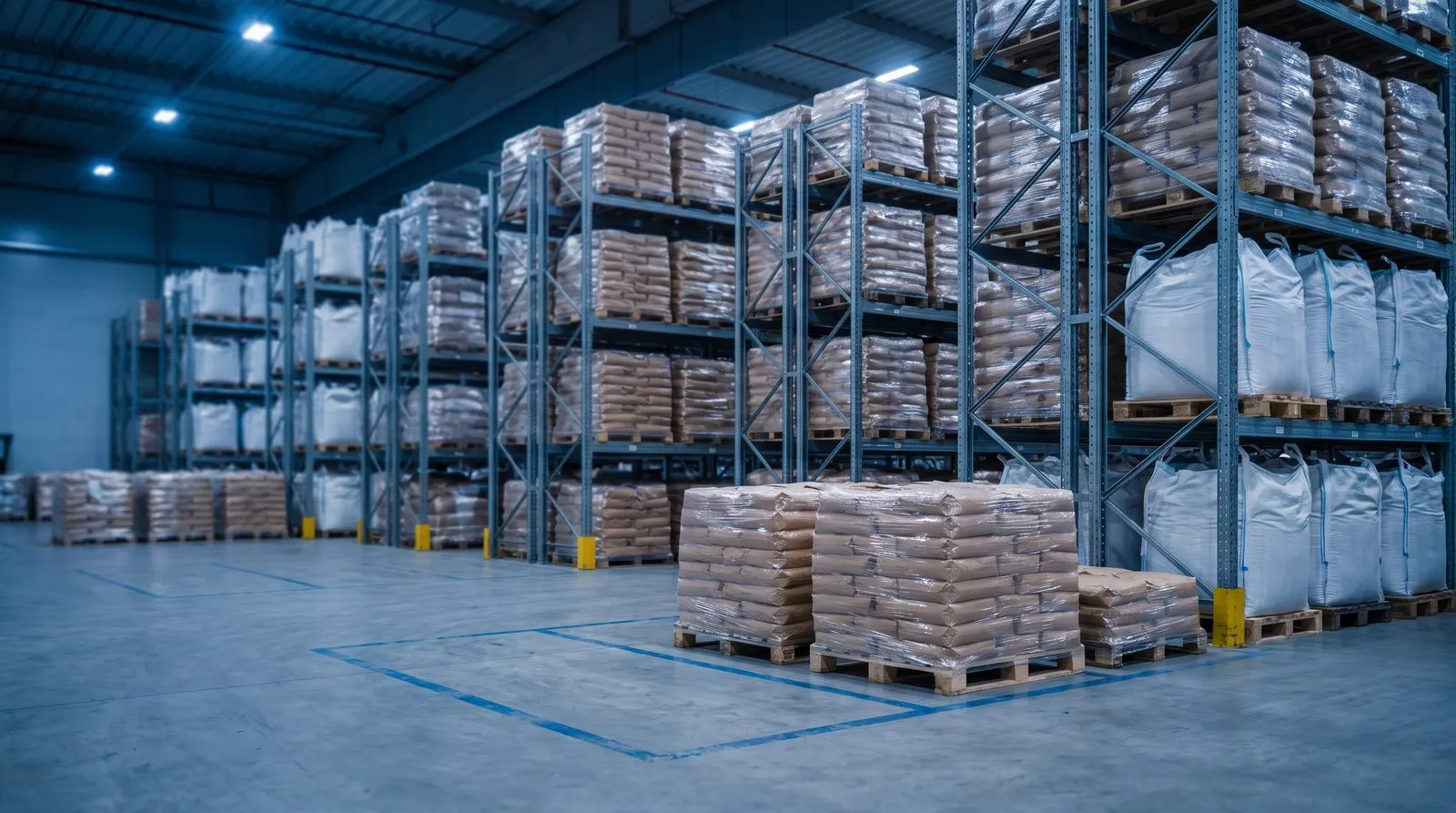
Safety stock for coconut ingredients should be sized off lead-time variability first and demand variability second. For most buyers importing desiccated coconut or coconut oil from Asia, the weeks a container can slip matter far more than the tonnes a production plan can swing. Size the buffer on demand alone and it will be too thin on exactly the shipments that go wrong.
The cost of getting it wrong is concrete. A line stoppage for want of one ingredient means spot buying at a premium, air or LCL expediting, or a missed retail window. Holding too much has a price too: working capital, warehouse space, and product ageing against its shelf life. The buffer is a trade between those two bills.
What is safety stock, and how is it different from cycle stock?
Safety stock is inventory held above expected usage to cover the gap between what you planned and what actually happens. Cycle stock is the stock you draw down between deliveries. If a 40-foot container lands every four weeks, the stock that falls from full to near-empty across those four weeks is cycle stock. Safety stock is the floor you do not plan to touch.
The reorder point sits on top of both: expected usage during the lead time, plus safety stock. When inventory hits that line, the next order goes out.
Why does lead time dominate the buffer for coconut imports?
Ocean schedules are the least predictable input in the chain. Sea-Intelligence reported global schedule reliability of 56.4% in July 2026, down 6.1 points in a month, with late vessels running an average 6.06 days behind, per a September 2026 summary of its data. That is the steepest monthly drop since January 2021.
Origin ports add their own drift. Kuehne+Nagel’s port update for late August 2026 put Colombo’s seven-day average vessel waiting time at about 1.71 days, with transshipment volumes creating connection risks. A missed feeder connection can cost a week on its own.
Add the upstream pieces: a mill running late on a production slot, a re-test after a COA query, a fumigation certificate reissued. Door-to-door lead time for an Asia–Europe coconut shipment is rarely a fixed number. It is a range, and the width of that range is what the buffer has to absorb.
How do you calculate safety stock for coconut ingredients?
Use the combined-variability formula when both demand and lead time move. SPS Commerce’s formula guide sets it out as:
Safety stock = Z × √(L × σd² + D² × σL²)
- Z is the service-level factor: 1.28 for 90%, 1.65 for 95%, 2.33 for 99%.
- L is average lead time (weeks). σL is the standard deviation of that lead time.
- D is average weekly usage (tonnes). σd is the standard deviation of weekly usage.
Pull σL from your own shipment history, measured from purchase order to goods received at your plant, not from the carrier’s quoted transit. Twelve shipments is a workable minimum. Fewer than that and the number is a guess.
A worked example: 40 tonnes a month of desiccated coconut
Take an illustrative European bakery buyer. The inputs below are hypothetical, chosen to show the mechanics, not a market benchmark.
| Input | Value |
|---|---|
| Average weekly usage (D) | 9.2 t |
| Weekly usage std. deviation (σd) | 2.5 t |
| Average PO-to-plant lead time (L) | 10 weeks |
| Lead-time std. deviation (σL) | 1.5 weeks |
The demand term is 10 × 2.5² = 62.5. The lead-time term is 9.2² × 1.5² = 190.4. Lead time contributes three times as much variance as demand does.
| Service level | Z | Safety stock | Weeks of cover |
|---|---|---|---|
| 90% | 1.28 | 20.4 t | 2.2 |
| 95% | 1.65 | 26.2 t | 2.8 |
| 98% | 2.05 | 32.6 t | 3.5 |
| 99% | 2.33 | 37.1 t | 4.0 |
Now run the demand-only version most ERP defaults use: 1.65 × 2.5 × √10 = 13.0 t at 95%. That is half the buffer the combined formula calls for.
That gap is where stockouts come from.
What service level should a coconut buyer target?
Match the service level to the cost of a stockout, not to a round number. An ingredient that stops a line or a co-manufactured run justifies 98–99%. A secondary inclusion with an easy substitute can sit at 90%.
Going from 95% to 99% in the example adds about 11 tonnes, roughly 40% more buffer, for four points of protection. The curve steepens quickly above 97%, so price each step before you commit to it.
Segment by SKU. A high-fat fine-grade desiccated coconut on a single approved supplier deserves more cover than a coconut oil you can source from three mills at a day’s notice.
What does holding the buffer actually cost?
Carrying cost is working capital plus storage plus ageing risk. Working capital is the easiest to model: tonnes held × landed cost per tonne × your cost of capital. Storage is a warehouse quote per pallet per week. Ageing is the one buyers forget.
Coconut ingredients do not sit forever. Desiccated coconut develops rancidity as it ages, and coconut milk powder picks up moisture if its packaging is compromised (see what degrades in coconut shelf life). If the buffer rotates slower than product ages, the extra tonnes turn into write-offs. Run the buffer strictly first-expiry-first-out and check that total cover (cycle stock plus safety stock) stays well inside remaining shelf life on arrival.
Can you shrink the buffer without raising risk?
Yes, by cutting lead-time variance rather than accepting it. Three levers the desk sees work in practice.
Split origins. Two qualified origins on the same spec let you pull the next order from whichever has the shorter queue. A multi-origin contract holding one spec narrows σL because one delayed port no longer delays everything.
Fix production slots. A forward contract with fixed monthly shipment windows removes the mill-side scramble from the lead time. The contract structures piece covers how forward and indexed terms differ.
Hold stock closer. Consolidated stock positioned at a regional hub cuts the variable leg from ten weeks of ocean and origin risk to a short regional delivery. Lead-time variance collapses, and so does the buffer.
Supply is also shifting. The International Coconut Community’s 2026 coconut oil outlook forecasts production of 3.025 million tonnes, up 10.8% on 2025 but still 13.5% below 2024. Better availability eases mill-side delays. It does nothing for vessel schedules.
What this means for buyers
- Procurement managers: recalculate safety stock with the combined formula using your own PO-to-plant history. If your system uses demand-only, your buffer is likely short.
- Importers and distributors: track σL by origin and by lane. The origin with the cheapest FOB price may carry the widest lead-time spread, and the extra buffer eats the saving.
- Brand owners scaling up: set service levels per SKU. Paying for 99% cover on every ingredient ties up cash that would do more on the two items that actually stop production.
- Everyone: reset the buffer at least quarterly. Schedule reliability moved six points in a single month this year.
FAQ
What is a good safety stock level for coconut ingredients? There is no universal figure. For a 95% service level with ten-week lead times swinging by 1.5 weeks, expect roughly two to three weeks of usage. Calculate it from your own usage and lead-time history.
Should I use the carrier’s transit time as my lead time? No. Use purchase order to goods received at your plant. Transit is only one leg; production slots, documents, port waits, and customs clearance all add variance the buffer must cover.
How often should safety stock be recalculated? Quarterly at minimum, and immediately after a lane disruption or a supplier change. Rolling the last 12 to 20 shipments into σL keeps the number current.
Does holding more safety stock risk quality problems? It can. If total cover exceeds a safe share of remaining shelf life, older lots age out before use. Rotate first-expiry-first-out and cap cover against shelf life.
Is it cheaper to hold stock or to shorten lead time? Usually shortening lead-time variance wins, because it cuts the buffer permanently rather than paying to carry it. Multi-origin supply and hub-positioned stock are the common routes.
Want a buffer sized against a supply plan that can actually hold it? Send the desk your volumes and lanes.