
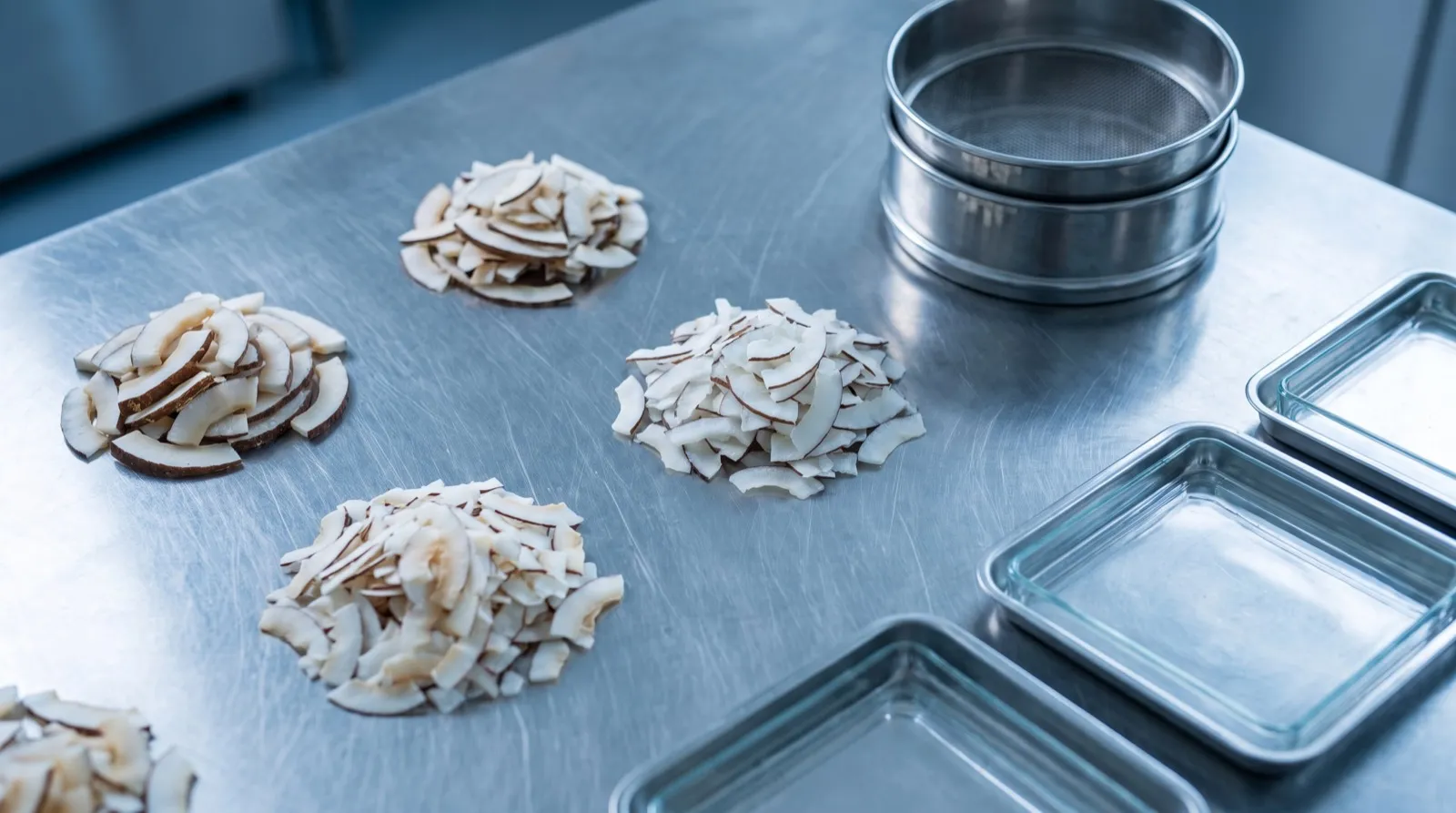
Coconut chips and flakes have no international grade definition. The Codex standard for desiccated coconut names them once, as examples of “other sized” product, and sets no dimensions for either. Toasted product sits outside the standard altogether. A buyer who orders “toasted chips” on the strength of a supplier’s product name is buying a product name with no numbers behind it.
That gap costs money in two places. A lot that arrives with the wrong cut thickness is a sorting and rework problem that no Codex clause covers. A toasted lot that arrives with the wrong roast depth or a rising peroxide value has no regulatory limit to be rejected against. The contract has to carry every number.
What does Codex actually say about chips and flakes?
Codex Standard CODEX STAN 177-1991 (revision 2011) defines three sized grades by sieve. Extra-fine: at least 90% of the weight passes a 0.85 mm square aperture, with no more than 25% passing 0.50 mm. Fine: at least 80% passes 1.40 mm, with no more than 20% passing 0.71 mm. Medium: at least 90% passes 2.80 mm, with no more than 20% passing 1.40 mm.
Everything else falls under “other sized desiccated coconut”. The standard lists “fancy cuts” there, naming tender or thin flakes, long and thin chips, extra fancy shreds, long shreds and standard shreds. It gives no sieve test, thickness or length for any of them. Sizing is also optional under the standard, so a COA can omit it and still comply.
Two terms need fixing. A chip is a long, thin or thick-cut piece of kernel, larger than any sieve-defined grade. A flake is a thin, broad piece. Both are trade words. Where a supplier’s chip is another supplier’s flake, only a written dimension settles it.
What does the standard still control on a chip or flake?
The compositional limits apply to the product as defined, whatever its cut. The table below shows what Codex supplies and what the buyer has to add.
| Parameter | Codex 177 gives | Buyer must add |
|---|---|---|
| Cut dimensions | None for fancy cuts | Length, width, thickness range, tolerance, oversize and fines limits |
| Moisture | 4% m/m maximum | A tighter figure if the cut is thick; method and sample point |
| Oil content | 60% m/m minimum (full fat); 35% to under 60% (partially defatted) | Declared fat grade on the label and COA |
| Acidity of extracted oil | 0.3% m/m maximum, as lauric acid | Same limit, stated on oil from the finished lot |
| Ash | 2.5% m/m maximum | Usually no change |
| Extraneous vegetable matter | 15 fragments per 100 g maximum | Brown skin (testa) fragments: a separate count |
| Foreign matter | Absent in 100 g | Metal detection or X-ray point, and reject size |
| Roast colour and flavour | Not covered | Colour scale, method, tolerance, flavour panel |
The Silk Chains commodity page specifies fine and medium grades to a 3% moisture maximum, tighter than Codex. The same logic applies to chips. Treat the Codex 4% ceiling as the loosest limit a contract should accept.
Why does a thicker cut change the spec?
Thickness changes how fast a piece dries and how evenly. A thin flake dries through in minutes. A thick chip can hold more water at its centre than at its surface, so the oven reading and the pack-out reading differ. Moisture on a COA is an average across a sample. A chip lot can pass on average and still contain damp pieces.
Moisture then drives the shelf-life problem. Desiccated coconut fails mainly by hydrolysis, which raises free fatty acids and the acidity figure. The shelf-life note covers the mechanism. The practical point for chips is simple. Ask for moisture tested on a ground composite and the acidity line tested on the extracted oil, both reported on the same COA. The six numbers on a COA apply unchanged.
Fat content works as it does for any other cut. A full-fat chip carries at least 60% oil under Codex. A partially defatted chip carries 35% to under 60%. Price per kilo differs, and so does price per kilo of fat. The high-fat versus low-fat comparison sets out the arithmetic.
What changes when the chips are toasted?
Toasting removes the product from the standard. Codex 177 states that it “does not cover salted, sugared, flavoured or roasted products”. No international limit therefore governs roast colour, residual moisture after roasting, or flavour.
The European market treats toasted and sweetened fancy cuts as a snack segment. CBI’s 2020 market guide describes chips, flakes, threads and shreds as toppings and cereal inclusions, with toasted and sweetened versions used increasingly as snacks. It also notes the snack segment is very small but usually pays more for bigger toasted cuts, since that is the only product eaten as it arrives.
A snack buyer tolerates less variation than a bakery buyer does. A bakery recipe hides a pale piece. A snack bag does not. So the toasted spec needs its own lines:
- Roast colour: a measured scale and tolerance, not “golden”. Agree the method before the first order.
- Moisture after roasting: a separate maximum from the raw chip.
- Peroxide value and acidity at pack-out: toasting opens the surface oil to oxidation. Set a limit at dispatch and a shelf-life window, and let the numbers come from your own QA data.
- Additives: if the product is sweetened or oiled, the carrier and any preservative are declared inputs. Check them against the destination market’s rules.
Does the kill step still apply?
Yes, and the cut raises the question. Salmonella control does not depend on grade. A roasting step can serve as a kill step, but only if it is validated: time, temperature and product load, with records. A bag labelled “toasted” proves nothing about lethality.
Australia treats the category explicitly. Its sampling plan covers dried, chipped and desiccated coconut at n=10, as set out in the kill-step note. A COA that tests five units does not meet that plan. For chips destined for ready-to-eat snack use, ask for the validation study, not only the lot result.
How should the contract describe a chip?
Write the cut as measurements and a test. Give a length range, a thickness range, a maximum share of oversize and a maximum share of fines, tested on a stated sieve set. Attach a reference sample and agree it as the golden sample. Reject by deviation from that sample plus the numbers.
The same discipline holds across origins. Two origins can both ship a “medium chip” that differ in thickness by a visible margin. A multi-origin programme holds one spec only if the spec is measured.
What this means for buyers
- Procurement (persona A): do not accept “chips” or “flakes” as a spec line. Require dimensions, tolerances and a reference sample in the contract.
- Importers and distributors (persona B): confirm which cut the supplier calls a chip before consolidating SKUs. Two suppliers’ chips will not blend cleanly.
- Brand owners (persona C): for toasted snack lines, write roast colour, post-roast moisture and oxidation limits yourself. No standard will do it for you.
- Traders (persona D): fancy and toasted cuts are priced apart from fine and medium. Quote against a stated cut and fat grade, or the spread is not comparable.
FAQ
Does Codex define coconut chips? No. Codex 177 lists “long and thin chips” and “tender or thin flakes” as examples of fancy cuts under “other sized” product. It sets no dimensions, so cut size must be specified in the contract.
Is toasted desiccated coconut covered by Codex? No. The standard excludes salted, sugared, flavoured and roasted products. Roast colour, post-roast moisture and oxidation limits have to be agreed between buyer and supplier.
What moisture should chips be bought at? Codex allows 4% m/m maximum. The desk specifies fine and medium grades at 3%. For thick chips, ask for the same or tighter and a composite test method.
Does toasting replace a kill step? Only if the roast is validated for lethality with time, temperature and load records. A “toasted” label alone is not evidence.
Need a chip or flake spec locked across origins? Send the desk an RFQ at the contact page.