
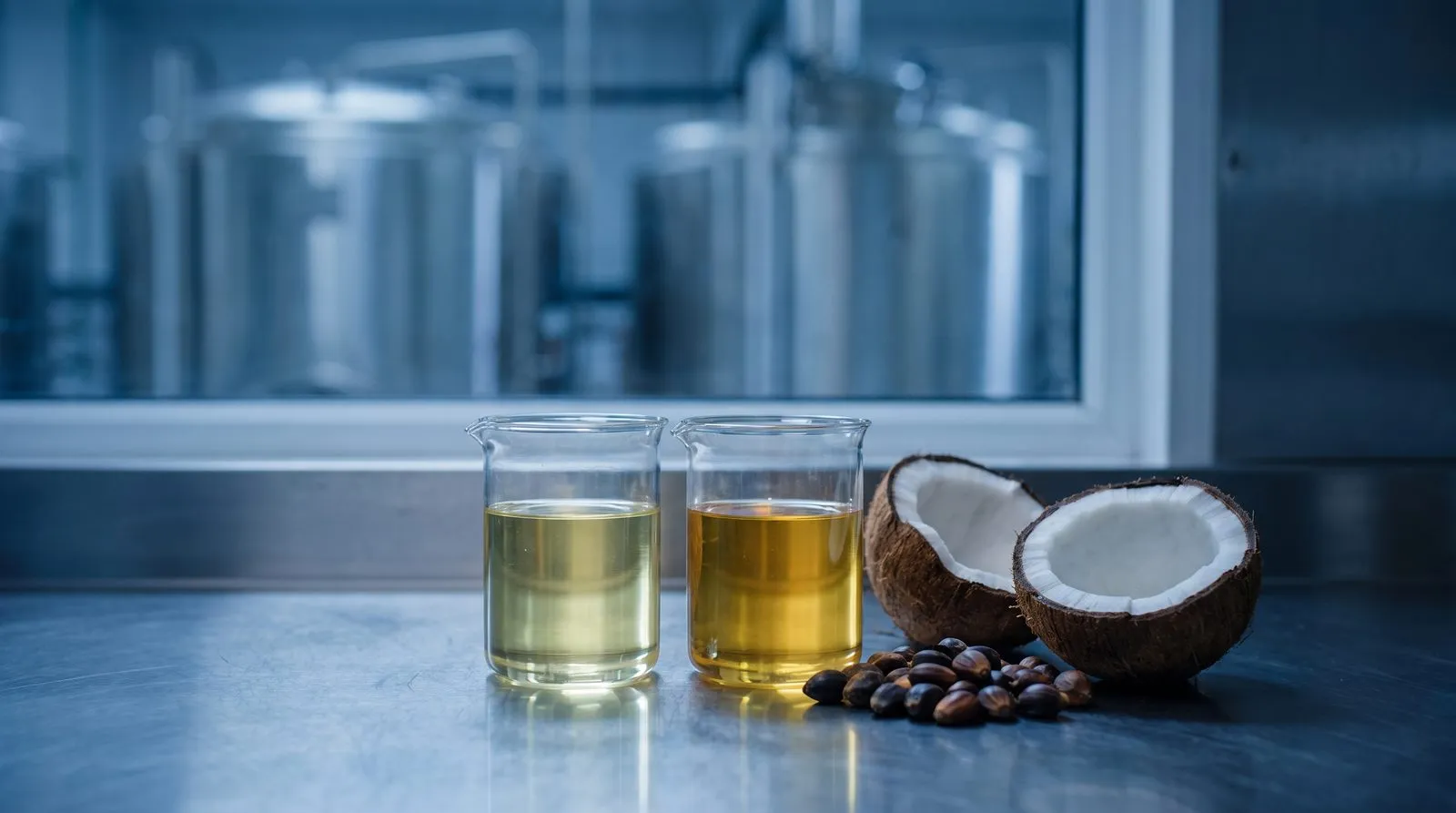
Coconut oil is the cheaper lauric oil right now, and by a wide margin. The World Bank’s September 2026 Pink Sheet put coconut oil at $1,853/t for August 2026 and palm kernel oil at $2,264/t. That $411/t discount is the substitution spread: the price gap that decides whether a formulator runs coconut oil or palm kernel oil in the same slot.
For a procurement manager buying 500 tonnes a year, $411/t is about $205,000 of annual ingredient cost. The question is whether a switch captures it, what the switch costs in validation and labels, and how long the window stays open. On current forecasts, most of the gap closes by year end.
What is the coconut oil vs palm kernel oil substitution spread?
It is the coconut oil price minus the palm kernel oil price, on a comparable delivered basis. Coconut oil (CNO) and palm kernel oil (PKO) are the world’s two lauric oils, meaning roughly half their fatty acids are lauric acid (C12:0). That shared profile lets them replace each other in soaps, surfactants, confectionery fats, creamers and coatings.
The spread has swung hard in two years.
| Period | Coconut oil ($/t) | Palm kernel oil ($/t) | CNO minus PKO ($/t) |
|---|---|---|---|
| 2024 average | 1,519 | 1,412 | +107 |
| 2025 average | 2,480 | 2,093 | +387 |
| Q2 2026 | 2,161 | 2,396 | −235 |
| July 2026 | 1,924 | 2,441 | −517 |
| August 2026 | 1,853 | 2,264 | −411 |
Source: World Bank Pink Sheet, August and September 2026 editions, CFR/CIF NW Europe basis. Spread calculated from the same tables.
Coconut oil carried a premium through 2024 and 2025. It flipped to a discount in early 2026 as the post-El Niño coconut crop recovered while palm kernel stayed tight. July was the widest print; August narrowed by about $100.
Why did coconut oil fall below palm kernel oil?
Supply moved in opposite directions. The International Coconut Community’s 2026 outlook forecasts world coconut oil output at 3.025 million tonnes, up 10.8% on 2025, led by a 20.4% rise in the Philippines. That is still 13.5% below 2024, but the direction is what priced the market.
Palm kernel went the other way. ResourceWise’s August 2026 oleochemicals review describes PKO rising fast in March and April on Southeast Asian maintenance and energy-driven logistics costs, correcting in May and June, then rebounding in July. It also expects higher biodiesel mandates in Indonesia and Malaysia to pull palm and lauric feedstock away from export.
There is a demand-side memory, too. Formulators who moved to PKO during the 2025 coconut spike did not all move back. That lag is one reason the discount opened as wide as it did.
How big does the spread need to be to justify a switch?
Bigger than most buyers assume, because the saving is recurring but the cost is front-loaded. A lauric swap is rarely a like-for-like drop-in. The two oils share lauric acid and differ elsewhere.
| Parameter | Coconut oil | Palm kernel oil |
|---|---|---|
| C8:0 caprylic (%) | 4.6 to 10.0 | 2.4 to 6.2 |
| C12:0 lauric (%) | 45.1 to 53.2 | 45.0 to 55.0 |
| C18:1 oleic (%) | 5.0 to 10.0 | 12.0 to 19.0 |
| Iodine value | 6.3 to 10.6 | 14.1 to 21.0 |
Source: Codex CXS 210-1999, Tables 1 and 2.
PKO’s higher oleic content and iodine value make it the less saturated of the two. In a filled chocolate, a whipped topping or a bar soap, that can shift texture, melt behaviour and oxidative stability enough to need a trial. Hydrogenated or fractionated grades narrow the gap, but they are separate SKUs with their own prices.
A simple test: annual volume × expected spread over the contract period, against one-off switching cost. Switching cost covers pilot runs, shelf-life validation, customer re-approval and packaging changes. A spread you expect to last one quarter rarely clears it. A spread you can lock forward for twelve months often does.
Does switching oils force a label change?
It depends on the market, and this is where US and EU buyers diverge.
In the US, 21 CFR 101.4(b)(14) lets a manufacturer list fat and oil ingredients that “may sometimes be used”, provided the label signals they may not be present with wording such as “and/or”. A label reading “coconut and/or palm kernel oil” lets the plant swap on price without reprinting.
The EU is narrower. Under Regulation (EU) 1169/2011, Annex VII Part A, refined vegetable oils may be grouped as “vegetable oils” followed by their specific origins, optionally with “in varying proportions”. That covers varying the ratio of oils actually present. It offers no clause for an oil that may be absent, so a full swap usually means new packaging.
Europe adds a second cost. Palm kernel oil at CN 1513 21 and 1513 29 falls under the EU Deforestation Regulation; coconut oil does not. From 30 December 2026, large and medium EU operators owe due diligence and geolocation on every PKO lot. We covered the scope detail in Does EUDR cover coconut?.
For an EU buyer, then, the spread understates coconut’s advantage.
When will the spread close?
Most forecasters expect it to narrow by year end. The International Coconut Community sees coconut oil at $1,850 to $1,950/t and PKO at $1,950 to $2,050/t by the end of 2026. That implies a PKO premium of roughly $100/t, a quarter of the August gap.
Three things could move it faster.
First, Philippine biofuel policy. The coconut methyl ester blend in diesel is still at 3%, with the Department of Agriculture backing a move to 5%. A higher blend would absorb domestic oil that would otherwise be exported, and each extra percentage point needs an estimated 900 million nuts.
Second, the returning formulator. Any buyer who switches back to CNO adds demand to coconut and removes it from palm kernel, narrowing the spread from both sides.
Third, weather. NOAA’s 13 August 2026 ENSO discussion flagged a strong El Niño into the northern winter. Coconut responds with roughly a year’s lag, so the risk sits in 2027 coconut supply. Palm yields can also suffer, which would leave both oils tight at once.
Indonesian domestic tenders show no palm kernel slide yet. Palm Oil Magazine reported crude palm kernel oil at IDR 30,280/kg Franco Dumai on 8 September and IDR 30,458/kg Franco Sei Mangkei on 22 September 2026.
How should buyers price a lauric contract now?
Price coconut oil on its own curve and treat the spread as a signal, not a hedge. PKO futures on Bursa Malaysia are the only listed lauric contract, and the spread moved by about $900/t between the 2025 average and July 2026. Our contract structures guide sets out why a palm kernel position is a poor proxy.
If you run PKO today and can take coconut oil, the practical move is a fixed-price forward on part of 2027 coconut oil volume while CNO sits below $1,900/t. Keep the rest indexed so a fast close of the spread does not strand you.
What this means for buyers
- Procurement managers (CPG, food): the August spread is about $411/t, but forecasts put it near $100/t by year end. Only switch on a volume you can lock forward.
- US brand owners: an “and/or” oil declaration under 21 CFR 101.4(b)(14) lets the plant act on future spreads without reprinting. Build it into the next label revision.
- EU importers and distributors: add EUDR due diligence cost to the PKO side of the comparison from 30 December 2026. Coconut’s real advantage is wider than the screen shows.
- Oleochemical and soap buyers: natural C12–C14 alcohols compete with synthetics. A cheaper coconut feed helps only if your downstream price can hold.
- Traders: watch the monthly Pink Sheet print. Two consecutive narrowing months would confirm substitution demand returning to coconut.
FAQ
Is coconut oil cheaper than palm kernel oil in 2026? Yes. World Bank data put coconut oil at $1,853/t and palm kernel oil at $2,264/t in August 2026, a $411/t discount. Coconut oil carried a premium through 2024 and 2025; the gap inverted in early 2026 as coconut supply recovered.
Can palm kernel oil directly replace coconut oil? Partly. Both are lauric oils with 45–55% lauric acid, but palm kernel oil has more oleic acid and a higher iodine value. That affects texture, melt and stability, so food and soap applications usually need a trial before switching.
Does palm kernel oil fall under EUDR? Yes. Palm kernel oil at CN 1513 21 and 1513 29 is in scope under oil palm. Coconut oil is not. Large and medium operators must comply from 30 December 2026.
Will the coconut and palm kernel spread close? Forecasts say mostly. The International Coconut Community projects end-2026 prices of $1,850–1,950/t for coconut oil and $1,950–2,050/t for palm kernel oil. That implies a gap near $100/t.
Running a lauric switch and want the coconut side priced across origins? Send the desk an RFQ.