
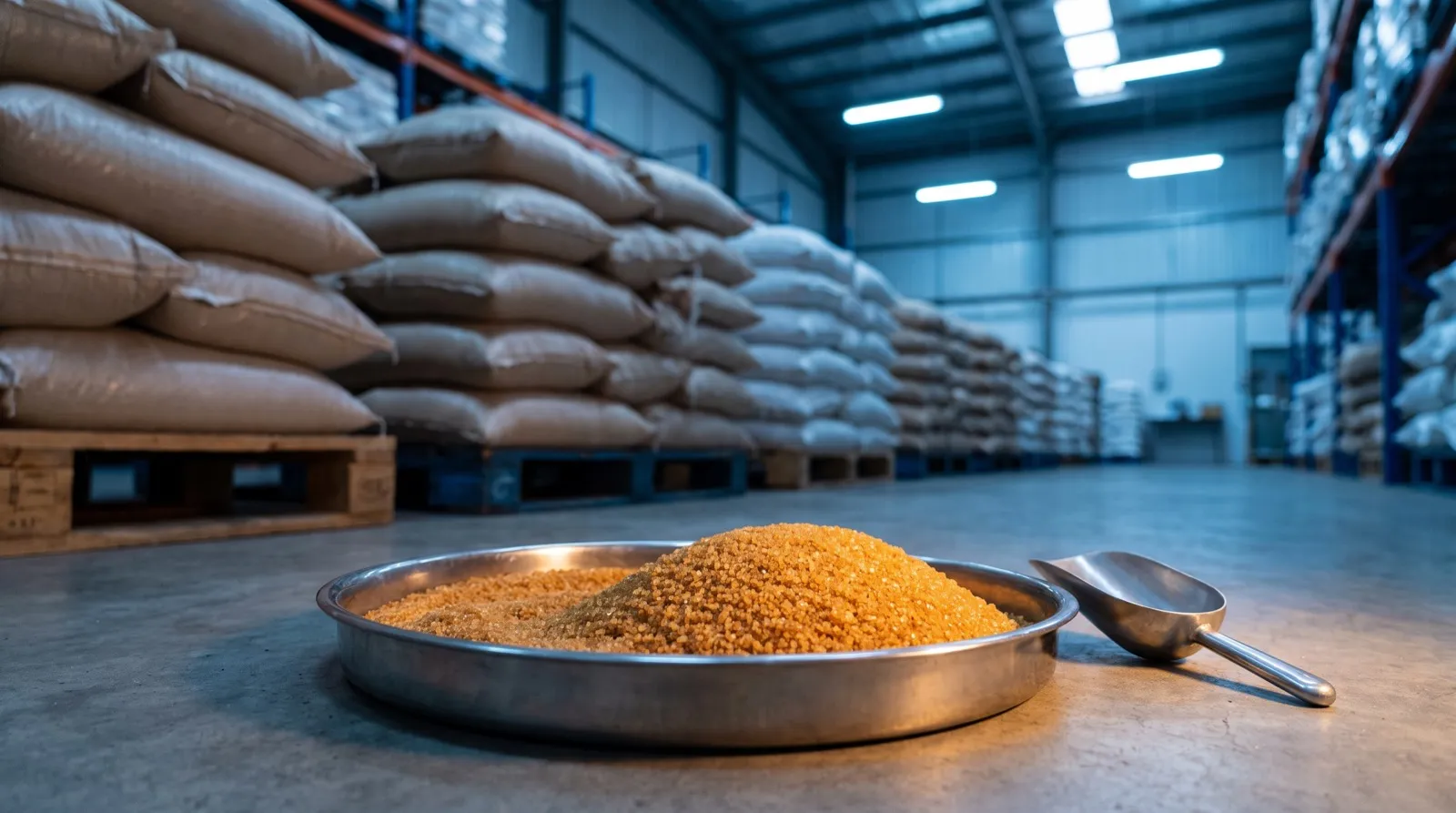
Coconut sugar has no international standard. Codex Alimentarius CXS 212-1999 names thirteen sugars and palm sugar is not one of them. That gap drives most of what goes wrong in coconut sugar sourcing: two origin countries write different specifications, the grade printed on the certificate of analysis carries no authenticity information, and the laboratory test buyers rely on was written for honey.
A laboratory at the University of East Anglia, funded by the UK Food Standards Agency, tested four retail palm sugar samples and estimated their cane sugar content at 82, 89, 81 and 69 percent. At those levels the product is cane sugar wearing a coconut label.
Is there an international standard for coconut sugar?
No. Codex CXS 212-1999 covers thirteen named products, among them white sugar, raw cane sugar, dextrose, glucose syrup, lactose and fructose. Coconut sugar, palm sugar and jaggery appear nowhere in the text.
So the contract specification is whatever the two parties write into it. Two national standards fill the gap, and they are not interchangeable.
What do the Philippine and Indonesian standards require?
| Parameter | Philippines PNS/BAFPS 76:2010 | Indonesia SNI 01-3743-1995 (granulated) | Indonesia SNI 01-3743-1995 (block) |
|---|---|---|---|
| Sucrose | 78.0 to 89.0 % | min 90.0 % (total sugars as sucrose) | max 77 % (total sugars as sucrose) |
| Reducing sugars | glucose 2.0 to 3.0 %, fructose 1.0 to 4.0 % | min 6.0 % | max 10.0 % |
| Moisture | not specified | max 3.0 % | max 10.0 % |
| Water activity | 0.5 to 0.8 | not specified | not specified |
| Ash | max 2.4 % | max 2.0 % | max 2.0 % |
| Water-insoluble matter | not specified | max 0.2 % | max 1.0 % |
| Lead | qualitative only | max 2.0 mg/kg | max 2.0 mg/kg |
| Microbiological limits | specified | not specified | not specified |
| Additives | none permitted | not specified | not specified |
Read the analyte labels before copying a number across. The Philippine standard reports sucrose. The Indonesian standard reports total sugars expressed as sucrose, which absorbs the glucose and fructose into the same figure. A buyer who lifts “sucrose 78 to 89 percent” out of the Philippine text and puts it into an Indonesian contract has written a clause neither mill can certify against.
Only the Philippine standard carries microbiological limits: Salmonella negative per 25 g, E. coli negative, and coliform, plate count and mould and yeast each below 10 cfu/g. Below 10 cfu/g is tight for an open-pan artisanal product. Quoting it is easy. Meeting it every lot is not.
One version warning. PNS 76 was revised in 2016 and SNI 3743 in 2021. Neither revision is publicly available, so the figures above come from the last openly published texts. Name the version in the contract and confirm it with the mill.
Why the grade on the certificate proves nothing
The Philippine grade ladder runs on colour and water activity. Premium class is light yellow to cream below 0.5. Class I is light brown to brown at 0.5 to 0.7. Class II is everything else clearing the minimums.
Colour is a boiling variable. Apriyantono and colleagues measured browning in coconut and palm sugar as a zero-order Maillard reaction, with the rate constant rising from 0.87 to 6.58 x 10⁻³ absorbance units per minute as pan temperature moved from 105 to 121 degrees Celsius. A mill shifts a lot from light to dark by raising the pan or extending the boil.
Colour is a dial, not a fingerprint.
Refined cane boiled in a coconut pan gives a clean Premium colour.
What makes cane substitution worth the risk?
The spread. ICE Sugar No. 11 raw sugar closed the week ending 24 August 2026 near US$377 per tonne, with London White No. 5 around US$511. Bulk coconut sugar trades at a multiple of that, but the multiple is a quoted number: no exchange lists it and no benchmark series is published.
Sap economics tightened through 2025 while that spread held. Coconut oil reached record levels near US$2,990 per tonne after global output fell about 2.5 percent year on year in 2024/25, on El Niño drought and heavy Chinese buying of whole nuts. USDA FAS reporting from April 2026 has the sector easing, with Philippine coconut oil output forecast to recover to roughly 1.60 million tonnes in 2026 from 1.36 million in 2025.
There is a customs consequence most buyers miss. US Customs classified Philippine coconut sugar under HTS 1702.90.9090 at 5.1 percent in ruling NY N035922, a line sitting outside the US sugar tariff-rate quota. Blend cane in and the lot can be pulled into the quota-controlled branch, where the over-quota rate on 1702.90.20 runs 35.74 cents per kilogram. Adulteration is a customs exposure, not only a quality one.
How is coconut sugar adulteration actually detected?
Stable carbon isotope ratio analysis. Coconut palm fixes carbon by the C3 pathway; sugarcane and maize use C4. The two leave different δ13C signatures in the finished sugar.
Rogers and colleagues, sampling 109 Indonesian producers over two years, put authentic coconut sugar at a mean δ13C of −25.6 ‰ and proposed −24.1 ‰ as the acceptance ceiling. Thirty-one of the 109 samples sat above the excess-C4 line. Cane and corn fall near −10 ‰. Against instrument precision around 0.1 ‰, a 15 ‰ separation makes detection the easy part.
The limitation is regulatory rather than analytical. No AOAC or ISO method is validated for coconut sugar. Laboratories run AOAC 998.12 or 991.41, both written for honey, adapted to palm sugar by the UEA group under Food Standards Agency funding. The honey method detects C4 sugar at or above 7 percent of total sugars, so a smaller addition sits underneath it. A supplier guarantee of zero cane content is not a testable claim.
Ask for two isotope values, not one: bulk δ13C, and δ13C of the protein fraction extracted from the same sample. The internal-standard version carries its own reference within each lot. A lone bulk figure is judged against a population, so a naturally low lot can be cut and still pass. Turnaround runs about a week.
Before commissioning any of that, read the sugar profile. Refined cane is roughly 99.5 percent sucrose with almost no free glucose or fructose, while the Philippine standard requires glucose at 2.0 to 3.0 percent and fructose at 1.0 to 4.0. The US Customs laboratory measured a Philippine lot at 83.1 percent sucrose, 2.6 percent fructose and 2.67 percent glucose on a dry basis. Sucrose above the band with flattened reducing sugars is a flag on the paperwork alone. Invert syrup defeats the screen, so it is not proof, but it costs nothing to run over a certificate of analysis.
Will the lot arrive loose or as a block?
Water activity decides it. The product is hygroscopic, which is why the Philippine standard grades on water activity at all: a ceiling of 0.8, Class I at 0.5 to 0.7, Premium below 0.5.
Nurhadi and colleagues found vacuum-dried amorphous coconut sugar began caking at water activity 0.65, and conventional crystalline product showed deliquescence at 0.75. The standard’s own acceptable band therefore overlaps the documented caking window. A Class I lot at 0.7 is fully compliant and still at risk across a six-week transit. Clause 6.3 permits no additives, so that compliant lot cannot carry the tricalcium phosphate anticaking treatment the same study shows works. The Indonesian granulated specification attacks it from the other side, capping moisture at 3.0 percent by mass.
Contract water activity at Premium level for hot lanes, specify a polyethylene-lined kraft or woven polypropylene bag, and put the reading on the pre-shipment certificate rather than only on the mill’s annual sheet. Bulk packaging matters more here than for a dry commodity.
What this means for buyers
- Procurement managers. Write the specification against one origin’s standard, name the version, and list sucrose, glucose, fructose, ash, water activity and microbiological limits explicitly. A spec copied across origins is unenforceable at arbitration.
- Brand owners. The low-GI figure on most sales sheets traces to the foreword of PNS/BAFPS 76:2010, which cites a 2006 to 2007 trade magazine article rather than a peer-reviewed study, and it has not been independently replicated. Substantiation risk for an on-pack claim sits with the brand, not the mill.
- Importers and distributors. US GSP lapsed on 31 December 2020 and has not been reauthorised, so the “Free” special rate shown on tariff lookup sites is unavailable. Reciprocal duties currently add 19 percent on Indonesian and Philippine origin. Model landed cost on the full stack, not the headline 5.1 percent.
- Compliance teams. EUDR does not cover coconut; Annex I of Regulation (EU) 2023/1115 lists cattle, cocoa, coffee, oil palm, rubber, soya and wood. The live EU deadline here is organic: since 1 January 2025 only control bodies recognised for compliance may certify in third countries, and every consignment needs a certificate of inspection in TRACES. Confirm your certifier made that transition and hold lot-level transaction certificates.
- Traders. No public price series exists and no clean export statistic does either. Origin tonnages in circulation are scraped shipment records or mis-mapped tariff baskets. Price this one on quotes.
FAQ
Does EUDR apply to coconut sugar? No. Annex I of Regulation (EU) 2023/1115 covers cattle, cocoa, coffee, oil palm, rubber, soya and wood. Coconut is absent. Buyers who also handle palm or cocoa often extend geolocation questionnaires to coconut suppliers by company policy, which makes it a contractual requirement rather than a legal one.
How much cane sugar can a laboratory actually detect? The honey method adapted for palm sugar detects C4 sugar at or above roughly 7 percent of total sugars. Smaller additions sit below the threshold. Contract to the method’s detection limit rather than to zero, because a zero-cane guarantee is not testable.
What HS code does coconut sugar use? US Customs classified Philippine coconut sugar under 1702.90.9090 at 5.1 percent in ruling NY N035922, and a UK advance tariff ruling placed it at CN 1702 90 95 00. It is not heading 1701, which is legally reserved for cane and beet sugar.
Does colour grade indicate quality? It indicates boiling conditions. Browning follows Maillard kinetics and the rate rises sharply between 105 and 121 degrees Celsius, so a mill can move a lot from light to dark at will. Philippine Premium class pairs a light colour with water activity below 0.5.
Need one coconut sugar specification that holds across Indonesian and Philippine mills, with isotope verification written into the contract? Send the desk an RFQ, or read how we qualify a new supplier first.