
Coconut prices are soft today because of rain that fell two years ago. Coconut oil averaged USD 2,480/mt across 2025 and traded at USD 1,924/mt in July 2026, down 29% from its quarterly peak, according to the World Bank Pink Sheet of 4 August 2026. That decline is the 2023-24 El Niño finally clearing the supply chain.
The next one has already started. NOAA’s Climate Prediction Center issued an El Niño Advisory on 13 August 2026 and put a very strong event at greater than 90% probability for the northern hemisphere autumn and winter of 2026-27.
For anyone pricing coconut supply, the gap between those two sentences is the trade. El Niño hits coconut supply roughly 12 months after the drought, not during it. Today’s soft tape reflects a crop that recovered. It does not reflect the crop now being set.
Where does ENSO stand in August 2026?
El Niño conditions are present and strengthening. The July 2026 Niño-3.4 index reached +1.4°C, with Niño-1+2 at +2.9°C and subsurface anomalies up to +10.0°C. CPC also recorded rainfall suppressed over Indonesia, which is the direct origin-drought signal for Southeast Asian coconut.
The forecast agreement is unusually tight. Columbia’s IRI Quick Look of 19 August 2026 puts El Niño at 100% probability from August-October 2026 through February-April 2027. The Philippine weather bureau PAGASA has run El Niño advisories since 9 June 2026 and expects conditions to persist into early 2027. CPC further estimates a 69% chance that October-December 2026 exceeds every El Niño measured since 1950.
What preceded it was mild. The 2025-26 season registered a weak La Niña, with the Oceanic Niño Index bottoming at -0.6°C. It never met CPC’s five-season threshold for a formal episode, so it is more accurate to call it La Niña conditions than a La Niña event. That distinction matters, because the recovery it delivered was real but shallow.
Why does coconut supply react a year after the drought?
Because the nut you buy was set on the tree a year ago. USDA’s Philippines Oilseeds Annual, published 16 April 2026, puts full maturity for copra and oil milling at 10 to 12 months from setting, against 6 to 7 months for young drinking nuts. Drought does its damage at flowering and nut setting. The tonnage shortfall appears when that cohort would have been harvested.
USDA states the mechanism plainly in its 2025 annual: “Since coconut production takes one year, the stressed coconut trees in 2024 are expected to soften productivity in MY 2025/26.” The same report attributes weak MY 2024/25 flowering directly to the El Niño that ran July 2023 to June 2024.
Two structural factors lengthen the recovery. Philippine plantations carry roughly 340 million standing trees, many of them senile, averaging about 40 nuts per tree per year against the Philippine Coconut Authority target of 60 or more. A stressed tree that fruits heavily in one year also underperforms the next. Damage compounds across seasons rather than clearing in one.
| Period | ENSO state | What coconut supply did |
|---|---|---|
| Jul 2023 - Jun 2024 | El Niño, ONI peak +2.0°C | Flowering suppressed. Philippine copra flat at Php 34-37/kg |
| Jul 2024 - Jun 2025 | Neutral, weakening | Copra breaks out to Php 61.8/kg by December 2024 |
| MY 2025/26 | Weak La Niña conditions, ONI -0.6°C | Philippine copra output troughs at 2,600 kt. Coconut oil peaks at USD 2,727/mt |
| Aug 2026 | El Niño Advisory, Niño-3.4 +1.4°C | Crops recovering, prices soft, new drought clock starts |
What did the last El Niño cost in tonnes?
Philippine copra production fell from 2,814 thousand tonnes in MY 2024/25 to 2,600 thousand tonnes in MY 2025/26, a 7.6% decline, on USDA’s revised series. Yield dropped from 0.7927 to 0.7222 MT/ha. The forecast for MY 2026/27 is 2,650 thousand tonnes, up 1.9%.
The export number is sharper than the production number. Philippine coconut oil exports fell from 1,400 to 1,130 thousand tonnes, a 19.3% drop, before recovering to 1,190. Domestic crush absorbs the first shortfall. Export availability takes the second, larger hit. Buyers feel the cycle amplified.
Sri Lanka shows the same clock running on a different island. Coconut production rose 48.3% year on year in March-April 2026, per the Central Bank of Sri Lanka agriculture bulletin for June 2026. Desiccated nut exports over January-May 2026 reached 16,538 tonnes, up 85.6%. Coconut oil exports rose 62.8% to 21,155 tonnes. Recovery, arriving on schedule and roughly two years behind the drought.
How did the lag show up in prices?
It showed up late, then violently. Philippine farmgate copra sat at Php 34.0/kg in October 2023, during the El Niño, and barely moved through March 2024. It reached Php 61.8/kg by December 2024, an 82% rise over 14 months. Domestic crude coconut oil ran from Php 56.39/kg in November 2023 to Php 158.0/kg in April 2025, up 180%.
Prices were flat while the drought was happening.
On the world market, coconut oil decoupled from its usual substitute. The spread over palm oil widened from about USD 189/mt in 2023 to USD 1,473/mt in 2025.
| Period | Coconut oil (USD/mt) | Palm oil (USD/mt) | Spread |
|---|---|---|---|
| 2023 average | 1,075 | 886 | 189 |
| 2024 average | 1,519 | 963 | 556 |
| 2025 average | 2,480 | 1,007 | 1,473 |
| Q3 2025 (peak) | 2,727 | n/a | n/a |
| July 2026 | 1,924 | 1,101 | 823 |
Peak quarter was July-September 2025. The El Niño ended in June 2024. That is a 12 to 15 month transmission lag from the end of the weather event to the top of the price move, and it is the single most useful number in this article. Coverage decisions taken on spot conditions are consistently one crop cycle out of date. The copra cycle does the rest.
Does the end of La Niña remove the copra drying risk?
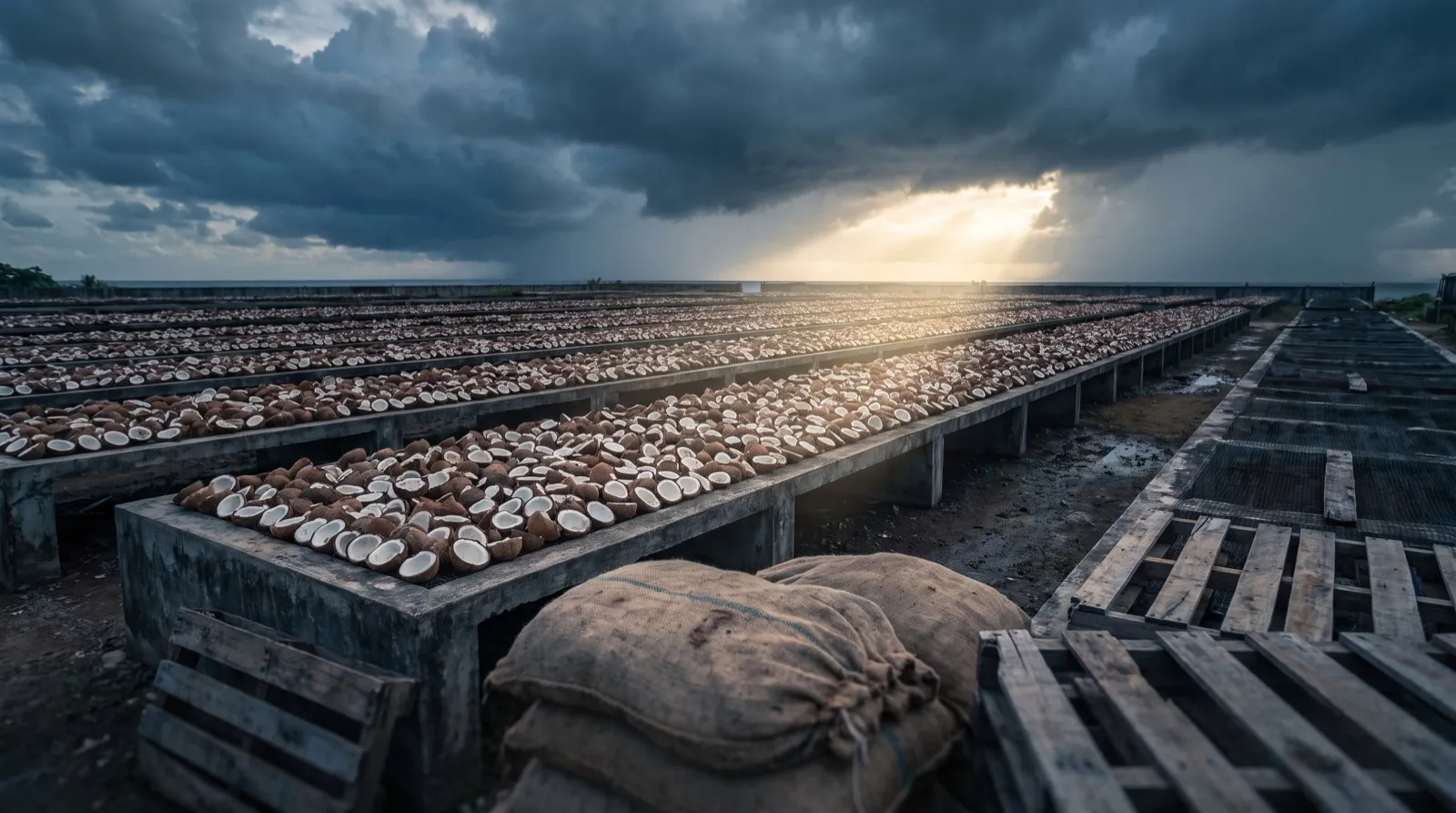
Partly, and not in the way most buyers assume. La Niña’s coconut risk was never yield. It was moisture at the drying stage. FAO guidance identifies drying to safe moisture within 48 hours of splitting the nut as the most important aflatoxin control measure, and warns that cloudy or interrupted drying carries a very high risk of aflatoxin B1. Safe levels sit at 12% moisture for sun or hot-air dried copra and 16% for smoke-dried.
El Niño does not clear that risk in the Philippines. PAGASA’s June 2026 advisory notes that western regions can still see above-normal rainfall during the Habagat when tropical cyclones enhance it, even while eastern regions dry out. Origin-level rainfall diverges. Contract-level QA should not.
USDA’s current read on Philippine crop condition is constructive: above-normal 2025 rainfall across Western Mindanao, Southern and Central Luzon, Bicol, Cagayan Valley and Eastern Visayas helped trees recover and improved nut setting. That is what supports the MY 2026/27 forecast. It is also a snapshot taken before this El Niño has done anything.
What this means for buyers
- Traders and brokers (persona D): the historical lag from event end to price peak is 12 to 15 months. A very strong El Niño peaking around December 2026 points to supply and price pressure across late 2027 and into 2028, not 2026. Current softness is the tail of the last cycle.
- CPG procurement (persona A): the window to extend cover on coconut oil and desiccated coconut is while origins are still reporting recovery. Coconut oil at USD 1,924/mt is 29% below peak and priced on a crop that is already harvested.
- Anyone single-origin on Philippines or Indonesia: CPC has already recorded suppressed convection over Indonesia. Sri Lanka and Vietnam do not share the same rainfall failure mode. Multi-origin qualification takes months to complete and should start before the shortfall, not after.
- Everyone: hold aflatoxin and moisture clauses in the contract regardless of the forecast. Drying risk is regional, not seasonal.
- Budget holders: model the coconut oil to palm oil spread separately. It ran from USD 189/mt to USD 1,473/mt in two years, and reformulation economics turn on it.
FAQ
Is it El Niño or La Niña in August 2026? El Niño. NOAA CPC issued an El Niño Advisory on 13 August 2026 with July Niño-3.4 at +1.4°C, and gives greater than 90% odds of a very strong event for the 2026-27 winter. The 2025-26 season carried weak La Niña conditions, now ended.
How long after El Niño do coconut prices rise? Roughly 12 to 15 months after the event ends. The 2023-24 El Niño ended in June 2024. Coconut oil peaked at USD 2,727/mt in the third quarter of 2025.
Why does the lag exist? Coconuts take 10 to 12 months to reach copra maturity from setting. Drought suppresses flowering and nut set. The tonnage gap appears when that cohort would have been harvested.
Does La Niña help coconut supply? For tree yield, generally yes. For copra quality, no. Excess rain slows drying past the 48-hour window FAO identifies as the critical aflatoxin control point.
Which origins are most exposed to this El Niño? Philippines and Indonesia carry the clearest signal so far, with CPC already recording suppressed rainfall over Indonesia in July 2026. Sri Lanka, India and Vietnam sit on different rainfall systems and are worth qualifying as parallel supply.
Working out how much cover to take before the next crop cycle prices in? Send the desk an RFQ and we will quote the spec across origins.