
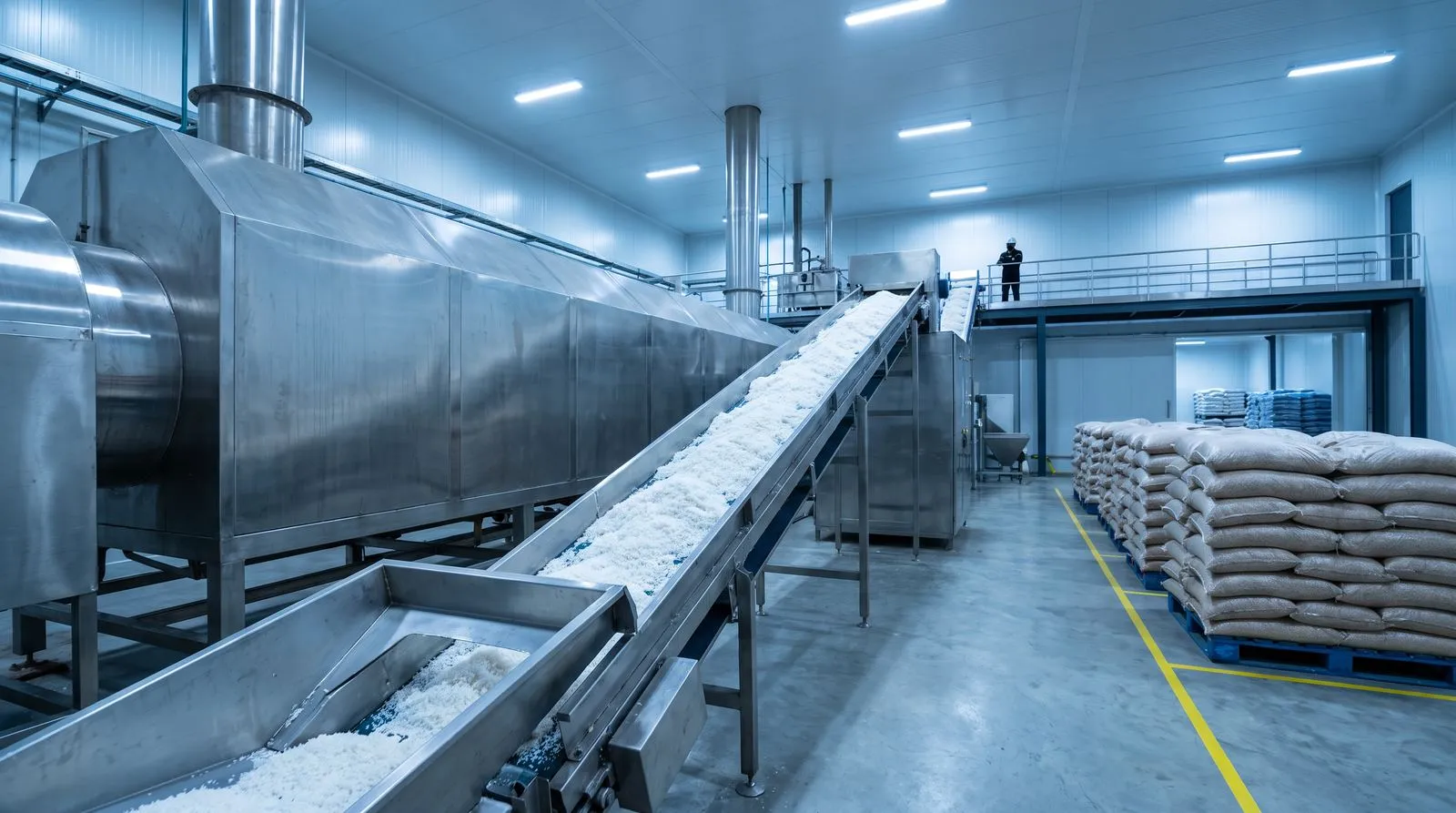
A tolling agreement is a contract in which the brand owner keeps title to the raw material and pays a processor a conversion fee to turn it into a finished ingredient. For coconut, that usually means supplying copra, nuts, wet kernel or crude oil and getting back desiccated coconut, refined oil or powder. The processor sells you capacity, not product.
The structure suits brand owners who have outgrown a co-packer’s supply but are not ready to own a plant. It also moves four risks onto your balance sheet: raw material cost, yield, inventory held at someone else’s site, and quality. Each one needs a number in the contract, not a promise.
What is the difference between tolling and buying a finished ingredient?
In a purchase contract the supplier owns the raw material, absorbs yield loss and quotes one delivered price. In a tolling agreement the principal buys the input, and the processor charges a fee per tonne of input or output. Price risk on the raw material sits with the principal.
| Term | Finished-ingredient purchase | Tolling agreement |
|---|---|---|
| Who buys raw material | Supplier | Principal (you) |
| Who owns goods in the plant | Supplier | Principal |
| Yield loss | Built into the price | Principal bears it unless capped |
| Pricing basis | One FOB or CIF price per tonne | Raw material cost plus conversion fee |
| Main control lever | Specification | Specification, yield and audit rights |
Conversion fees are agreed deal by deal. No public benchmark exists for coconut tolling in Southeast Asia, so any fee quoted without a basis (input tonne, output tonne, or processing hour) should be treated as an opening position.
Why is yield the first number to lock?
Yield decides your real cost per tonne of output. If 1,000 kg of kernel is expected to return 950 kg of product, that expectation belongs in the contract, along with what happens when the return is lower. Contract guides point out that without a written standard, parties argue about whether a shortfall was normal loss or negligence.
Write the yield as a range, state the moisture basis it is measured on, and name who weighs input and output. Then classify variances: normal loss inside the range, approved variance, rework, and unexplained difference. Each class gets a different commercial consequence.
A common trap is a clause that makes the stated yield the processor’s only obligation for loss of product. Read it twice. It can leave you paying for shrinkage that came from poor process control.
Who owns the goods while they sit in the processor’s plant?
The principal should, and the contract should say so in plain words. But ownership in a contract is not the same as ownership in an insolvency. Legal commentary on toll manufacturing warns that title to materials on a processor’s premises can be ambiguous if the processor fails, which is how a processor’s creditors end up claiming a principal’s stock.
Practical protections:
- Keep principal-owned lots physically segregated and labelled, and require inventory records that separate ownership from custody.
- Ask for a signed acknowledgement that the stock is held for the principal, and take legal advice on whether a registered security interest is available under the governing law.
- Define the point where risk of loss passes back to you, and require the processor to hold property insurance covering your stock.
What does quality control look like when you do not run the plant?
Quality stays your problem. Write the specification into the agreement as a schedule, with test methods and acceptance limits, the same way you would in a supply contract. Our note on reading a desiccated coconut COA lists the parameters worth fixing: fat, moisture, free fatty acid, microbiology.
Add three rights that a supply contract often lacks. First, audit access to the line, not just the paperwork. Second, retained samples from every production run, kept for the shelf life plus a margin. Third, a lot-coding scheme that links each output lot to the input lots that fed it; see traceability lot coding for coconut buyers.
Formulas and process settings are also yours. Confidentiality and a non-use clause stop a processor from reusing what it learned on a competitor’s run.
Why does the 2026 supply picture matter for tolling?
Because the principal buys the input, a tight raw material market lands directly on your cost. The International Coconut Community reported that Philippine coconut oil exports fell 2.6 percent to about 375,273 tonnes in January to March 2026, attributed to reduced nut availability and lower crushing activity. In the same review, Indonesian coconut oil exports rose 22.8 percent year on year to 238,856 tonnes for January to April 2026.
A processor with idle capacity in a short-nut year will accept a tolling deal. A processor running full will not discount. Check the plant’s utilisation before you negotiate the fee, and ask what happens to your volume if nut supply tightens and the plant prioritises its own contracts.
Minimum volume commitments are common in tolling. They can earn a lower fee, but they lock you into a floor even when your own demand softens. Cap the commitment at what your forecast supports and add a carry-forward for shortfalls.
What should buyers check before signing?
Short version: you are buying control, so pay for it with paperwork.
- Procurement and brand owners (personas A, C): fix yield as a range, attach the spec as a schedule, and require lot-level traceability.
- Importers and distributors (B): confirm who arranges export documents and who is exporter of record, since your customs treatment follows from that. Ask your customs broker how the processed goods are valued on entry.
- Traders and brokers (D): tolling lets you convert a position without buying finished product, but only if the fee and the yield are fixed before the input price is.
- All: confirm in writing who pays for rework, and whether any local levy or registration applies to toll arrangements in the processing country. Some producing countries have regulated these before, so check current rules rather than assume.
FAQ
Is a tolling agreement the same as contract manufacturing? Not quite. In contract manufacturing the manufacturer usually buys the materials and sells you finished goods. In tolling you supply the materials and pay a fee for the conversion.
Who bears yield loss in a tolling agreement? The principal does by default, since it owns the input. The contract can cap loss at an agreed yield range and make the processor liable above it.
Can a tolling agreement hold a multi-origin spec? Yes, if the input specification is fixed per origin and the output specification is fixed once. See holding one spec across origins.
How is the conversion fee usually set? Per tonne of input, per tonne of output, or per processing hour, with minimums. Pick the basis that matches the risk you want the processor to carry.
Need a processing route priced against a locked spec? Send the desk an RFQ through the contact page.