
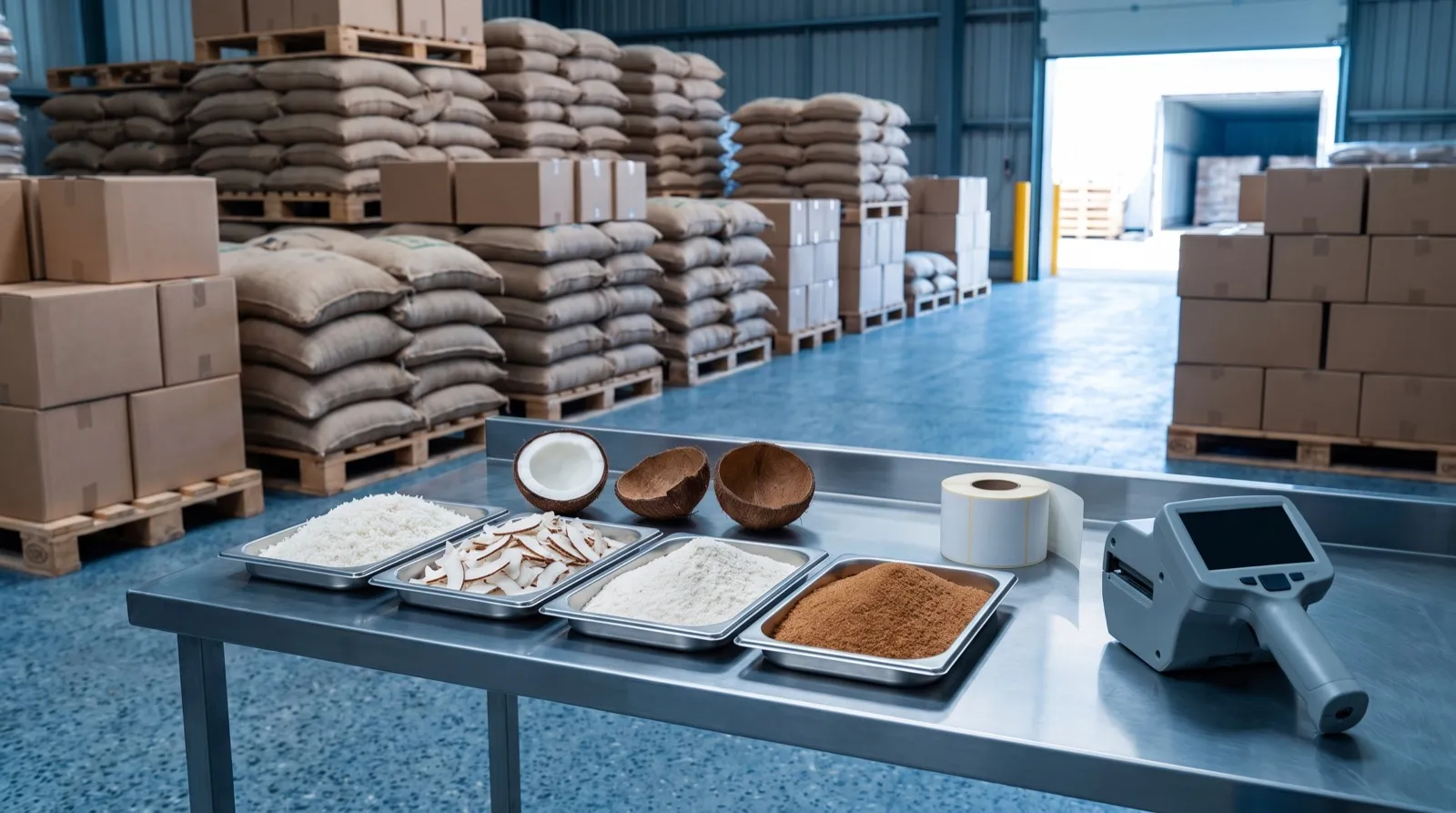
No regulation tells your coconut supplier how large a lot is. EU law defines a lot as a batch produced “under practically the same conditions” and leaves the supplier to draw the line. A month of dryer output can legally be one lot.
That decision sets how much stock you pull when a result comes back positive. Traceability and lot coding for coconut live in the purchase specification, not in the statute book. US and EU rules create an obligation to trace one step back and one step forward. Neither sets a code format, a data schema, or a response clock for plant-origin food.
The gap is measured in containers. A lot drawn per dryer shift puts 20 tonnes at risk. A lot drawn per month puts a programme at risk.
Is coconut inside the FDA Food Traceability Rule?
Mostly no, with one exception buyers miss. FSMA Section 204 applies only to foods on the Food Traceability List. The FTL entry for nut butters names coconut butter as an example, alongside almond and cashew. Whole coconut is expressly excluded from the tropical tree fruits entry.
| Coconut form | FSMA 204 FTL status |
|---|---|
| Coconut butter | In scope, named on the list |
| Desiccated, shredded, chipped | Out |
| Coconut oil, RBD and virgin | Out |
| Coconut milk and cream | Out |
| Coconut water | Out |
| Coconut flour, coconut sugar | Out |
| Whole or fresh coconut | Out, expressly excluded |
One tension sits unresolved. FDA removed coconut from its tree nut allergen list in January 2025, yet the FTL still names coconut butter as of July 2026. Nothing reconciles the two, so treat coconut butter as in scope.
The compliance date moved, and not the way it is usually reported. FDA proposed a 30 month extension on 7 August 2025 and never finalised it. Congress set the date instead, through Section 780 of H.R. 5371, which bars FDA from enforcing the rule before 20 July 2028. A rider travels with its funding cycle, so treat July 2028 as the working date rather than a settled one.
What does EU law actually require?
Article 18 of Regulation (EC) 178/2002 requires every operator to identify who supplied them and who they supplied. For plant-origin food that is the whole obligation. No lot format, no data fields, no deadline.
The prescriptive version exists, but only for food of animal origin. Implementing Regulation (EU) 931/2011 lists what must travel with a consignment: an accurate description of the food, the volume or quantity, the supplying operator’s name and address, the consignor or owner where different, the receiving operator’s name and address, a reference identifying the lot, and the date of dispatch. Coconut is plant-origin, so none of it binds. Copy the list into your specification and it becomes contractual.
Lot coding itself sits in Directive 2011/91/EU. Article 3 leaves the lot determination with the producer, manufacturer, packager or first EU seller, and requires the letter “L” as a prefix only where the code is not otherwise clearly distinguishable. Article 5 removes the separate lot indication entirely where a durability date already shows an uncoded day and month.
So a compliant coconut carton can reach your warehouse with no field your system can read as the lot. Demand the L prefix in writing.
Where does the first real lot boundary form?
At mill intake. Not at the farm, and not at the village collector.
The US Department of Labor’s September 2024 supply chain study on Philippine coconut records that copra from different farms “is co-mingled before being purchased by downstream buyers”, and that produce sold to traders is “not linked to a particular farm by any formal contract or labeling”. Local traders aggregate the output of 150 to 200 farmers. Larger consolidators reach 2,000. Around 95% of harvested trees sit on smallholder farms, three quarters of them under 2 ha. The study concludes that current coconut traceability initiatives are “largely ineffective”.
Buy the documented intake batch instead of the farm story: weighbridge ticket, intake date, and the processing batch it fed. Certification does not close the gap either. Organic has no credit or mass balance mechanism, while Rainforest Alliance permits mass balance for coconut oil at farm level. Two certificates, two different claims about physical identity. See organic chain of custody for where those chains break.
What should the lot code carry?
| Packaging level | Identifier to demand | GS1 application identifier |
|---|---|---|
| Consumer unit | GTIN plus lot | (01) and (10) |
| Case or carton | Lot plus production or expiry date | (10) with (11) or (17) |
| Pallet or logistic unit | SSCC, 18 digits, on a GS1-128 label | (00) |
The lot field, AI (10), accepts up to 20 alphanumeric characters. Most coconut suppliers use six and waste the rest. Spend them: origin code, mill, dryer line, production date. Lot coding that decodes without a lookup table survives the supplier’s staff turnover.
One claim to push back on. GS1’s Sunrise 2027 programme targets retail point of sale and explicitly excludes non-consumer units scanned in distribution. Ingredient pallets do not need 2D barcodes by 2027. The ask stays a GS1-128 logistic label.
Does a bulk oil parcel have a lot?
Yes, and hardware defines it. Codex CAC/RCP 36-1987 on bulk storage and transport of edible oils says grades should be kept separate, and that pumping new oil into old “should in particular be avoided”. It adds a line written for coconut oil buyers: “Special care should be taken to prevent adulteration between lauric oils and non-lauric oils.”
Four things make a tank lot defensible: marked tanks and pipelines, a superintendent’s written report at each loading and discharge, the three previous cargoes declared in the shipping contract, and sealed loading samples.
Does a certificate guarantee a four hour trace?
No. The four hour figure comes from one sentence in one standard, and it is a recommendation. BRCGS Food Safety Issue 9, clause 3.9.3, says traceability “should be achievable within 4 hours”. Every other sentence in that clause says shall: the test shall run at least annually, and it shall include a quantity check or mass balance.
IFS Food version 8 makes traceability a knock-out requirement, KO7 at clause 4.18.1, and publishes no hour limit. FSSC 22000 and SQF set none either. The repeated line that GFSI requires a four hour trace is folklore built on one non-binding sentence.
Write the clock into the contract if you want it.
Mass balance carries a second coconut-specific trap. No scheme publishes a numeric tolerance, so the site sets and justifies its own. Coconut loses water at every stage, so require the supplier to state the moisture basis used in the reconciliation. A mass balance with no declared wet or dry basis proves nothing.
What does lot discipline actually buy?
Scope control, at the border and in a recall.
Import Alert 23-12 applies detention without physical examination to coconut, with firms listed in Sri Lanka, India, the Philippines, Vietnam and nine other origins. Release turns on private laboratory analysis of “a representative sample(s) collected from the affected article”. The affected article is a lot. A shipper who cannot draw a lot boundary cannot scope a release test, and the container sits.
The recall side shows the same mechanic working. CFIA recalled Captain’s Choice shredded coconut on 17 April 2025 for Salmonella, a Class 1 event with reported illnesses. On 5 May 2025 it recalled Hong Kong brand shredded coconut, a different brand from a different importer, carrying the identical lot code GT0918003. Both recalls stayed at one lot. The shared code is documented in both notices; a common upstream producer is a reasonable inference, not a confirmed fact.
Without that code, the second recall is brand-wide.
What this means for buyers
- Procurement (CPG): write the lot break rule into the specification. Name the event that ends a lot, whether a dryer shift, a tank parcel or a copra intake consignment, and set a maximum lot tonnage.
- Procurement (CPG): demand the 931/2011 data set on every consignment even though coconut is exempt from it. It costs the supplier nothing and completes your one step back record.
- Brand owners: do not treat a GFSI certificate as a four hour trace guarantee. Ask for the last trace test report, its timings, and the mass balance result with its moisture basis.
- Brand owners: selling coconut butter into the US puts you inside FSMA 204 from July 2028, needing lot codes and key data elements. FSVP records are a separate obligation.
- Both: check the physical label. If the supplier leans on the durability date to carry lot identity, your receiving system has nothing unique to scan.
FAQ
Is coconut covered by the FDA Food Traceability Rule? Only coconut butter, which FDA names under nut butters on the Food Traceability List. Desiccated coconut, coconut oil, milk, water, flour and sugar are outside it, and whole coconut is expressly excluded. Enforcement is barred before 20 July 2028 by an appropriations rider.
What is a traceability lot code? Under 21 CFR 1.1310 it is a descriptor, usually alphanumeric, that uniquely identifies a traceability lot in the records of whoever assigned it. It is assigned at initial packing, first land-based receiving of seafood, or transformation. A receiver carries the existing code forward.
How long can a lot code be? The GS1 batch or lot field, application identifier (10), holds up to 20 alphanumeric characters. That covers origin, mill, line and production date in one string.
Does BRCGS require a four hour trace? No. Clause 3.9.3 of Issue 9 says traceability should be achievable within four hours, which is a recommendation. The binding parts are the annual test frequency and the mass balance. If four hours matters, make it a contract term.
Who decides how big a lot is? The supplier does. Directive 2011/91/EU leaves the determination with the producer, manufacturer or packager, and defines a lot only as production under practically the same conditions. Nothing caps it, so buyers set the ceiling in the specification and hold it across origins. See multi-origin contracts.
Need lot rules written into a multi-origin spec? Send the desk an RFQ.