
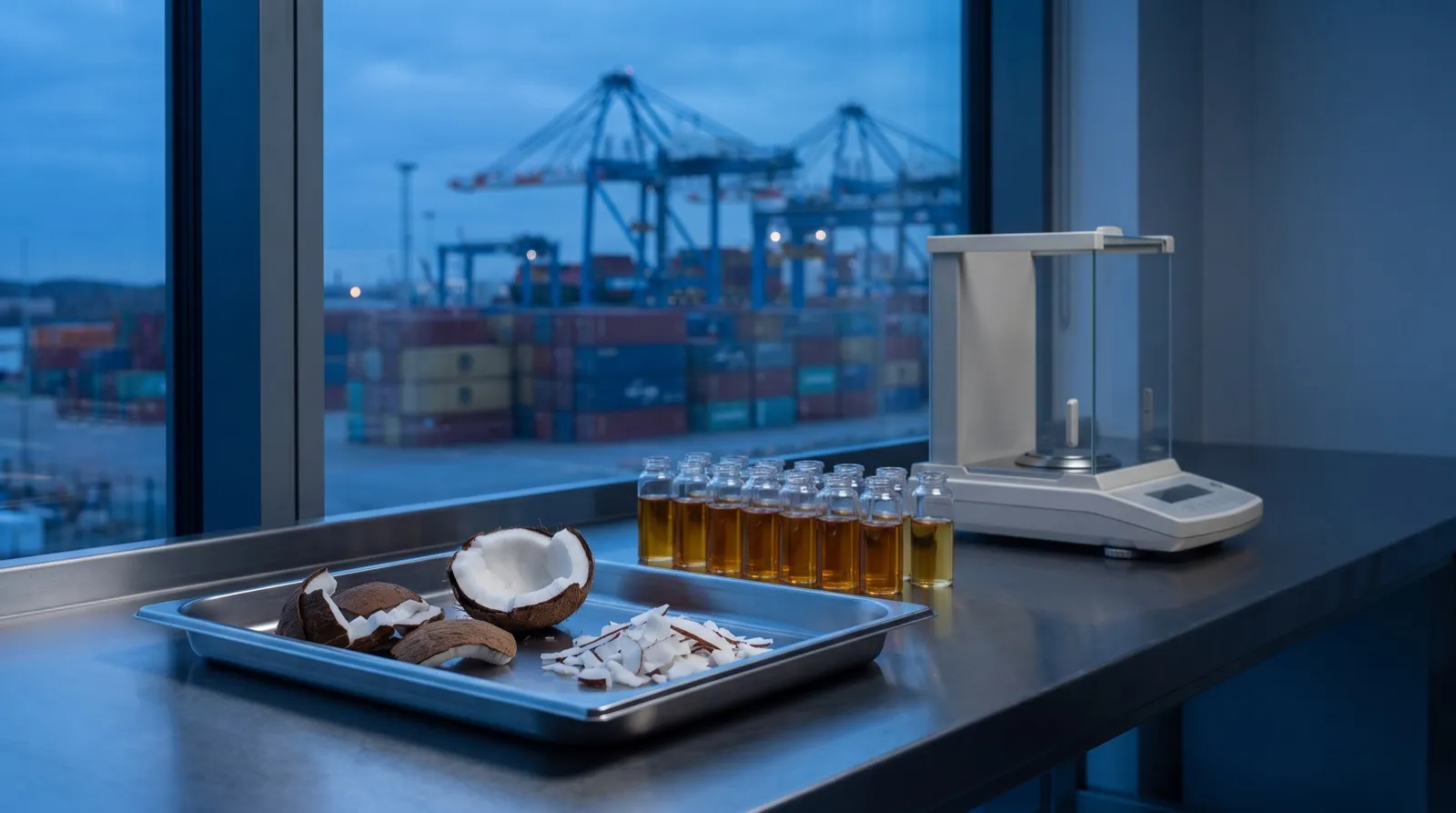
Aflatoxin in coconut ingredients is a copra problem before it is a coconut problem. The feedstock decides the risk. A 2025 survey of 85 coconut oils in Sri Lanka found aflatoxin in all 25 bulk copra oil samples, at 0.4 to 617 ppb, and in none of the 20 virgin coconut oil samples (Journal of Agricultural Sciences Sri Lanka, September 2025). Same country, same laboratory, same method. Different raw material.
That gap is worth money. In the European Commission’s 2025 Alert and Cooperation Network report, 75 per cent of product notified for mycotoxins was rejected at the border. An accredited four-aflatoxin panel costs about EUR 95 a sample. Most markets do not name coconut in their rules, so the figure that applies to your lot is a classification judgement that changes by destination.
Which coconut products carry the risk?
Feedstock splits the category in two. Copra is kernel sun-dried in the open over days. Desiccated coconut and virgin coconut oil come from fresh white kernel within hours of opening the nut.
| Product | Feedstock | Measured aflatoxin |
|---|---|---|
| Bulk copra oil, unbranded | Sun-dried copra | 25 of 25 positive, 0.4 to 617 ppb; 8% met the EU 4 ppb level |
| Branded copra oil | Sun-dried copra | 18 of 20 positive, 0.2 to 178.4 ppb |
| Virgin coconut oil | Fresh kernel | 0 of 20 positive at a 0.2 ppb detection limit |
| Coconut powder, milled | Dried copra | AFB1 in 40% of retail samples, Turkey, 2023 to 2024 |
| Desiccated coconut, coconut flour | Fresh kernel | No published survey; the low risk is structural |
Refining rescues the copra chain. Alkali neutralisation removes most of the toxin, bleaching earth adsorbs residues, and aflatoxin B1 is largely degraded above 160 degrees C during deodorisation. Crude mill oil, cold-pressed copra oil and chekku oil get none of those steps.
Why does copra decide the chain?
Contamination is set in the first two days after the nut is split. FAO’s mycotoxin HACCP manual calls drying to a safe moisture content within 48 hours of splitting “by far the most important control measure”, and records aflatoxin produced within 10 days where split meat stayed above 0.82 water activity. Fresh kernel starts near 50 per cent moisture and has to reach 6 per cent. That transit is the whole risk window.
Drying method moves the target. FAO trials found smoke-dried copra stored safely at 16 per cent moisture, while sun-dried copra had to reach 12 per cent. Philippine standards go further: split within four hours, hold 6 to 7 per cent in store, re-dry anything above 12 per cent.
Sun drying needs four or five clear days. Farmers commonly give it two or three.
One habit deserves retiring. Across 100 coconut oil samples from small mills, researchers found no correlation between free fatty acid and aflatoxin. FFA and colour remain the right indices for what degrades in storage, and say nothing about what curing created.
Which limit applies to coconut?
Most markets capture coconut through a general category. One names it outright.
| Market | Instrument | Total aflatoxins | How coconut is captured |
|---|---|---|---|
| EU | Reg (EU) 2023/915 | 4.0 ppb, B1 2.0 ppb | Not named; dried fruit and tree nut rows land on the same figure |
| EU, oils | Reg (EU) 2023/915 | No maximum level | Crude oils for refining and refined oils are expressly excluded |
| US | FDA CPG 555.400 | 20 ppb | General action level; coconut is not carved out |
| Australia, NZ | Food Standards Code Schedule 19 | 15 ppb | Listed by name in the Schedule 22 tree nut class |
| Japan | MHLW Notice 0331-5, applying 1 October 2011 | 10 ppb | All foods, with no commodity list at all |
| Codex | CXS 193-1995 | No coconut level | Named species only: almonds, hazelnuts, peanuts, pistachios, figs |
The EU list carries no catch-all row for aflatoxin, so coconut enters by analogy, and which analogy an importing member state applies is written down nowhere. The useful accident is that both candidate routes, processed dried fruit and processed tree nuts, give the same on-market figures: B1 at 2.0 ppb, total aflatoxins at 4.0 ppb. Put those in the specification and the argument never has to be had.
Japan reads as the most generous of the strict markets and behaves as the harshest. Its 10 ppb applies to all foods under the Food Sanitation Act, and results are not averaged across sub-samples. One sub-sample over the limit fails the lot, with no retest.
What to test for, and with which method
Test total aflatoxins with B1 reported separately, on copra-derived lines. Ochratoxin A does not earn a routine spec line: a 2025 Turkish retail survey detected none in any coconut powder sample, and the only positive coconut data is one study from 1993.
| Method | AFB1 limit of quantification | Time | Status |
|---|---|---|---|
| LC-MS/MS | 0.001 to 0.3 ppb | 2 hours on instrument | Confirmatory; the EU reference laboratories’ first choice |
| HPLC with fluorescence detection | 0.1 to 0.66 ppb | Hours | Confirmatory only with immunoaffinity clean-up |
| ELISA plate, lateral flow strip | 2 to 5 ppb | 6 minutes to 3 hours | Screening only |
Commission Implementing Regulation (EU) 2023/2782, applying since 1 April 2024, sets the performance floor: a limit of quantification at or below 1 ppb per aflatoxin outside infant food, recovery of 70 to 120 per cent, repeatability RSD at or below 20 per cent. Suspect screening results must be re-analysed by a confirmatory method. A strip reading down to 3 ppb cannot prove compliance with a 2.0 ppb limit. It can only tell you when to stop loading.
Ask a laboratory for its ISO/IEC 17025 scope, not its certificate. Accreditation runs per method and per matrix, and Reg 2023/2782 classes copra as a difficult or unique commodity for validation. Cover for almonds does not reach your copra.
Sampling decides the result more than the laboratory does
Mould grows in pockets, so the sample carries the error rather than the instrument. In one maize study, sampling accounted for about 95 per cent of total variance, preparation 4 per cent and analysis 1 per cent.
Reg 2023/2782 shows what a real plan looks like. For large-particle commodities, a 25 tonne lot is one sublot needing 100 incremental samples of roughly 200 g, combined into a 20 kg aggregate and split into two laboratory samples, each ground separately.
The regulation also gives the bag arithmetic. A 25 tonne container in 25 kg bags works out at one draw from every tenth bag, 100 bags opened. A supplier who pulls three bags from the container door has not sampled the lot, whatever the certificate says.
What a usable certificate states
A number on its own is not a result. The certificate should carry the method reference, the limit of quantification as a figure, the result as x plus or minus the expanded uncertainty at a coverage factor of 2, and the laboratory’s accreditation scope. “Not detected” without a stated limit of quantification is uninterpretable: under 2023/2782, results below that limit are replaced by zero when a sum is calculated, which is only auditable if the figure is printed.
Then the decision rule, where the money moves. A lot is rejected only when the result minus the expanded measurement uncertainty exceeds the maximum level, and laboratories may report a default expanded uncertainty of 50 per cent. At that default a result has to approach roughly twice the maximum level before the lot formally fails. A contract that says “must not exceed the maximum level” has accepted that headroom without pricing it. State whether the acceptance test applies uncertainty, and at what value, alongside the rest of what the certificate has to prove. Accredited panels run 10 business days to two weeks, so book the test into the shipping schedule.
What this means for buyers
- Buying oil: put the aflatoxin clause on copra-derived lines. RBD and virgin coconut oil are low risk by process and feedstock. Crude, cold-pressed and wood-pressed copra oils are not.
- Buying desiccated coconut or flour: the feedstock is fresh kernel, so aflatoxin is not the governing hazard. Spend the budget on the Salmonella kill step.
- Shipping to several markets: the US sits at 20 ppb, Australia and New Zealand at 15, Japan at 10, the EU at 4. Hold the tightest figure as one house spec rather than running four.
- Qualifying a supplier: ask for the 17025 scope covering aflatoxins in that matrix, and the sampling plan used. A results-only certificate is not a verification record.
FAQ
Is desiccated coconut a source of aflatoxin? Rarely. It is made from fresh white kernel dried within hours, not copra cured in the open, and no published survey reports aflatoxin in it. Its governing hazard is Salmonella.
Does refining remove aflatoxin from coconut oil? Largely. Alkali neutralisation is the main removal step, bleaching earth adsorbs residues, and deodorisation above 160 degrees C degrades aflatoxin B1. Crude and cold-pressed copra oils skip all three.
Does the EU set an aflatoxin limit for coconut? Not by name. Coconut is absent from Annex I of Reg (EU) 2023/915 and there is no catch-all food row. The processed dried fruit and tree nut rows both give B1 2.0 ppb and total 4.0 ppb.
Need one aflatoxin clause that holds across origins and markets? Send the desk an RFQ.