
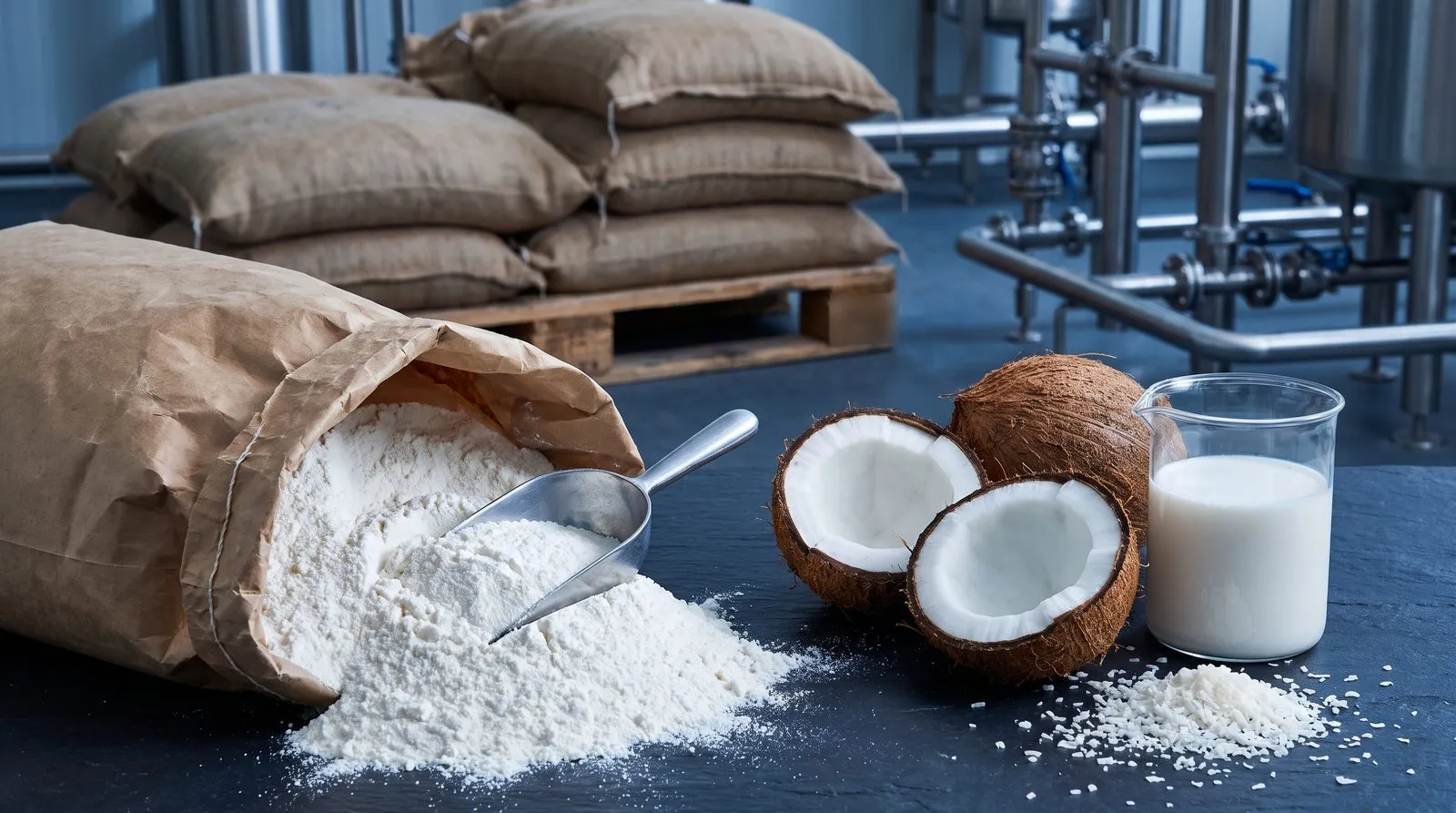
Coconut milk powder carriers decide three things on a brand owner’s label: whether the pack can say vegan, whether it needs a milk allergen declaration, and how long the ingredient list runs. Conventional powder is roughly 61% fat. Fat at that level will not spray-dry into a free-flowing powder without help, so processors add maltodextrin as a drying aid and sodium caseinate as an emulsifier. Sodium caseinate is a milk protein.
That single ingredient is why a product made from coconut and water can fail a dairy-free claim. The plant-based alternative swaps the caseinate for gum acacia and sources the maltodextrin from tapioca. A third option drops added carriers almost entirely and relies on coconut solids.
Each route changes the price per kilo of fat, the shelf-life claim and the paperwork. Below: what each carrier does, what it costs on the label, and what to write into the spec before the first container.
Why does coconut milk powder need a carrier at all?
Because the fat is too high to dry alone. The Tetra Pak Coconut Handbook puts spray-dried powder at about 61% oil, 27% carbohydrate, 7% protein and 0.2–0.8% moisture, with coconut fat on a solids basis reaching 79% (Tetra Pak). Its summary is blunt: maltodextrin is required for the spray-drying operation, and casein stops the powder lumping.
The mechanism is encapsulation. Protein coats each oil droplet, and carbohydrate forms a glassy shell around it as water flashes off in the dryer. Fat that escapes the shell sits on the particle surface. This free fat sticks particles together, oxidises faster and slows dispersion in water.
Sodium caseinate is the industry’s default because it does this job better than most alternatives. A Journal of Dairy Science review of spray-dried dairy-like emulsions found powders made with sodium caseinate showed the lowest surface-fat coverage regardless of homogenisation conditions (Vega and Roos, 2006). Coconut-specific work uses surprisingly little of it: one 2021 study dried coconut milk with 1–2% sodium caseinate and 8–9% maltodextrin at 140–180°C and held powder moisture under 5% at every temperature (Journal of Food Science and Technology).
What is actually in a conventional powder?
Three ingredients. An Australian distributor specification for a Philippine or Malaysian powder lists coconut milk, maltodextrin and milk protein (sodium caseinate), with fat at minimum 60%, moisture at maximum 2.5%, pH 5.90–6.40 and a 12-month shelf life at ambient (Superior Food Services, COCO470). Its allergen line reads: contains milk derivatives.
Carrier loadings are not standardised. Research formulations range from the 1–2% caseinate noted above to 4% caseinate with 17.5% maltodextrin. Ask for the split, because every point of maltodextrin is a point less coconut.
| Carrier system | Typical ingredients | Label consequence | What it protects |
|---|---|---|---|
| Conventional | Coconut milk, maltodextrin (usually maize), sodium caseinate | Milk allergen declaration; no vegan or dairy-free claim | Lowest surface fat, best-proven flow and dispersion |
| Plant-based | Coconut milk, tapioca maltodextrin, gum acacia | Vegan, kosher pareve possible; two added ingredients | Acceptable flow; encapsulation depends on the gum |
| Coconut-solids-led | Dehydrated coconut milk, minimal or no added carrier | Shortest list; “maltodextrin-free” marketing | Least buffer against caking and oxidation |
The Codex standard for aqueous coconut products permits maltodextrin and sodium caseinate in coconut milk and cream, but its scope is packaged liquid product, not powder (CXS 240-2003). No Codex compositional standard covers the powder. The contract spec is the standard.
What does sodium caseinate do to your label?
It makes the product a milk-containing food in every major market. In the United States milk is a major food allergen, so the pack needs a “Contains: Milk” statement or the source named in the ingredient list. If the pack also says nondairy, FDA regulation requires the caseinate to be followed by a parenthetical such as “a milk derivative” (21 CFR 101.4(d)).
“Dairy-free” is less protected than buyers assume. The FDA has no regulatory definition of the term, and the Food Allergy Research and Resource Program has identified products labelled dairy-free that contained milk protein (FARRP). A brand that prints dairy-free over a caseinate powder is relying on the absence of a definition, not on compliance.
The EU is stricter on presentation. Milk and products thereof, including lactose, sit in Annex II of Regulation 1169/2011 and must be emphasised in the ingredient list by font, style or background colour. The only exemptions are whey used for distillates and lactitol (University of Manchester summary). Sodium caseinate is not exempt. Our earlier note on coconut allergen labelling in the US and EU covers the coconut side of the same panel.
Undeclared caseinate is a recall trigger. FDA notices for undeclared milk as sodium caseinate appear regularly, including one where the ingredient entered a product through a breakdown in the company’s own packaging process (FDA). For a co-manufactured brand, that is the scenario to spec against. Religious certification follows the same line: a caseinate powder is kosher dairy, not pareve, as our halal and kosher note explains.
What do clean-label carriers look like in practice?
Native Forest’s retail powder lists coconut milk, tapioca maltodextrin and gum acacia, the dominant plant-based recipe, and carries vegan, kosher pareve and non-GMO claims (Edward & Sons). Wildly Organic lists organic dehydrated coconut milk, organic tapioca maltodextrin and organic acacia fibre, states it contains no sodium caseinate, and calls the powder more than 97% coconut milk (Wildly Organic).
The reason for tapioca rather than maize is regulatory as much as marketing. Under EU Regulation 1829/2003 a food ingredient produced from a genetically modified organism must be labelled “produced from genetically modified maize” even where no GM material survives processing, unless the GM presence is adventitious and below 0.9% (EUR-Lex). Maize maltodextrin needs an identity-preserved chain or a GM label. Cassava has no commercial GM crop, so tapioca sidesteps the question.
Gum acacia brings its own supply risk. Sudan produced an estimated 100,000–150,000 tonnes a year before its war began in April 2023, and Sudan, Chad and Nigeria together ship about 95% of the world’s exports. In the 2023–2024 season Sudanese exports fell to roughly 48,000 tonnes, about 40% of pre-war levels (Radio Dabanga, February 2026). A brand that moves its carrier off milk protein has moved it onto a commodity with one dominant conflict-affected origin.
That risk sits in a small share of the recipe.
Consumer pressure pushes the other way. Innova Market Insights reported in March 2025 that 30% of global food and beverage launches carried a clean-label claim, and nearly three in four consumers reconsider purchases based on the ingredient list (Innova). Sensient told trade press in April 2025 that customers ask to avoid carriers such as maltodextrin or dextrose altogether (Food Ingredients First). That demand is behind the coconut-solids-led powders.
What changes in spec, shelf life and duty when you switch?
Fat and moisture barely move. Proof does. Sri Lankan processor Econutrena quotes 60–65% fat on a dry basis, moisture below 4%, a 24-month shelf life, and a solubility index tied to a reconstitution test on the batch rather than a general claim (Econutrena). Without caseinate, the burden of showing low free fat and clean dispersion shifts to batch data, so write a free-fat or dispersibility test into the Certificate of Analysis.
Shelf-life claims run from 12 to 24 months at ambient. The carrier is one variable among several covered in our note on what degrades in coconut ingredients. Ask for the accelerated-storage data behind the number.
Cost follows the carrier. The figures below are illustrative, not market quotes:
| Item | Conventional | Plant-based | Note |
|---|---|---|---|
| Added carrier share of powder | 10% | 10% | Research formulations run 9–22%; confirm with supplier |
| Carrier price difference | base | +$1.00/kg of carrier | Illustrative only |
| Effect on powder price | base | +$0.10/kg | Carrier share times price difference |
| Effect per kg of coconut fat (60% fat) | base | +$0.17/kg fat | Divide by fat fraction |
Carrier price moves the powder price only in proportion to the loading. The larger cost items are usually the smaller batch, the dedicated dryer run and the organic or non-GMO documentation that travels with a clean-label recipe.
Duty is the sleeper. Carriers are why powder tends to classify under HS 2106 food preparations rather than heading 2008, a gap worth 5.4 points in the United States, as set out in our powder versus liquid landed-cost note. Removing caseinate does not automatically move the code back. Get a binding ruling on the actual recipe before pricing a programme.
What this means for buyers
- Persona C, brand owner: decide the claim first, then the carrier. Vegan or pareve means no caseinate. Non-GMO without a GM label in the EU means tapioca or identity-preserved maize. Shortest list means accepting more caking risk and proving it in storage trials.
- Persona A, procurement manager: write carrier identity and percentage, fat on a dry basis, moisture, free fat and a dispersibility test into the spec. “Coconut milk powder” alone describes three different products.
- Persona B, importer or distributor: hold a caseinate SKU and a plant-based SKU separately. The allergen panels differ, and a mixed pallet invites a label error.
- Persona D, trader: gum acacia and maltodextrin are now part of your coconut exposure. A Sudan supply shock or a maize-price move reaches the powder price through a 10% loading, not a 100% one.
FAQ
Does coconut milk powder always contain dairy? No. Conventional powders use sodium caseinate, a milk protein, as the emulsifier. Plant-based powders replace it with gum acacia, and some rely on coconut solids with minimal carrier. Read the ingredient list and ask for carrier percentages in writing.
Is maltodextrin an additive or an ingredient? An ingredient. Codex lists it as a permitted ingredient in coconut milk and cream, not as a food additive. The clean-label objection is to the word and to its usual maize origin, not to its regulatory status.
Can a caseinate powder be labelled dairy-free? Not safely. The FDA has no definition of dairy-free, but milk must be declared as an allergen, and a nondairy claim requires “a milk derivative” after the caseinate. In the EU, milk must be emphasised in the ingredient list.
Does removing caseinate change the HS code? Not by itself. Classification turns on the whole recipe and packing size, and official sources disagree on where powder sits. Obtain a binding tariff ruling for the exact formulation before quoting a landed cost.
Need a carrier system locked across origins before the first dryer run? Send the desk an RFQ.