
Copra Meal and Shell Charcoal: How By-Products Move Coconut Oil
Copra meal and coconut shell charcoal move coconut oil prices at the margin, not at the core. Copra meal is a credit inside the crusher’s margin. Shell charcoal is a credit inside the whole-nut processor’s cost. When either credit shrinks, someone in the chain either pays less for copra and nuts or asks more for oil and kernel products.
For a trader, the size of that effect is the useful number. On International Coconut Community (ICC) quotes for 2026, the fall in Philippine copra meal since April is worth roughly USD 25 per tonne of coconut oil. Over the same months, Philippine millgate oil moved by more than USD 500. By-products explain the edges of a price move, and sometimes the timing of a crusher’s offer, but rarely the trend.
What are copra meal and shell charcoal?
Copra meal is the protein-rich residue left after oil is pressed or solvent-extracted from copra (dried coconut kernel). It sells mainly as animal feed. Mechanically expelled meal typically keeps 8 to 12% oil, while solvent-extracted meal keeps 2 to 4%, according to the FAO-hosted Feedipedia datasheet.
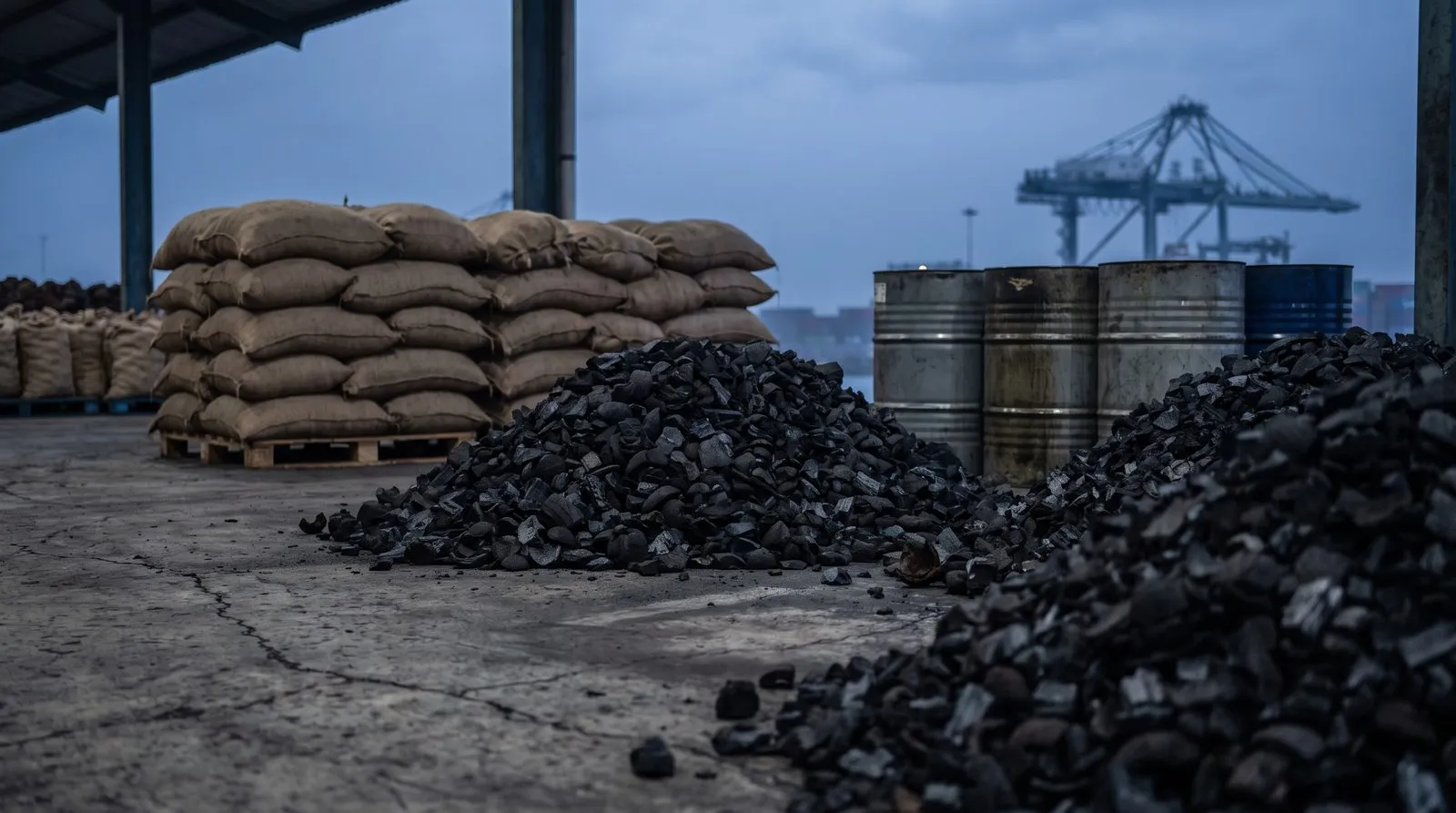
Coconut shell charcoal is the carbonised hard shell of the nut. Its main industrial buyer is the activated carbon sector, which turns it into filtration media for water treatment and air purification.
The two by-products sit in different parts of the chain. Meal belongs to the copra crusher. Shell belongs to whoever opens the nut: a copra maker, a desiccated coconut plant, or a coconut milk factory.
How much does copra meal add to a crusher’s margin?
Not much per tonne, but enough to matter when margins are thin. Feedipedia gives a typical balance of 180 kg of copra per 1,000 nuts, containing about 110 kg of oil and 55 kg of meal. That works out to roughly 0.61 tonnes of oil and 0.31 tonnes of meal per tonne of copra.
Apply ICC prices to that ratio and the meal credit becomes visible. The table uses Philippine domestic quotes from the ICC monthly price updates, in USD per tonne.
| Week (2026) | Philippine oil, millgate | Philippine copra meal | Oil value per t copra | Meal value per t copra | Meal share of output value |
|---|---|---|---|---|---|
| 4 April | 2,123 | 284 | 1,295 | 88 | 6.4% |
| 26 September | 1,999 | 234 | 1,219 | 72 | 5.6% |
| 17 October | 1,599 | 235 | 975 | 72 | 6.9% |
The oil and meal values per tonne of copra are the desk’s arithmetic from the ICC prices and the Feedipedia yield ratio. Real yields vary with copra moisture, expeller settings and whether the plant runs solvent extraction.
Meal is 6 to 7% of what a tonne of copra produces. A crusher pricing copra purchases treats it as a known offset. When meal drops USD 50 per tonne, the crusher loses about USD 15 of value per tonne of copra crushed.
That loss has to land somewhere. It either comes off the copra price the crusher bids or goes onto the oil price it offers.
Why do copra meal prices move?
Copra meal trades as a feed ingredient, so its price follows feed markets more than coconut markets. It competes with palm kernel meal and other oilseed meals in livestock rations. Strong feed demand lifts it. A heavy oilseed crush elsewhere pressures it.
The 2026 data shows the pattern. Philippine domestic copra meal fell from USD 284 in early April to USD 235 by mid-October, about 17%. Kerala meal in India fell from USD 426 to USD 326 over the same span, about 23%, per the ICC price tables.
That is a feed-side move. It also came in a year when the ICC expected Philippine coconut output to recover, and more copra crushed means more meal coming off the presses.
How does shell charcoal feed into coconut prices?
Through the cost of the nut. A desiccated coconut or coconut milk plant buys whole dehusked nuts, uses the kernel and sells the shell, often to charcoal makers. When shell charcoal is expensive, that sale offsets part of the nut cost. When charcoal falls, the offset shrinks and the plant’s kernel cost rises, even if the nut price has not changed.
Charcoal had an unusual 2025. The ICC’s April 2026 market review of coconut shell charcoal reports Indonesian charcoal above USD 1,000 per tonne in the first half of 2025, with Sri Lankan and Indian prices also at historically high levels. Sri Lanka’s activated carbon export earnings reached USD 199.1 million in 2025 on 55,404 tonnes, with export prices peaking at USD 4,575 per tonne in December 2025.
By October 2026 the raw material had cooled. ICC quotes for the week of 17 October put Indonesian domestic shell charcoal at USD 692 per tonne and Tamil Nadu at USD 1,000. Sri Lankan domestic charcoal was quoted at USD 699 a week earlier.
So the shell credit that helped whole-nut processors through 2025 is thinner now. Buyers of desiccated coconut and milk products should expect processors to cite it when they defend offers.
Do by-products ever drive the oil price?
Rarely on their own. The main drivers of coconut oil remain copra supply, weather and the spread against palm kernel oil. The ICC’s January 2026 outlook expected global coconut oil production to recover to about 3.5 million tonnes in 2026, with Philippine exports rising to around 1.25 million tonnes, per its 2026 coconut oil outlook. Those volumes set the direction.
By-products matter in three narrower cases:
- Thin crush margins. When oil and copra prices are close, a weak meal price can make crushers slow purchases, which tightens near-term oil offers.
- Competition for the nut. The ICC notes copra competes with higher-value uses such as virgin coconut oil, desiccated coconut and coconut milk. A rich shell credit makes whole-nut processing more attractive and can pull nuts away from copra.
- Origin spreads. Charcoal and meal prices differ widely by origin. India’s meal and charcoal quotes sit well above Philippine and Indonesian levels, which changes how processors in each country price their main product.
None of these overrides a weather shock. They explain why two origins quoting the same oil benchmark can behave differently in the same week.
What this means for buyers
- Traders and brokers (D): Track Philippine copra meal alongside millgate oil. A falling meal price with steady copra bids usually precedes firmer crusher oil offers. Size the effect: about USD 25 per tonne of oil for a USD 50 move in meal.
- Importers (B): When a supplier cites by-product weakness to justify an oil increase, check the arithmetic. A meal move that is worth USD 15 per tonne of copra cannot justify a USD 100 oil increase.
- Brand owners buying desiccated coconut or milk (C): Shell charcoal is no longer at 2025 peaks. Ask how the processor treats the shell credit in its costing.
- Procurement managers (A): Use benchmarks consistently. Our note on coconut price benchmarks explains which quotes to anchor contracts to, and the copra cycle sets the bigger rhythm.
FAQ
What is copra meal used for?
Copra meal is mainly an animal feed ingredient, used for cattle, pigs and poultry. It is the residue left after oil is extracted from copra. Expeller meal keeps 8 to 12% oil and solvent-extracted meal 2 to 4%, which affects its feed value and price.
How much copra meal comes from a tonne of copra?
A typical balance is about 0.31 tonnes of meal and 0.61 tonnes of oil per tonne of copra, based on Feedipedia’s figure of 110 kg oil and 55 kg meal from 180 kg of copra. Actual yields depend on copra moisture and the extraction method.
Why does shell charcoal affect desiccated coconut prices?
Desiccated coconut plants buy whole nuts and sell the shells. A high shell charcoal price offsets part of the nut cost. When charcoal falls, the plant recovers less from each nut, so its effective kernel cost rises even if nut prices are unchanged.
Where can I find copra meal and shell charcoal prices?
The International Coconut Community publishes weekly prices in its monthly price updates, covering copra meal in the Philippines and India and shell charcoal in Indonesia, Sri Lanka and India. Quotes are domestic, in USD per tonne.
Need a coconut oil offer that shows its cost logic line by line? Send the desk an RFQ.