
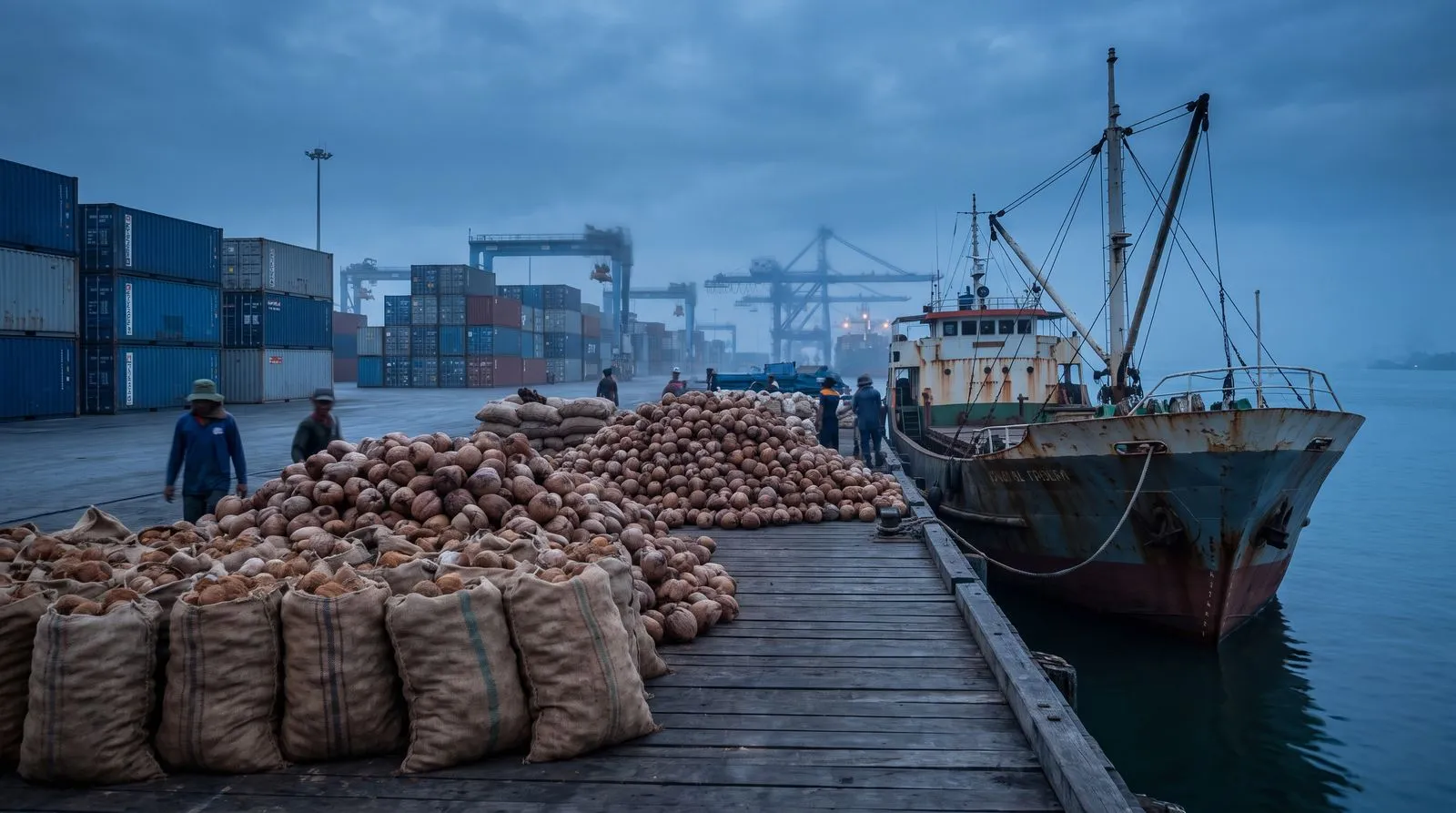
Indonesian Coconut Supply: Sulawesi, Riau and the Export Chain
Indonesia is the largest coconut-growing country by area, but a large share of its crop never reaches an international spec-driven buyer in processed form. For a trader or broker, the useful question is where the nuts are grown, who processes them, and how much reaches the export chain as copra, desiccated coconut, oil or whole nuts. This memo maps that chain and flags what to verify before a contract is signed.
The short answer: Indonesian supply is deep but fragmented, and domestic policy now matters as much as the crop. Buyers who treat it as one uniform origin tend to find out the difference in the spread between quoted and deliverable tonnes.
How big is Indonesian coconut supply?
Indonesia has about 3.37 million hectares under coconut, roughly 31% of the world total, according to figures reported by Antara and Indonesian government sources. The processing association HIPKI projected 2025 output at about 15 billion nuts, around 23% of global production, as reported by RRI.
Those are association projections, not audited statistics. Treat them as scale indicators. Smallholders, typically on tall palms, produce most of the crop, and yields per hectare are lower than on well-managed estates elsewhere.
Where do Riau and Sulawesi fit?
Riau and North Sulawesi are named among the main producing provinces, with East Java, North Maluku and Central Sulawesi also significant, per Tridge market data. The two regions serve different parts of the chain.
| Region | Typical role in the chain | What buyers ask about |
|---|---|---|
| Riau (Sumatra) | Large smallholder base, whole-nut flows, proximity to Malaysia and Singapore | Whole-nut versus processed share, collector traceability |
| North and Central Sulawesi | Traditional copra and coconut oil country, processing clusters | Copra grade, drying practice, port consolidation |
| Java and others | Domestic processing, desiccated coconut and milk plants | Plant capacity, certification, spec consistency |
The table is a buyer’s working map, not a statistical ranking. Confirm the actual origin of each lot on the documents. A lot described as Sulawesi copra may have been aggregated from several islands, and the certificate of origin is the only record that settles it. Ask for the collector or plant name alongside the province, and keep it on file for audits.
How does the export chain work?
Most Indonesian coconut leaves through three routes. Whole nuts go to nearby markets, with the Agriculture Ministry citing Malaysia as a major buyer, per a July 2026 Malaysian Palm Oil Board news summary. Copra and coconut oil feed oleochemical and food buyers. Desiccated coconut (DC, the dried, shredded kernel used in confectionery and bakery) is shipped by a smaller group of plants.
Collectors aggregate from smallholders, processors dry or crush, and exporters consolidate in containers at the port. Each hand-off is a point where moisture, aflatoxin risk and origin documents can drift.
The chain is long.
A buyer purchasing through a Singapore desk usually sees only the last two steps. The desk’s job is to push spec and document checks back to the plant and the collector, so a failed lot is caught before it is loaded rather than after it reaches the discharge port. That also gives the buyer a clean record if a claim is needed.
What do recent DC numbers say?
The International Coconut Community reported that Indonesian DC exports fell 5.8%, from 77,536 MT to 73,030 MT, in January to August 2025 against the prior year, while export value rose, per its October 2025 DC market review. The same review put Indonesian prices near USD 3,200 per tonne at the start of 2025, easing to about USD 2,975 by September.
Lower volume with a higher value tells a buyer that the market was tight on supply earlier in the year. For the Philippine comparison, see our note on desiccated coconut origins compared.
How does export policy change the picture?
Indonesia’s government has pushed to process more coconut at home. The Agriculture Ministry announced a downstreaming initiative in October 2025 aimed at reducing whole-nut exports, according to RRI. HIPKI has asked for a temporary halt to exports, and an export levy on whole nuts has been reported as under review, per Investor Trust.
We could not confirm from public reporting that a binding ban or levy is in force today. Verify the current Trade and Finance Ministry rules before pricing a whole-nut or copra cargo. Policy risk is the main reason Indonesian quotes carry shorter validity than other origins.
What should a spec lock cover for Indonesian lots?
A spec lock for Indonesian coconut should name the processing plant, the moisture ceiling, the microbiological limits and the sampling point. Moisture drives most disputes on copra and DC, because smallholder drying varies with weather. Our note on moisture and water activity sets out the limits we ask suppliers to hold.
Three clauses do most of the work. First, a plant-of-origin clause, so a lot cannot be swapped to an unaudited facility. Second, a pre-shipment sample approved by the buyer, tested by an independent lab. Third, a tolerance on moisture and free fatty acid that triggers a price adjustment rather than a rejection. Each one converts a quality argument at the port into a number agreed in advance.
For oil and DC programmes, see our commodity pages for desiccated coconut and coconut oil.
What this means for buyers
- Procurement managers (A): ask for named processing plants, not just “Indonesia” as origin, and request the COA and phytosanitary certificate per lot.
- Importers and distributors (B): build a clause that lets the contract re-price or switch origin if an export levy takes effect.
- Brand owners (C): lock the spec, including moisture and micro limits, so a change of plant does not change the product.
- Traders and brokers (D): watch domestic processor margins and the copra cycle; our copra cycle note covers the timing.
FAQ
Which Indonesian regions produce the most coconuts? Riau and North Sulawesi are named among the leading provinces, with East Java, North Maluku and Central Sulawesi also large. Figures vary by source, so check the lot’s origin documents.
Is Indonesian desiccated coconut cheaper than Philippine? Indonesian DC was quoted near USD 2,975 per tonne in September 2025 per the International Coconut Community. Spreads move monthly, so compare current offers on the same spec and incoterm.
Is there an export ban on Indonesian coconuts? Whole-nut export curbs and a levy have been proposed and discussed. We could not confirm a binding measure in force. Check current ministry rules before contracting.
What documents should accompany a shipment? Typically a COA, phytosanitary certificate, certificate of origin and, for DC, a fumigation or treatment record where required by the destination.
Need a spec locked across origins? Send the desk an RFQ.