
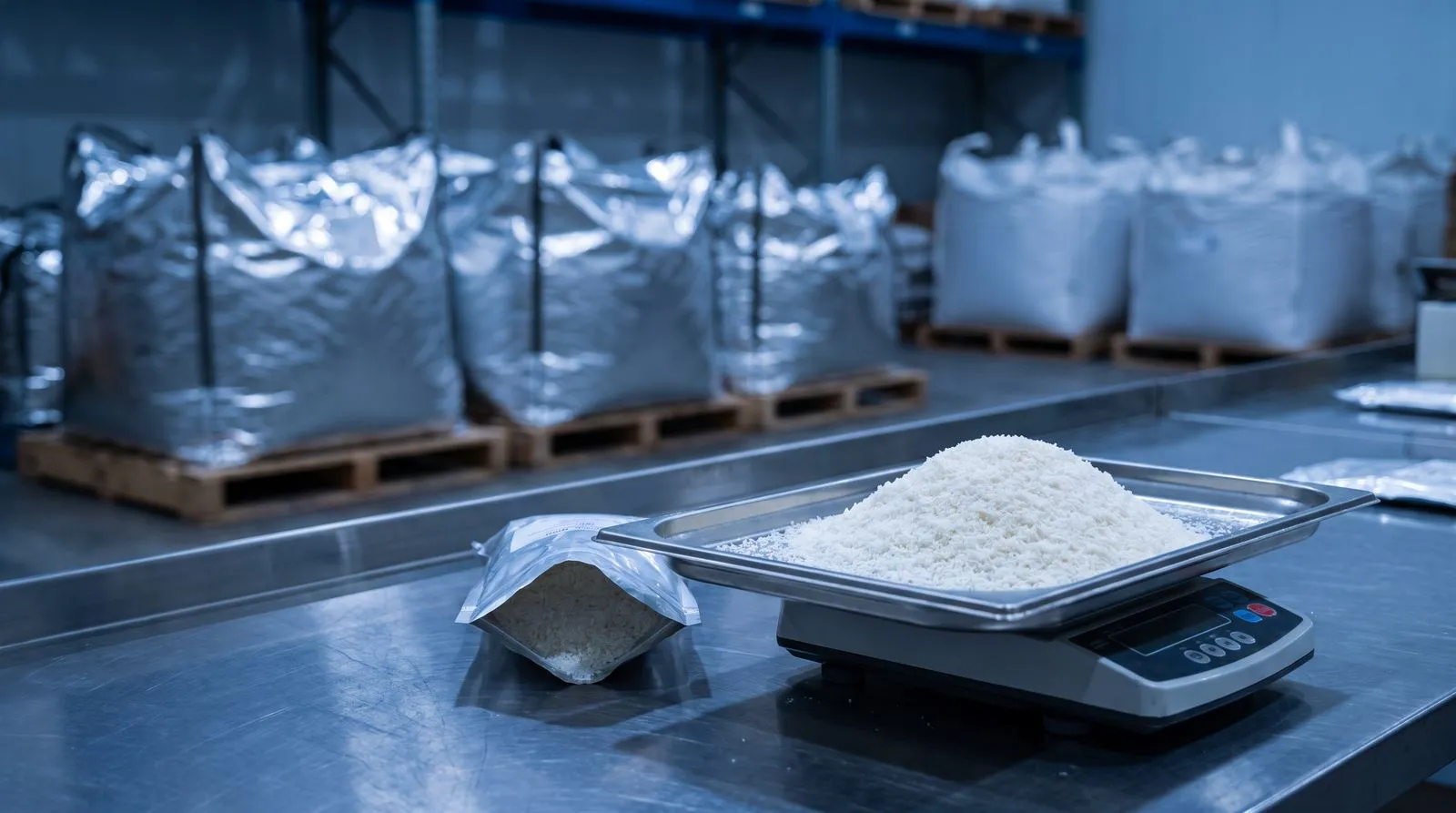
The moisture limit that stops mould claims in desiccated coconut is the one measured at your warehouse door, not the one on the supplier’s certificate. Codex allows 4 percent moisture. European buyers ask for 3 percent. A lot that leaves the factory at 2.7 percent can still arrive above the line if the bag lets humid air through.
For a procurement team, the spec clause is only half the job. The other half is packaging, transit time and where the pallets sit before use. This note sets out what each number means, what water activity adds, and how the desk writes the clause.
What is the moisture limit for desiccated coconut?
Codex Alimentarius sets a maximum of 4 percent m/m moisture for desiccated coconut, in CXS 177-1991. The commercial bar is tighter. The Dutch import promotion body CBI lists a maximum of 3 percent in its European market entry quality table, updated December 2023, and links higher moisture to contamination risk.
| Reference | Moisture limit | Nature |
|---|---|---|
| Codex CXS 177-1991 | max 4% m/m | International standard |
| CBI European buyer table | max 3% | Commercial requirement |
| SCS desiccated coconut programme | max 3% | Contract spec |
The gap between 3 and 4 percent is a full percentage point of water on a product that starts below 3. Contracts that cite “Codex” and certificates that cite “3 percent” are not the same clause. Our guide to reading a desiccated coconut COA covers that mismatch.
What is water activity, and why add it to the spec?
Water activity (aw) is the ratio of the vapour pressure of water in a food to that of pure water at the same temperature. It runs from 0 to 1 and measures how much water is free for microbes to use, where moisture percentage measures how much water is present.
Two lots at the same moisture can behave differently in storage. Fat content, particle size and local humidity all shift how tightly the water is held. Water activity captures that, which is why food-safety auditors ask for it.
Be clear on its standing. Water activity is not one of the parameters Codex sets for desiccated coconut, and the CBI table does not list it. Any limit in a contract is a buyer specification. Salmonella needs a water activity of at least 0.93 to grow, according to the Food Standards Australia New Zealand risk statement on dried coconut. Dry coconut sits far below that, so a water activity result is a stability record, not a safety release.
At what moisture does mould start?
Lower than the spec limit suggests, once the product is in a humid supply chain. A study of Sri Lankan desiccated coconut by Samarajeewa and Illeperuma, published in the Journal of the National Science Council of Sri Lanka in 1985, notes that moisture levels as low as 4 to 7 percent have supported mould growth and off odours from xerophilic fungi, which are moulds that tolerate dry conditions.
The same paper put a figure on how fast a bag can fail. It sealed 10 g of fine-grade coconut at 2.7 percent moisture in six packaging films and held them at 25 °C for 90 days. It took 3.5 percent as the critical level.
At 100 percent relative humidity, the non-laminated films let the coconut reach that level in 6 days. The laminated aluminium films took 83 days. Below 80 percent relative humidity, the laminated bags never reached it.
One short point follows. The packaging film sets the real moisture limit.
Where does the extra moisture come from?
From the supply chain, not the dryer. The Sri Lankan study notes that export bags, an 85-micron polyethylene liner inside a five-layer paper sack, sit in storage and transport for up to six months. Over that time the coconut trades moisture with the surrounding air through the film.
In the 90-day trial the bags held at 33 percent relative humidity lost weight. Every bag at 70, 80 and 100 percent gained it. Dry coconut is hygroscopic, meaning it takes up water from humid air, so a monsoon-season transit through a tropical transshipment port is a moisture event even when the container is sealed.
CBI gives the storage counterpart: keep packed product clean, cool and dry at 26 °C or lower, away from direct sunlight. It lists a shelf life of twelve months for sulphite-treated product and nine months for organic. Those figures assume the bag stays dry. A buyer holding stock past them, or storing near a loading dock, is spending the margin the spec was meant to protect.
How should the clause be written?
A usable clause states the number, the basis and the test. Four items belong in it:
- Moisture limit at loading and at receipt. For example, max 3 percent on the COA at shipment. A separate acceptance figure at destination removes the argument over transit pick-up.
- Method and conditions. Name the loss-on-drying method, oven temperature and time. The 1985 study dried 5 g at 102 °C for 2 hours; a different protocol gives a different number on the same sample.
- Water activity as a reported value. Ask for it on the COA with the measurement temperature, and agree a ceiling with the supplier on first shipments before making it a rejection criterion.
- Packaging. CBI describes the common format as polythene sealed inside paper bags, typically 25 kg, and advises storage at 26 °C or lower, clean, cool and dry. State the liner and seal in the contract. Our note on bulk packaging formats compares the options.
What this means for buyers
- Procurement managers (A): write moisture as a two-point clause, shipment and receipt, and cite the method. Do not cite Codex for a 3 percent limit.
- Importers and distributors (B): check liner type and seal before accepting long transits through the monsoon season. Warehouse humidity matters as much as the certificate.
- Brand owners (C): request water activity on the COA of every lot for the first three shipments, then set a ceiling from your own data.
- Traders and brokers (D): a 3 percent lot in a plain polyethylene liner is not the same product as a 3 percent lot in foil laminate. Price the packaging.
FAQ
Is 3 percent moisture a legal limit for desiccated coconut? No. Codex sets 4 percent. The 3 percent figure is a commercial requirement that European buyers use, so it only binds if the contract says so.
Does low moisture make desiccated coconut safe from Salmonella? No. Low water activity stops Salmonella multiplying but does not kill it. Safety depends on a validated kill step upstream. See shelf life and what degrades.
Should I put water activity in the contract? Report it first and set a rejection limit only after you hold data from several lots. No Codex limit exists to copy.
What packaging protects moisture best? The 1985 Sri Lankan study found laminated aluminium and polyethylene films resisted moisture uptake best. Plain polyethylene liners let coconut reach the critical level within days at saturated humidity.
Need a moisture and packaging clause locked across origins? Send the desk an RFQ.