
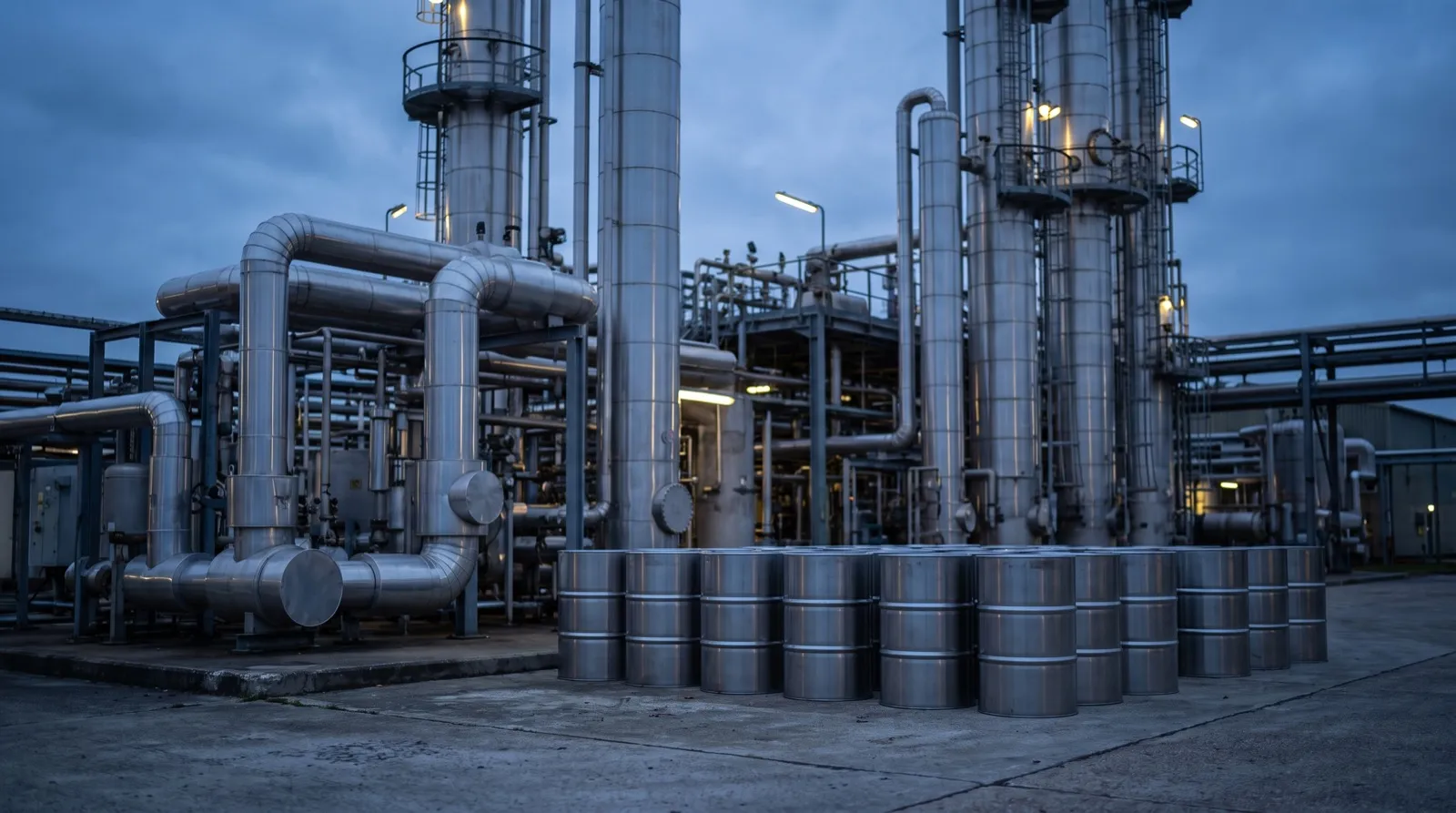
Moving from coconut oil into MCT changes three things at once, and buyers usually price only the first. The molecule gets more expensive. The customs duty changes. And the origin claim stops being testable.
Sourcing MCT oil sits one process step past anything a coconut contract covers. Medium-chain triglycerides are caprylic (C8) and capric (C10) fatty acids stripped out of a lauric oil and rebuilt onto a glycerol backbone. That rebuild moves the product out of the coconut tariff line and into a chemical one.
The awkward part for anyone buying on a coconut story: most commercial MCT is not made from coconut at all.
How is MCT oil actually made?
Four unit operations, and only the first two are familiar from an oil contract.
Copra or palm kernel is expelled to crude oil, then refined, bleached and deodorised. The refined oil is then split: hydrolysed with water at high temperature and pressure, usually by the continuous Colgate-Emery route, into free fatty acids and glycerine. USDA Agricultural Research Service authors put that step at 96% fatty acid yield and 10% glycerine.
The mixed acids then go to fractional distillation. Chains differing by two carbons separate cleanly, so cuts of 90% purity or better come off the column. Lauric feedstocks run up to 30 trays for the tightest cuts.
The C8 and C10 cuts are finally re-esterified with glycerol back into a triglyceride. That is the MCT.
Glycerine returns as a co-product and is worth less than most cost models assume. Crude glycerol averaged about 300 USD per tonne on 2024 UN Comtrade values. At 10% yield that is roughly 30 USD per tonne of oil split.
Is MCT oil coconut or palm kernel?
Usually palm kernel. The pharmacopoeias permit either, and the trade takes the cheaper barrel.
USP-NF defines medium-chain triglycerides as containing not less than 95% saturated C8 and C10 fatty acids, derived from coconut or palm sources. Compliance with the monograph therefore says nothing about botanical origin.
The one piece of independent laboratory evidence on the public record points to palm. US Customs analysed a commercial 60/40 MCT oil in ruling NY N237990 and found re-esterified triglycerides sourced from palm oil and palm kernel oil, origin Malaysia and Indonesia. Wilmar, one of the largest merchant suppliers of C8/C10 acid, states plainly that its fatty acids derive from palm oil and palm kernel oil and lists MCT as a downstream use. Coconut is not mentioned.
Here is the part that surprises people. Coconut is the better C8/C10 feedstock and still loses.
| % of total fatty acids | Coconut oil | Palm kernel oil |
|---|---|---|
| C8:0 caprylic | 4.6 to 10.0 | 2.4 to 6.2 |
| C10:0 capric | 5.0 to 8.0 | 2.6 to 5.0 |
| C12:0 lauric | 45.1 to 53.2 | 45.0 to 55.0 |
| C14:0 myristic | 16.8 to 21.0 | 14.0 to 18.0 |
| Iodine value | 6.3 to 10.6 | 14.1 to 21.0 |
| Saponification value | 248 to 265 | 230 to 254 |
Source: Codex CXS 210-1999, Tables 1 and 2.
Coconut carries roughly twice the C8 plus C10 of palm kernel. Volume settles the argument anyway. A lauric splitter is run for lauric and myristic acid, which feed fatty alcohols and surfactants and make up more than 60% of either barrel. C8 and C10 come off as light ends. Whoever splits the most tonnes makes the most C8, and that is palm.
The scale gap is not close. World coconut oil production is forecast at 3.82 million tonnes for 2026/27 in the USDA Oilseeds circular. Indonesia alone makes about 5.25 million tonnes of palm kernel oil, Malaysia another 2.09 million.
Yield math finishes it. At the Codex midpoint of about 13.8% C8 plus C10 and 96% recovery on splitting, a tonne of coconut oil gives roughly 125 to 130 kg of usable C8/C10 acid. That puts seven to eight tonnes of coconut oil behind every tonne of coconut-derived MCT. Treat it as desk arithmetic on published ratios.
Where does the duty change?
At re-esterification, and by more than most buyers expect. The US tariff follows chemical form, not the product name on the invoice.
| Form | US HTS | Duty |
|---|---|---|
| Coconut oil and its fractions, not chemically modified | 1513.19.00 | Free |
| Re-esterified MCT | 1516.20.9000 | 8.8 cents/kg |
| Industrial fatty acids from coconut or palm kernel | 3823.19.20.00 | 2.3% |
| Caprylic acid, separate chemically defined | 2915.90.10.50 | 5% |
Rates from the USITC Harmonized Tariff Schedule. CBP applied 1516.20 in NY N237990, and 2915.90.10.50 in ruling NY N309636 on caprylic acid of Malaysian origin.
A physical fraction of coconut oil enters duty-free. Split the same oil and rebuild the same molecules, and it pays a specific duty of 8.8 cents per kilo, biting hardest on cheap tonnage. Purify a single acid instead and the rate more than doubles against the mixed cut.
EU buyers face a separate classification question, covered in our note on whether EUDR reaches coconut.
Which specification do you write?
Not the Codex one. Codex CXS 210-1999 governs the feedstock oil and stops there. MCT is specified against a pharmacopoeial monograph or a supplier data sheet.
Published commercial grades cluster tightly. A representative food and pharma grade runs C8 at 50 to 65%, C10 at 30 to 45%, C6 and C12 capped at 2% each, acid value 0.2 mg KOH/g maximum, peroxide value 1 meq/kg maximum, saponification value 325 to 345, and water 0.1% maximum. Wilmar’s equivalent sets C8 at 53% minimum and C10 at 36 to 47%.
The commercial grades sold as 60:40 and 70:30 describe the C8 to C10 split. Both can sit inside the same monograph window, so the ratio is a contract term rather than a compliance one. Pure C8 is a different product, priced off a narrower cut.
One line matters more than any of the numbers above. Ask for the feedstock in writing.
Why origin stops being verifiable
Fractionation destroys the evidence. Caprylic acid from coconut and caprylic acid from palm kernel are the same molecule, so no composition test on the finished MCT can separate them. The compositional fingerprint that distinguishes the two oils sits in C12, C14 and C18:1, and those are exactly the chains the process removes.
Everything downstream of the splitter is therefore a documentary claim. Mass balance, supplier attestation and audit carry it. Buyers who read a coconut COA as proof of origin are reading the wrong instrument.
The chain is long, because the coconut and the conversion sit in different countries. USDA’s 2025 Philippine oilseeds report counts 61 coconut oil mills with 4.14 million tonnes of copra crush capacity, of which only 13 make oleochemicals. Indonesia exported 5.07 billion USD of industrial fatty acids in 2024, against 85 million from the Philippines.
What changed in the 2026 spread
The assumption that coconut is the premium lauric oil stopped being true in February 2026.
| USD/tonne | Aug 2026 |
|---|---|
| Coconut oil | 1,853 |
| Palm kernel oil | 2,264 |
| Palm oil | 1,117 |
| Soybean oil | 1,638 |
Source: World Bank Pink Sheet, 2 September 2026 edition.
The coconut premium over palm kernel peaked at 839 USD in June 2025, flipped negative in February 2026, and reached minus 489 in July. That is a 1,328 USD swing in thirteen months, and coconut is now the discounted lauric oil. Feedstock economics now argue for coconut on price and against it on logistics.
Indonesian policy pulls the other way. The export levy runs 12.5% on crude palm kernel oil against 10% on the refined grades, which is a deliberate subsidy for processing at origin. Indonesia now ships 97.3% of its palm kernel oil already refined or fractionated. The fractionation step is migrating toward the feedstock.
What this means for buyers
- Procurement (persona A): a USP or Ph. Eur. certificate does not evidence coconut origin. If your label or claim needs coconut, write feedstock into the specification and require documentary traceability to the splitter.
- Procurement (persona A): check your ten-digit code before contracting. The difference between a coconut oil fraction and a re-esterified MCT is duty-free against 8.8 cents per kilo.
- Traders (persona D): the CNO to PKO spread has been negative since February 2026 and reached minus 489 in July. Substitution economics in the lauric complex currently favour coconut feedstock.
- Both: no credible market size exists for MCT oil. Published estimates come from paid research vendors and disagree by roughly 70% on overlapping years.
- Both: if you need the feedstock rather than the derivative, crude and RBD coconut oil is the contractable product, and the RBD versus virgin split sets what refining you are paying for.
FAQ
Is MCT oil made from coconut? Often not. USP permits coconut or palm sources, and the available laboratory and supplier evidence points to palm kernel oil for most commercial volume. Coconut origin has to be specified and documented, never assumed from a monograph claim.
Can a lab test prove my MCT is coconut-derived? No. Fractionation removes the C12, C14 and C18:1 chains that distinguish coconut from palm kernel oil. The remaining C8 and C10 molecules are identical, so origin rests on documentation rather than analysis.
Why is MCT dutiable when coconut oil is not? Because re-esterification changes the tariff heading. A physical fraction of coconut oil enters the US free under 1513.19, while a re-esterified triglyceride classifies at 1516.20 and pays 8.8 cents per kilogram.
How much coconut oil does one tonne of MCT need? Roughly seven to eight tonnes, on Codex composition midpoints and published splitting yields. Coconut oil carries about 13 to 14% combined C8 and C10, and only that fraction becomes MCT feedstock.
Buying lauric feedstock and want the classification and origin questions settled before you contract? Send the desk an RFQ.