
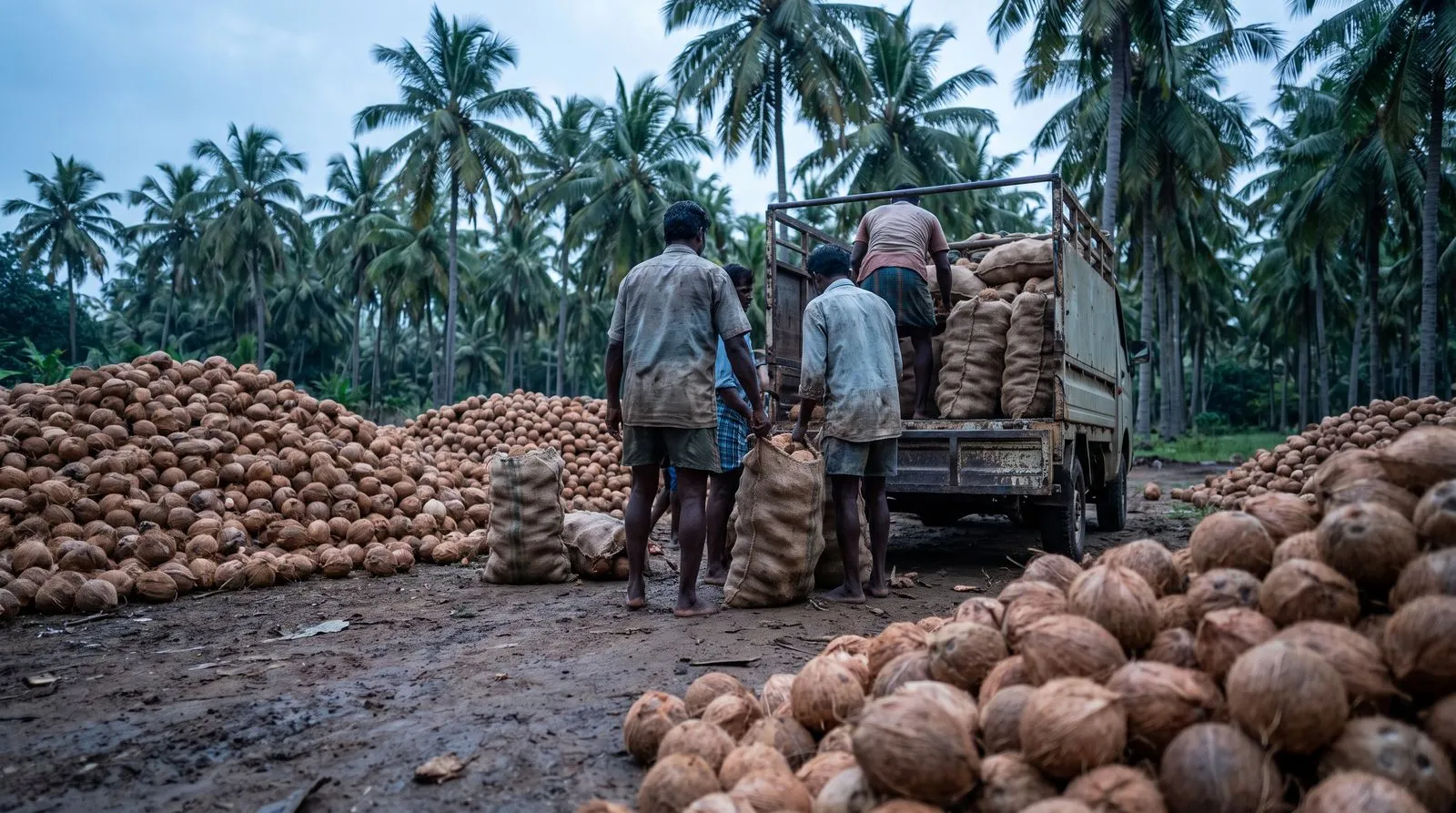
Smallholder coconut sourcing means the social risk in your supply chain sits on farms nobody in your audit programme has visited. A factory audit stops at the desiccated coconut mill gate. Behind that gate are thousands of family plots, village traders and copra dryers, and that is where the documented labour and poverty problems sit.
The buyer’s practical answer is to stop treating social compliance as a certificate on file and start treating it as a mapped risk with named controls. The EU’s forced labour ban applies from 14 December 2027, and it reaches every product placed on the EU market regardless of company size. A buyer who cannot describe the farm tier of a coconut contract today has roughly five contract cycles to fix that.
Why is coconut a smallholder commodity?
Coconut palms are rarely grown as estate monoculture. In the Philippines, the US Department of Labor’s September 2024 supply chain study records that around 95% of harvested trees sit on smallholder farms, three quarters of them under 2 ha. Sri Lanka, Indonesia and India follow similar patterns of family holdings feeding commercial mills.
That structure has a direct consequence. Between the palm and the processor sit collectors. A smallholder coconut farmer is typically a price-taker selling to a village trader, who sells to a town trader or consolidator, who sells to the mill. The same DOL study found local traders aggregate the output of 150 to 200 farmers, and larger consolidators reach 2,000.
So one 20-tonne container of desiccated coconut can carry nuts from well over a thousand farms. The mill knows its traders. It usually does not know their farmers.
Where does the social risk actually sit?
It sits at farm and collector level, and one origin carries a formal US listing. The DOL List of Goods Produced by Child Labor or Forced Labor, 2024 edition published 5 September 2024, lists Philippine coconuts for child labour, a listing in place since 2009. Philippine coconut oil and copra meal appear as goods made with an input produced with child labour. No other coconut origin is listed, and no origin is listed for forced labour in coconut.
Poverty is the underlying driver. The Philippine Statistics Authority put poverty incidence among farmers at 27.0% in 2023, among the highest of its basic sectors. That figure covers all farmers, and coconut-specific data from the last three years is thin. Buyers should treat older NGO estimates with caution rather than quote them in supplier questionnaires.
Sri Lanka offers the clearest price benchmark. Fairtrade’s living income reference price for Sri Lankan coconut is LKR 108 per nut at farmgate, about USD 0.29. It models a 5-acre farm yielding 3,840 nuts per acre, against a living income benchmark of LKR 1,260,000 a year and production costs of LKR 815,875. When farmgate prices fall well below that line, the pressure shows up as family labour, deferred replanting and side-selling.
Reputational risk travels faster than regulation. In 2020, several US retailers stopped stocking a Thai coconut milk brand after investigations into monkey labour on supplying farms. National Geographic reported that the brand’s own audit had inspected 64 of 817 farms, under 8%.
That number is the whole problem in miniature.
What does the law now ask of coconut buyers?
Three instruments matter, and they move on different clocks.
| Instrument | Who it binds | Applies from | What it means for coconut |
|---|---|---|---|
| EU Forced Labour Regulation (EU) 2024/3015 | Any operator placing products on, or exporting from, the EU market; no size threshold | 14 December 2027 | Products made with forced labour can be banned and withdrawn |
| CSDDD, as amended by Directive (EU) 2026/470 | EU firms with 5,000+ staff and EUR 1.5bn+ turnover; non-EU firms with EUR 1.5bn+ EU turnover | Compliance from 26 July 2029 | Risk-based due diligence; large customers will push questions down to suppliers |
| EUDR (deforestation) | Operators in listed commodities | 30 December 2026 (large and medium firms) | Coconut is out of scope; check palm-containing blends |
The forced labour regulation is the one that reaches a mid-sized importer. The Commission adopted its guidelines on 26 June 2026, though its risk database was still under development in July 2026. It has no commodity list, so coconut is covered by default.
The corporate due diligence directive was cut back hard by the Omnibus package. Directive (EU) 2026/470 entered into force on 18 March 2026, raised thresholds, allowed a focus on direct suppliers, and capped fines at 3% of turnover. Few coconut buyers will be in scope directly. Many sell to retailers and CPG groups that are, and those customers will ask for the evidence anyway.
The deforestation regulation is a distraction for pure coconut lines. We covered why in does EUDR cover coconut.
What can a mill audit prove, and what can’t it?
A mill audit proves conditions inside the mill. Sedex’s SMETA methodology, revised to version 7.0 in 2024, added a management-systems review and a “Collaborative Action Required” finding for issues the audited site cannot fix alone. That finding is an honest admission of scope. The farm tier sits outside the audited site.
Traceability claims have the same boundary. AAK, one of the larger coconut oil buyers, reports 100% traceability to crushing plant for 2024. That is mill level. It is a real achievement and it still stops one to three tiers short of the farm. Our note on traceability and lot coding explains why the first physical lot boundary forms at mill intake.
Certification helps in narrower ways than its logos suggest. Fairtrade and Rainforest Alliance both carry farm-level standards, and group certification runs on an Internal Control System that visits member farms. Coverage across coconut is patchy, and the cost lines differ; see certification premiums. The Sustainable Coconut Partnership, a Singapore-based industry platform, reports 30,000 farmers in dedicated programmes against its 22-outcome Charter. Useful progress, and small against the size of the farm base.
What should buyers put in the supplier pack?
Ask for evidence at each tier, and accept that the answer gets thinner the further upstream you go.
- Mill tier: a current SMETA 4-pillar or equivalent audit, with the corrective action log, not only the summary page.
- Collector tier: a named list of the traders or consolidators supplying the mill in the last 12 months, with approximate volume share.
- Farm tier: the supplier’s own social programme, if any: grievance channel, child labour remediation procedure, farmgate price records.
- Origin risk: a written statement of which origins feed the lot, so a Philippine-origin lot is flagged against the DOL listing.
- Contract clause: a right to request farm-tier evidence and to suspend a lot pending review, written now, before 2027.
The desk’s view from contract work: the collector list is the question suppliers resist most and the one that tells you the most. A mill that will not name its traders has either not mapped them or does not want you to.
What this means for buyers
- Procurement (persona A): map every coconut SKU to origin and mill before your customers ask. Philippine-origin lots need a documented child labour control, since that listing is public and searchable.
- Procurement (persona A): budget social due diligence as a supplier qualification cost. Add it to your new supplier qualification checklist.
- Importers and distributors (persona B): your EU customers inherit the forced labour ban from December 2027. Expect their questionnaires in your 2027 contract round.
- Brand owners (persona C): a single-origin, single-mill programme is easier to evidence than a spot-bought blend. Multi-origin security and traceable depth pull in opposite directions, so decide which one each SKU needs.
FAQ
Are coconuts on the US child labour list? Yes. The US Department of Labor’s 2024 list names coconuts from the Philippines for child labour, listed since 2009. Philippine coconut oil and copra meal appear as goods made with a child labour input. No other coconut origin is listed.
Does the EU Forced Labour Regulation cover coconut? Yes. Regulation (EU) 2024/3015 has no commodity list and no company-size threshold. From 14 December 2027 it can ban any product made with forced labour from the EU market, including coconut ingredients.
Is a SMETA audit enough for coconut social compliance? No. SMETA audits the processing site. In smallholder coconut, most labour risk sits on farms and with collectors upstream of the mill, which the audit does not reach.
What is a living income reference price? It is the farmgate price a typical farmer needs to earn a decent living after costs. Fairtrade sets it at LKR 108 per nut for Sri Lankan coconut, modelled on a 5-acre farm.
Buying across origins and need the farm-tier questions answered before 2027? Send the desk an RFQ.