
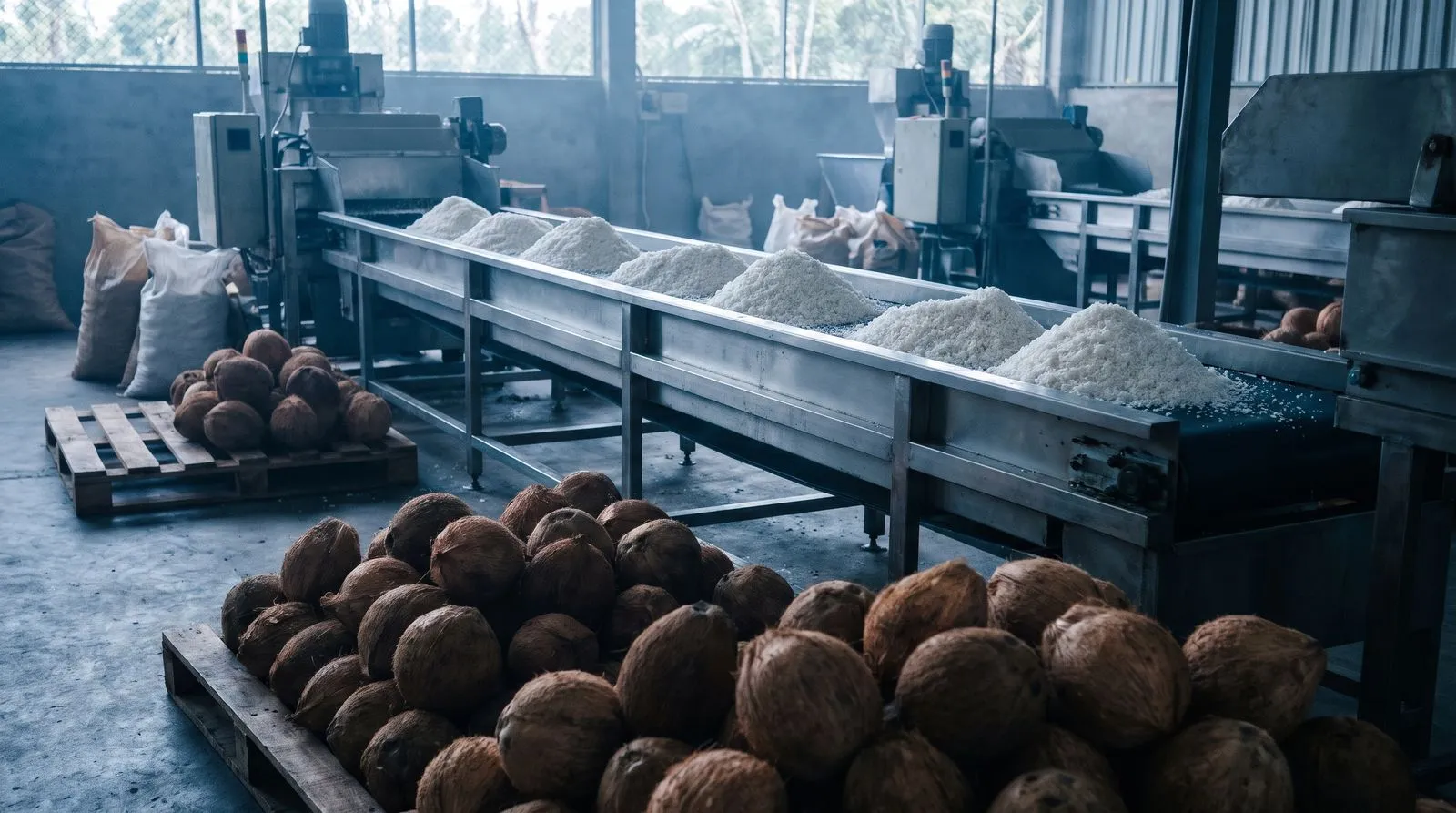
Sri Lankan desiccated coconut mills are constrained by fresh nut supply far more than by machine capacity. A mill can run a line at full speed only when husked nuts arrive at a price that leaves a margin, and in 2026 that has been the pinch point. For a buyer, the practical result is that allocation tightens and loosens with the crop, and the weeks when it tightens are predictable.
Procurement teams that treat Sri Lanka as a flat-supply origin tend to be surprised twice a year: once when quotes firm and lead times stretch, and once when a mill says it cannot add a container to a program. This note sets out what drives mill throughput, what public data does and does not show, and how to place volume around the cycle.
What limits a desiccated coconut mill?
Nut availability limits a mill before any piece of equipment does. Desiccated coconut is made by paring, washing, grinding, drying and grading the white kernel. The drying and grinding lines are sized for peak weeks, so they sit partly idle when nut intake drops.
Three inputs set the real ceiling:
- Nut intake per day. Mills buy from estates, smallholder collectors and auction channels. Intake falls when farm-gate prices rise, because nuts are pulled toward fresh sale and oil.
- Drying and grading hours. A fixed number of dryer hours caps output per shift, which matters in the weeks when nuts are plentiful.
- Certification and line allocation. Organic, sulphite-free and customer-audited runs need clean line changeovers, so one mill cannot flex freely between grades.
Mill-level utilisation is not published. The Coconut Development Authority and the Central Bank report national production and export volumes, but no source we could find gives an industry-wide utilisation percentage. Any seller quoting a precise figure is quoting its own plant.
How big is the nut supply behind the mills?
National output is large but mostly goes elsewhere. The Central Bank of Sri Lanka reports production rising to 3,040 million nuts in 2025 from 2,790 million in 2024, with output declining after October 2025. The President’s 2026 Budget speech, as reported by Daily FT, put annual production at 2.8 to 3 billion nuts with about 70 percent consumed domestically.
That leaves roughly 30 percent for oil, copra, milk, desiccated coconut and other exports, which all compete for the same nuts. The Coconut Cultivation Board has set a 2026 goal of 4.2 billion nuts, and the same report flags leaf blight as a threat with no effective treatment.
The Central Bank’s August 2026 bulletin shows production in May and June 2026 down 8.9 percent year on year, partly against a high 2025 base. Its September 2026 bulletin lists desiccated nut exports of 27,271 tonnes for January to August 2026. Read that as a sign that mills are still shipping, not as proof of spare capacity.
When does supply tighten and ease?
Supply follows rainfall, with a lag of months. A Coconut Research Institute study found that year-to-year yield swings come mainly from rainfall and solar radiation, and that January and February rain most strongly affects the following year’s total. The mechanism is covered in our note on the El Niño supply lag.
Monthly output also moves inside a year. Trade press reporting has put the monthly peak at about 280 million nuts in March 2024, falling to about 220 million by September of that year. In 2022 the peak ran to 380 million nuts in June. The peak month changes, so a fixed calendar is a weak guide.
| Period | What buyers usually see | Contract implication |
|---|---|---|
| Mid-year flush (varies, often March to June) | Better nut intake, firmer lead-time commitments | Good window to add volume and extend cover |
| Second half, post-peak | Intake eases, mills prioritise existing contracts | New spot requests meet longer lead times |
| November to December | Industry projections embed a 14 percent drop in nut availability (CMB News, September 2026) | Lock Q4 and early Q1 volume now |
| Early new year | Depends on January and February rain | Watch rainfall before committing H2 |
The 14 percent figure comes from unnamed industry projections cited by CMB News, so treat it as direction, not a forecast to the tonne.
What happens to allocation and price in a tight period?
Mills protect contract customers first and quote spot buyers last. Price follows the nut: when auction prices rise, quotes lift within days, as described in how Sri Lankan auction prices feed export quotes.
A tight period also pushes mills toward their higher-margin grades. High-fat and fine-cut runs for large accounts can displace small orders of medium grade or organic. Buyers on thin programs, one or two containers a month, feel this first.
How should buyers contract around the cycle?
Fix volume before the tight weeks, and fix the spec with it. Four habits help:
- Book Q4 and early Q1 now. Mills are filling year-end slots against a smaller nut base, and late requests wait.
- Split by origin. Hold Sri Lanka for the grades it does best and place part of the volume in the Philippines or Indonesia. The origin comparison shows where each fits.
- Write tolerance into the contract. A shipment window of two to three weeks and a quantity tolerance protect both sides when a crop week slips.
- Hold the spec constant across origins. A buyer who switches origin to dodge a tight month should not also change fat, moisture or SO2 limits. See holding one spec across origins.
The single short rule: do not wait for the quote to firm before asking for allocation.
What this means for buyers
- Procurement managers (A): secure Q4 and Q1 allocation now, and ask each mill for its confirmed monthly intake rather than a nameplate capacity.
- Importers and distributors (B): consolidate SKUs into fewer, larger monthly lots so you rank higher in a mill’s allocation list.
- Brand owners (C): a small program is the first to be cut in a tight month; pre-agree a minimum monthly volume.
- Traders (D): watch January and February rainfall and the Central Bank’s monthly production prints; they lead price by one to two quarters.
FAQ
Do Sri Lankan mills run out of capacity? Rarely in machine terms. The binding limit is nut supply, which varies through the year and between years with rainfall.
Is there public data on mill utilisation? No industry-wide figure is published. National production and desiccated exports are reported monthly by the Central Bank of Sri Lanka.
When is the best time to place Sri Lankan volume? Before a tight period, not during it. With a lower nut base projected for November and December 2026, Q4 and early Q1 cover is the near-term priority.
Does seasonality change quality? Spec limits stay the same, but fat content and colour can drift with nut maturity and weather, so keep COA review on every lot.
Need a spec locked across origins? Send the desk an RFQ, and see the desiccated coconut range.