
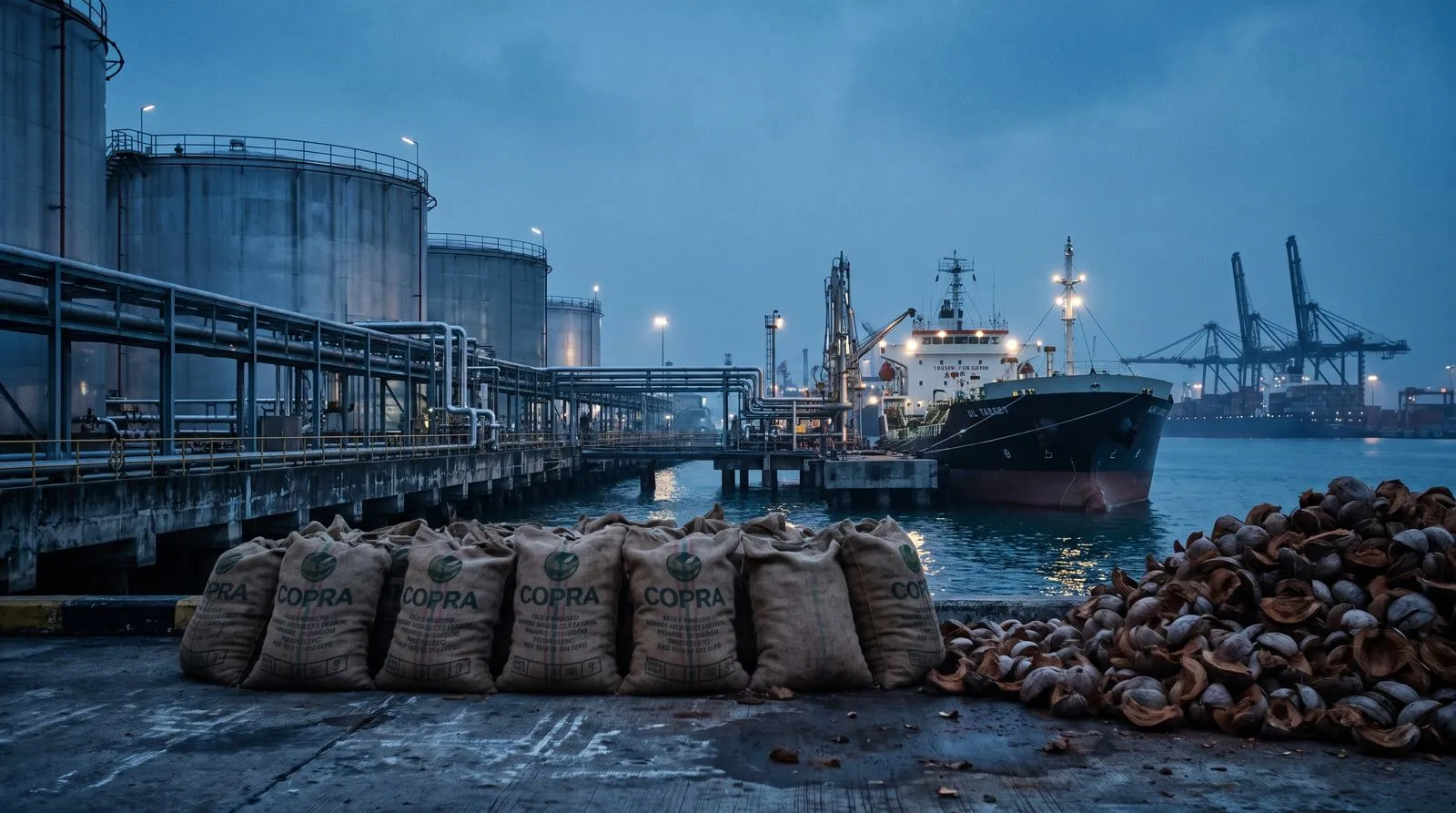
The Philippine biodiesel mandate is a domestic fuel rule that moves the world coconut oil market. Every extra percentage point of coconut methyl ester (CME) blended into diesel pulls crude coconut oil away from export buyers. As of October 2026 the operative blend is still B3, and a move to B5 is pending with the Department of Energy.
For a buyer, the question is timing. A blend step announced with a few months’ notice tightens oil availability before it shows in a quoted price. Procurement teams that read the mandate calendar can lock cover earlier than those that wait for the offer sheet to change.
What is the Philippine biodiesel mandate?
The mandate is the blending requirement set under the Biofuels Act of 2006 (Republic Act No. 9367). It obliges diesel suppliers to blend CME, a biodiesel made from coconut oil, into diesel sold in the Philippines. “B3” means 3 percent CME by volume; “B5” means 5 percent.
The original schedule set B3 from October 2024, B4 from October 2025 and B5 from October 2026. The National Biofuels Board suspended the B4 step after international coconut oil prices rose by around 300 percent, according to the Department of Agriculture. B3 remained in force.
Where does the blend stand in October 2026?
B3 is still the operative mandate. In June 2026 the Agriculture Secretary endorsed a coconut-sector resolution calling for an immediate move to B5 and sent it to the Senate and to the Energy Secretary, who chairs the National Biofuels Board (Department of Agriculture, 22 June 2026).
The Philippine Coconut Authority has since recommended B3 to B5. Press reports from late August 2026 quote its administrator saying CME is the sticking point: CME was averaging around PHP 135 per litre against PHP 77 to 97.50 for diesel, and the government expects to raise the blend in 2027 once CME prices settle. No order had been published in the sources checked for this note.
How much oil does a blend step absorb?
Domestic fuel use already competes with exports. The USDA Foreign Agricultural Service expects Philippine coconut oil exports of 1.19 million tonnes in 2026/27, against 1.13 million tonnes the season before and a recent peak of about 1.67 million tonnes (Procurement Resource summary of USDA FAS, 27 May 2026). The same outlook notes that the B3 mandate limits the volume left for export.
Copra output is forecast at 2.65 million tonnes, about 1.9 percent above the adjusted prior-season estimate. That is a thin cushion. A rise from B3 to B5 adds demand of roughly two-thirds on the fuel side, while the crop is growing by low single digits.
| Mandate step | CME share | Status, October 2026 | Buyer read |
|---|---|---|---|
| B3 | 3% | In force since October 2024 | Baseline, already in prices |
| B4 | 4% | Suspended | Skipped in practice |
| B5 | 5% | Recommended by PCA, DOE decision pending | Tighter oil in 2027 |
| B7 | 7% | Local production said to support it (industry estimate) | Upper bound, not scheduled |
Why does the blend move prices outside the Philippines?
The Philippines is the largest exporter of coconut oil, so domestic diversion tightens the traded pool. Crude oil that goes to CME is not available to the refiners who supply food, oleochemical and cosmetic buyers.
The effect runs through the spread to alternatives. When coconut oil climbs, buyers look at palm kernel oil; see our note on the coconut oil and palm kernel oil spread. The mandate also sits on top of the copra cycle, so a weak crop and a blend step arriving together is the stress case.
A blend increase does not hit every grade equally. Crude and RBD oil feed fuel and food alike, while virgin oil is a separate market; see RBD versus virgin coconut oil.
What would a B5 decision change in a contract?
Most of the exposure sits in unpriced volume. Three points matter:
- Fixed-price cover. Volume priced before an announcement is protected; volume left open is not.
- Origin spread. Indonesia and Sri Lanka are not bound by the Philippine mandate, so their offers carry a premium when Philippine oil tightens. Multi-origin contracts help only if the spec holds across origins.
- Shipment windows. Tight supply shows first in delayed loading, not in the quote. Keep a laycan clause with a stated remedy.
Without futures, desks cover with forward fixes and tiered volumes; see hedging coconut price risk without futures.
What should buyers watch before a decision?
Three signals come ahead of any order. The first is the CME price against diesel, since the Philippine Coconut Authority ties the timing to that gap. The second is the agenda of the National Biofuels Board, which advises the Department of Energy. The third is the monthly export record; our note on Philippine copra export data shows how to read it.
A quiet board does not mean a quiet market. Industry estimates that local production could support up to B7 mean the supply side is not the binding limit. Price is, and price can turn within a season. Review open volume monthly until a blend order is published or formally deferred.
What this means for buyers
- Procurement managers (A): fix 50 to 70 percent of first-half 2027 volume before a DOE order, and keep the balance on a formula tied to a published benchmark.
- Importers and distributors (B): reprice stock held against open sales; a B5 order lifts replacement cost before it lifts your shelf price.
- Brand owners (C): ask the supplier which origin and grade your oil comes from. A Philippine-only chain carries the full mandate risk.
- Traders and brokers (D): watch the National Biofuels Board agenda and CME price against diesel. The decision is stated to depend on that gap.
FAQ
Is B5 in force in the Philippines? No. As of October 2026 B3 is the operative blend. The Philippine Coconut Authority has recommended B5, and the Department of Energy decides on the National Biofuels Board’s advice.
Why was B4 suspended? The National Biofuels Board suspended it after international coconut oil prices rose around 300 percent, which made CME far dearer than diesel.
Does the mandate affect desiccated coconut or milk? Not directly. It affects coconut oil, and indirectly copra and coconut supply competition. Watch the desiccated coconut price drivers for the wider picture.
Which buyers are most exposed? Buyers of crude or RBD coconut oil from Philippine origin on open-priced contracts.
Need coconut oil cover across more than one origin? Send the desk an RFQ, and see the coconut oil specification page.