
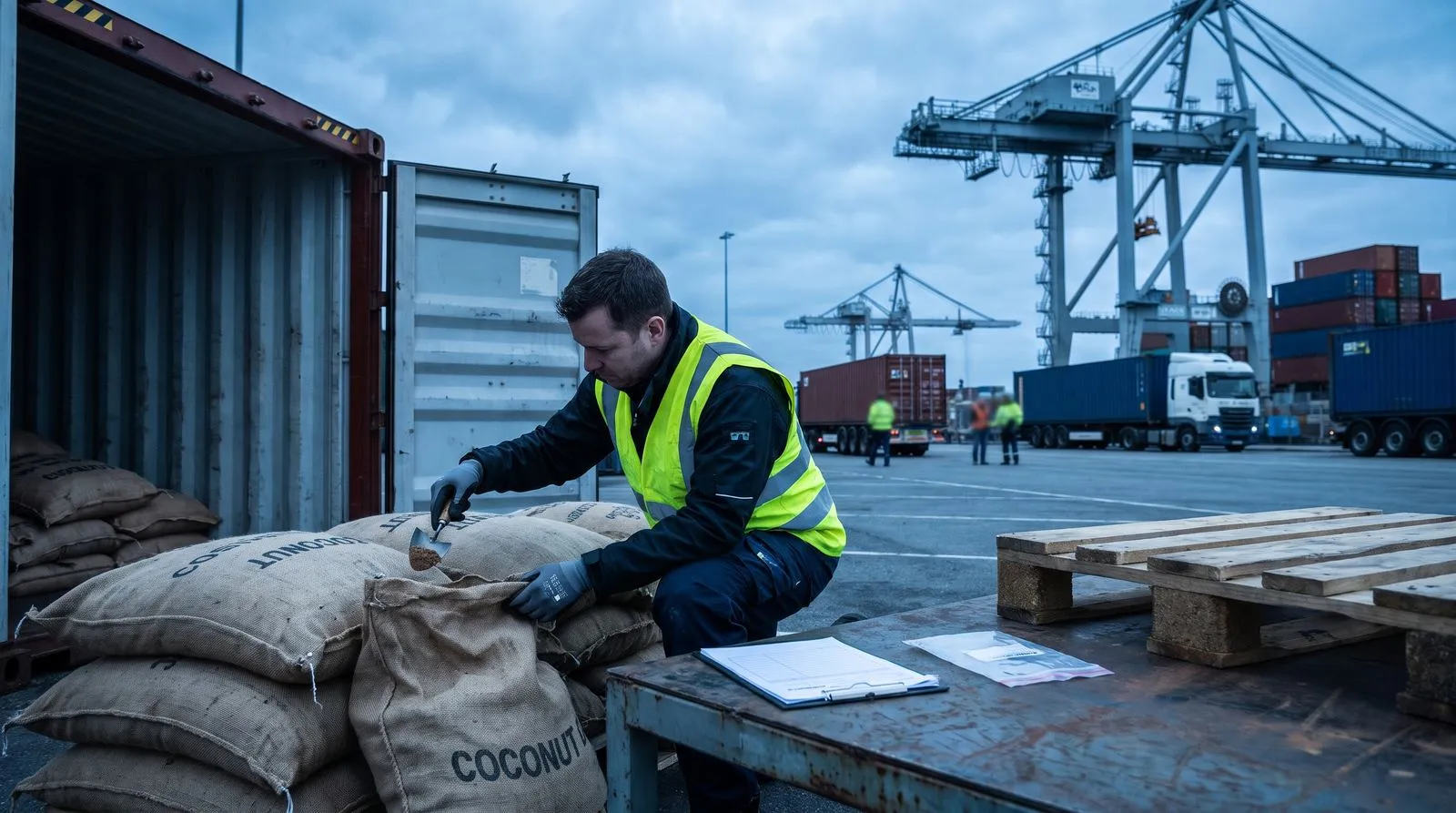
An organic coconut shipment cannot enter the EU as organic without a certificate of inspection (COI) issued electronically in TRACES, the Commission’s online trade control system. No valid COI means the goods are treated as conventional, and the organic premium is lost on the spot. For desiccated coconut, coconut milk or virgin oil, that premium is often the whole reason the container was ordered.
The COI is not the same as the supplier’s organic certificate. The supplier certificate proves the operation is certified. The COI proves that one specific consignment meets the EU organic import rules. Buyers who treat the two as interchangeable are the ones calling the forwarder on the day the vessel arrives.
What is a certificate of inspection?
A certificate of inspection is a per-consignment document, issued in TRACES under Delegated Regulation (EU) 2021/2306 of 21 October 2021, which supplements the EU organic framework in Regulation (EU) 2018/848. Each consignment needs its own certificate. It is issued by the competent authority or control body in the exporting country, using the model in the regulation’s annex.
The certificate is generated electronically and carries a qualified electronic seal. A paper printout is not the document of record. Finnish guidance treats a signed printout as acceptable only in exceptional circumstances, and the electronic version is what customs and organic inspectors read.
Who does what before the container sails?
Three parties touch the COI, and each has a different deadline.
| Party | Task | Where it goes wrong |
|---|---|---|
| Exporter or supplier | Requests the COI from its control body, with lot and quantity data | Quantities or lot numbers differ from the packing list |
| Control body or authority (origin) | Checks the chain of custody and issues the COI in TRACES | Request lodged too late; one certification body asks for at least 48 hours before departure |
| EU importer (first consignee) | Completes the import notification in the COI and presents it at the border | Box 20 not filled in time |
Transport details are often not final when a COI is issued, so boxes 13, 16 and 17 can carry provisional data at that stage. Check the update rule for the member state you import into. One UK source requires those boxes to be updated within 10 days of signature, and the UK is not the EU, so confirm the EU-side practice with your national authority rather than assume.
What happens at the EU border?
The importer must complete box 20 of the COI before arrival. One certification body states the cut-off as no later than one day before the scheduled arrival. An Italian source gives it as at least one working day before the goods reach the border control point listed in the certificate.
Authorities then run a documentary check on every consignment. A random identity check follows, and a physical check where needed. Customs endorses the electronic certificate in TRACES before the goods are released for free circulation.
The Netherlands tightened this in 2025. From 1 March 2025, Dutch customs release an organic consignment only once a COI verified by the Dutch control body Skal appears in TRACES, and the importer quotes document code C644 plus the COI number at release. A verified COI cannot be modified afterwards. Other member states run their own procedures, so a Rotterdam routing and a Hamburg routing can ask for different steps.
Who pays for the check?
The Netherlands moved inspection costs to importers. From 1 April 2026, Skal bills importers directly: EUR 130 per inspected COI, rising to EUR 260 for inspections outside office hours or at weekends, plus an annual system contribution. Treat this as a landed-cost line, not an overhead. On a 20-tonne container of organic desiccated coconut the fee is small. On a 2-tonne LCL parcel it is not.
Ask your forwarder whether the quoted all-in rate includes the organic inspection fee at the destination port. Many quotes do not. For a wider view of what the organic claim adds to cost, see certification premiums for organic and Fairtrade.
What if the consignment is split?
A consignment divided into batches before release for free circulation needs the COI endorsed in TRACES first. Slovenian guidance puts this on the national inspectors. Swiss rules require an extract of the certificate for each resulting batch.
The practical point: decide the split before the vessel arrives. A container consolidated for three customers at a bonded warehouse needs its paperwork arranged in advance, because a split discovered after arrival holds the whole box. If the goods go into a customs warehouse, the Dutch notice says box 20 stays empty and box 23 is filled instead.
Which mistakes hold organic coconut containers?
Most delays trace back to a handful of mismatches. These are the ones to check before sailing:
- Lot numbers on the COI differ from the bill of lading or packing list.
- The gross and net weights disagree, even by a small margin.
- The border control point in the COI differs from the actual discharge port after a transshipment change. Routing through a hub is common for coconut from Sri Lanka and Indonesia, which is why transshipment risk matters here.
- The supplier’s organic certificate expired or does not list the product category on the COI.
- The importer is not registered with its national organic control body.
The importer also keeps records. Finnish guidance requires the original certificate to stay available to control authorities for two years. Ireland adds an advance notification of organic imports through its INIS portal, in force since 1 June 2022.
What this means for buyers
- Procurement managers (persona A): write the COI into the purchase contract. Make “COI issued in TRACES and verified before vessel departure” a shipment condition, with the right to refuse if it is missing.
- Importers and distributors (persona B): budget the destination inspection fee and keep lot data identical across the COI, invoice and packing list. Plan splits before discharge.
- Brand owners (persona C): your own label claim depends on this document. Ask the supplier for the draft COI data before booking.
- Traders (persona D): organic parcels carry timing risk that conventional ones do not. A late COI converts an organic sale into a conventional one at a lower price.
For the origin-side half of the chain, read organic chain of custody for coconut and the coconut import document pack. Note that a US organic certificate does not substitute here either, as set out in GRAS and organic certificate scope limits.
FAQ
Is a supplier’s organic certificate enough to import into the EU? No. The supplier certificate shows the operator is certified. Each shipment also needs its own electronic COI issued in TRACES, which customs and organic inspectors check before release.
Can I use a paper COI? The electronic COI in TRACES is the document of record. Finnish guidance accepts a signed printout only in exceptional circumstances, so plan on the electronic version.
When must the importer complete box 20? One certification body states no later than one day before scheduled arrival, and an Italian source says at least one working day before arrival at the border control point. Confirm the exact rule with your national authority.
Can a COI be corrected after verification? In the Netherlands, no. Once Skal verifies the COI it cannot be modified, so errors in lot or weight data must be fixed before verification.
What if I want to split a container after arrival? The COI must be endorsed in TRACES before release for free circulation, and some states require an extract per batch. Arrange this before the vessel docks.
Need an organic coconut spec locked, with the COI timeline written into the contract? Send the desk an RFQ.