
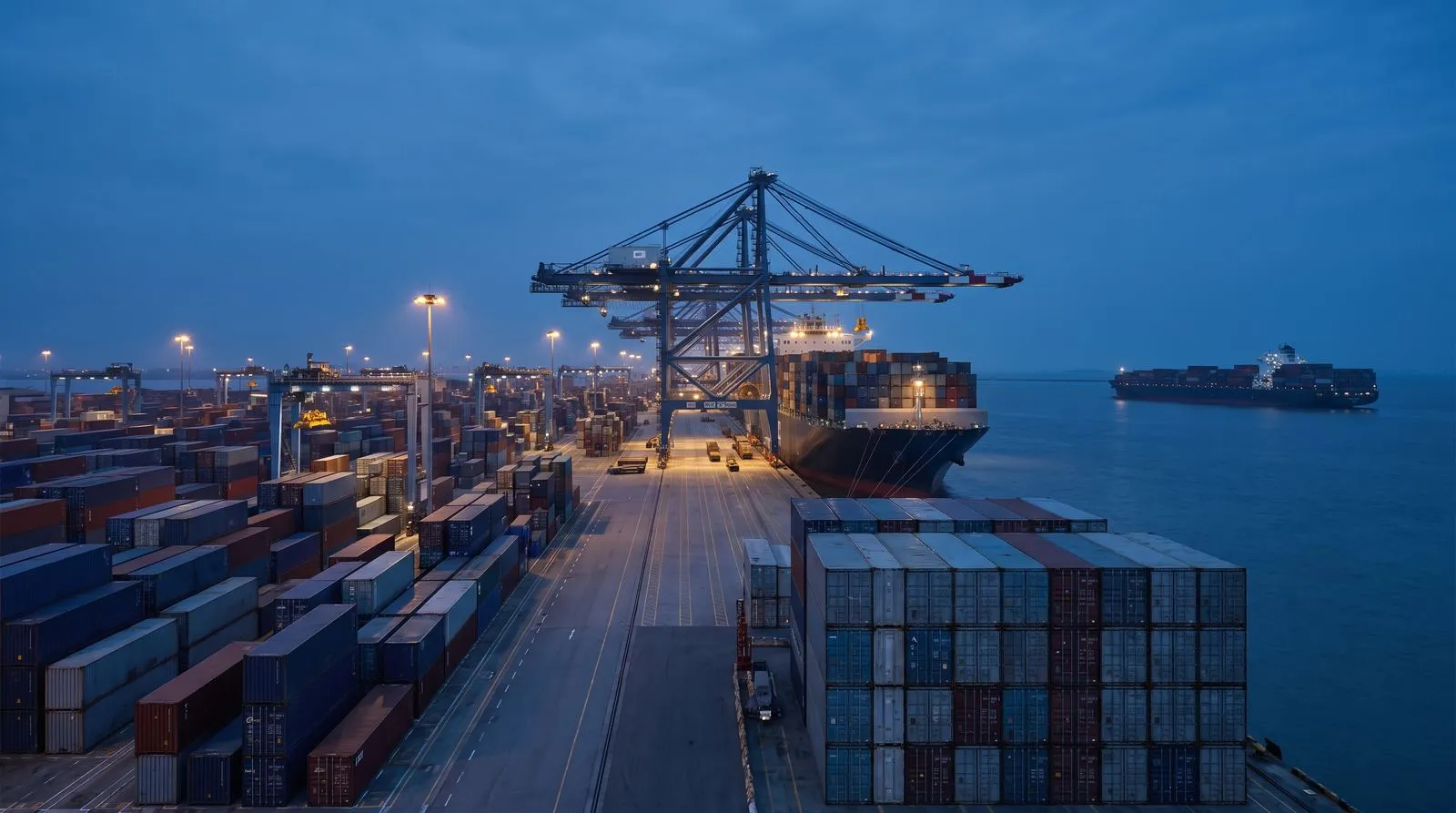
A coconut container routed through Singapore or Colombo does not run on one schedule. It runs on two, joined by a yard stay that neither the shipper nor the buyer controls. When the first vessel is late, the second one often leaves without the box.
For an importer or distributor, that means a quoted transit time is a best case, not a promise. This note explains how transshipment delay reaches your delivery date, what the current data shows for the two hubs that matter most to coconut programmes, and which clauses protect the buyer.
What is transshipment, and why does it add risk?
Transshipment is the transfer of a container from one vessel to another at an intermediate port on its way to the final destination. The cargo is discharged, stacked in the terminal yard, then loaded on a second ship or feeder service.
Each handoff adds three exposures: the inbound vessel can arrive late, the container can sit in the yard longer than planned, and the onward vessel can be full or can skip the call. A direct service has none of these. A transshipped one has all three.
Most coconut ingredients from South and South-East Asia travel this way. Origins such as Sri Lanka and the Philippines rely on hub ports to reach Europe, the US and the Gulf, so the question is rarely whether a shipment transships, but where and how tightly the connection is planned.
How reliable are the schedules right now?
Not very, at the global level. Sea-Intelligence put global schedule reliability at 62.6 percent in June 2026, down 4.7 percentage points on June 2025, in its monthly liner performance release of 27 July 2026. Vessels that arrived late were late by 5.31 days on average, 0.78 days worse than a year earlier.
That is a global figure, not a Singapore or Colombo figure. It still sets the baseline. If the inbound leg runs five days late on average, a connection planned with a two-day buffer fails more often than it holds.
| Hub | Recent signal | Source |
|---|---|---|
| Singapore | 44.66 million TEU handled in 2025, up 8.6% | MPA |
| Singapore | Berth waits of 3 to 5 days reported, October 2026 | Tradlinx, citing Kuehne+Nagel, 9 October |
| Colombo | August 2026 transshipment 638,843 TEU, up 7.8%; 82.3% of throughput | Maritime Gateway, 24 September 2026 |
Read the table as a pressure gauge. Both hubs are handling more transshipment than a year ago, and busy hubs have less slack to absorb a late vessel. The berth-wait figure for Singapore comes from a logistics blog relaying a forwarder update, so treat it as a signal and confirm it with your forwarder before changing delivery dates.
Why does a late inbound vessel cost so much?
Because the container cannot join its onward sailing until it has been discharged. A box that reaches the terminal after the onward vessel’s cut-off waits for the next sailing, and the Tradlinx analysis notes that containers already in the yard can also be bumped to later departures when space is tight.
The same analysis of 508,055 container shipments found carrier ETAs missing in 8.43 percent of cases, and transshipped cargo made up 87 percent of those gaps. In practice, the booking record can show the original onward vessel for days after the connection has already failed.
That is why the buyer’s ETA and the carrier’s ETA drift apart.
What does the delay do to the coconut itself?
It depends on the product. Dry goods such as desiccated coconut, flour and sugar are hygroscopic, meaning they take up water from humid air. Extra weeks in a tropical yard or a sweating container raise the moisture risk covered in our note on moisture and water activity specs.
The marine insurer TT Club notes that wet-damage claims are frequent and that many could be avoided with a thorough pre-loading condition check. Its guidance on protecting cargo from wet damage is a useful reference for the packing checks to request. Lining and desiccants help, but they have limits, and a longer transit uses them up.
Temperature-sensitive cargo has a different problem. Chilled or frozen coconut cream and milk depend on the reefer plug being live at every stop. A long yard stay raises the odds of a power or set-point lapse, and our comparison of reefer vs dry for coconut milk and cream sets out when each format fits.
How should buyers price and plan for it?
Plan for the late case, not the quoted one. Four steps cost little and remove most of the surprise:
- Ask for the routing, not just the transit time. Request the transshipment port, the onward vessel name and the planned connection window on every booking. A direct or single-hub routing with a long buffer is often worth a small freight premium.
- Add a buffer to the delivery date. The desk plans production and safety stock against the late case. Our note on safety stock for coconut ingredients shows how to size it.
- Track both legs. Check the inbound vessel, then confirm the onward vessel and its ETA before telling the customer a date. An unchanged tracking record is not proof the connection holds.
- Know who pays for delay. Container storage and detention charges accrue at the destination when cargo arrives late, which is covered in our guide to demurrage and detention.
A contract that fixes the loading date but is silent on routing leaves the buyer carrying the connection risk. Under an FOB sale the buyer usually controls the carrier and routing and therefore owns the choice. Under CIF the seller books the carrier, but risk of loss still passes at loading, as set out in our Incoterms guide for coconut buyers.
What this means for buyers
- Procurement managers (A): Specify moisture limits at receipt as well as at loading, and ask for the planned routing in the shipment notice.
- Importers and distributors (B): Build the delay case into inventory cover and payment terms. Negotiate a notice duty for any change to the onward vessel.
- Brand owners (C): Do not promise launch dates off the quoted transit time. Hold a buffer of ingredient on the shelf.
- Traders and brokers (D): Price the connection risk into forward sales. A hub with a congestion signal deserves a wider buffer than one without.
FAQ
How long does transshipment add to a coconut shipment? There is no single figure. A planned connection can add a few days, and a missed one can add a full weekly sailing. Ask the forwarder for the planned connection window and the next available sailing on each booking.
Is Singapore or Colombo the safer hub for coconut? Neither is safe by default. Both are carrying more transshipment volume than last year. Pick the routing by the connection buffer and the carrier’s record, not by the hub name.
Who bears the cost if the box misses its connection? It depends on the Incoterm and the contract. Under FOB the buyer usually holds the carrier relationship. Write the notice duty and any storage cost split into the sales contract.
Does transshipment affect coconut quality? It can. Longer yard stays raise moisture exposure for dry goods and temperature risk for chilled products. Pack for the late case and agree a receipt specification.
Need a routing and buffer built into your coconut contract? Send the desk an RFQ at /contact/.