
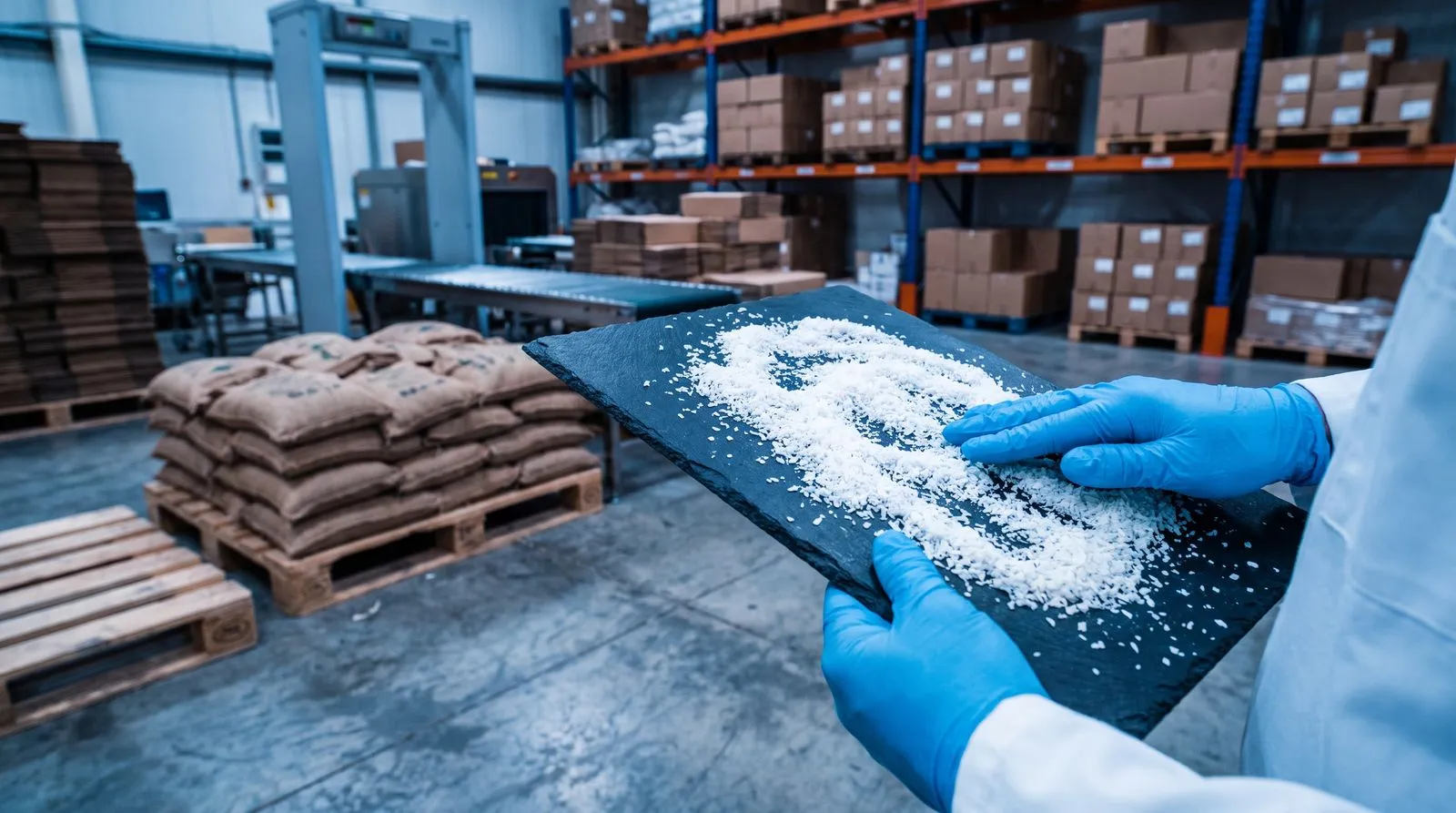
A foreign matter spec for coconut ingredients needs three separate lines: what counts as foreign, how many harmless fragments are tolerated, and how metal is detected and rejected. Most contracts carry one of the three, usually the first, and leave the other two to the supplier’s own habits.
That gap matters because a metal fragment or a piece of plastic is a recall risk, not a quality grade. It also matters because the claims that follow are hard to settle. Nobody can re-test a bag that has already been blended into a customer’s product.
This note covers what the standards say, what metal detection sensitivity looks like in practice, and what to write into the contract. It sits alongside our earlier notes on reading a desiccated coconut COA and heavy metals testing, which cover chemical contaminants rather than physical ones.
What does Codex say about foreign matter in desiccated coconut?
Codex STAN 177 separates two things. Extraneous vegetable material is defined as harmless vegetable matter associated with the product, with a limit of 15 fragments per 100 g. Foreign matter is defined as any visible or apparent matter not usually associated with the product, and the requirement is absence in 100 g.
The test is simple. The standard’s methods table has the analyst spread 100 g of sample in a thin layer against a white background and count the extraneous material with the naked eye.
Two points follow. First, “absence” is judged on a 100 g sample, which is a tiny fraction of a 20 tonne lot. Second, the standard treats a container that fails any quality requirement as a defective, and lot acceptance depends on the number of defectives against the sampling plan. A single contaminated bag can matter under that logic.
| Category | Codex STAN 177 requirement | What it covers |
|---|---|---|
| Extraneous vegetable material | 15 fragments or fewer per 100 g | Shell, husk or testa fragments from the coconut itself |
| Foreign matter | Absence in 100 g | Anything not from the product: plastic, string, glass, insects, metal |
Source: Codex STAN 177.
Where do dark specks and shell fragments fit?
They sit in the grey zone, and that is where most arguments start. Brown testa and shell pieces are vegetable matter from the nut, so they fall under the 15 per 100 g allowance. A buyer making a white, premium product may find that allowance too loose.
Trade specifications often tighten it. One European buyer’s published technical specification for desiccated coconut, a document from a Belgian wholesaler, lists a dark-speck tolerance of 10 per 100 g. That is a single company document, not a standard, and the desk cites it only to show that buyers do write tighter numbers than Codex.
If speck count matters to your product, define a speck: colour, minimum size, and how it is counted. “Free from black specks” cannot be tested. “No more than 10 dark particles over 0.5 mm per 100 g, counted visually on a white background” can. Particle size also changes how visible specks are, so check the cut grade you are buying.
What sensitivity should metal detection hit?
No standard sets one universal test-piece size. Practitioner guidance says the size depends on product, packaging, pack size and the aperture of the detector, and that sizes can come from the customer, a code of practice or the site’s own validation at the control point.
Vendor guidance gives a range. One metal-detection supplier describes 3 mm and 4 mm test spheres as common, with tighter targets of roughly 1.5 to 2 mm sometimes used for dry snacks and powders. The Belgian specification above asks for 2 mm ferrous, 2.5 mm non-ferrous and 2.8 mm stainless steel.
Those three metal types are not interchangeable. Stainless steel is the hardest to detect, because it conducts poorly and is usually non-magnetic. A detector that finds a 2 mm ferrous sphere may need a larger stainless piece to trip. A contract that names only “metal detection” has not said which of these it expects.
Dry, low-moisture products like desiccated coconut are easier to inspect than wet or salty ones, but fat content and packing density still affect the signal. Sensitivity has to be proven on the actual product, not assumed from the machine’s brochure.
How is detection verified day to day?
A detector is only as good as its last successful test. Mettler Toledo says its certified test samples, in ferrous, brass, stainless steel and aluminium, can support HACCP-based GFSI schemes including BRC and FSSC 22000. Vendor guidance is to run each test piece at production speed and confirm the reject mechanism actually removes the pack.
Ask the supplier for four things:
- The test-piece sizes by metal type, and the CCP or prerequisite status of the detector in their HACCP plan.
- The test frequency, for example at start-up, hourly and at changeover.
- What the reject system does: diverter, belt stop or bin, and who clears it.
- The records, kept per shift, including failed tests and the product held after each failure.
These are the same questions a good pre-shipment inspection checks on site.
What if the supplier has no metal detector?
Some mills rely on magnets and sieving instead. Those catch ferrous pieces and oversize debris but miss stainless steel, aluminium and plastic. If the supplier uses them, the contract should say so, and the buyer should decide whether that is acceptable for the end use. A buyer with a downstream detector may be comfortable. A buyer shipping into a retail snack line may not be.
Ask before the first order, not after the first complaint.
What contract wording closes the gap?
Six items cover most of it:
- Foreign matter: absence, with the Codex 100 g visual method named.
- Extraneous vegetable material: a numeric limit per 100 g, tighter than Codex if the product needs it.
- Dark specks: a defined size and colour, a numeric limit and a counting method.
- Metal detection: test-piece sizes by metal type, test frequency and reject method.
- Records: detector logs and rejected-pack records available on request, retained for a stated period.
- Remedy: what happens on a confirmed finding, covering notice period, retained samples, replacement or credit, and who bears investigation cost.
Pair these with the golden sample so that “normal appearance” is anchored to a physical reference. If a lot does arrive contaminated, the rejected container playbook covers the evidence a claim needs.
What this means for buyers
- Procurement managers (A): write foreign matter and speck limits as numbers with methods, then audit the supplier’s detection records once a year.
- Importers and distributors (B): ask which metal types the detector tests for, and keep photographs of any contaminant found, with the bag lot number.
- Brand owners (C): match the supplier’s detection sensitivity to your own downstream controls, and do not assume one replaces the other.
- Traders and brokers (D): price in the cost of a tighter spec. Premium white product with low specks and fine metal sensitivity does not trade at commodity-grade prices.
FAQ
Is foreign matter the same as extraneous vegetable material? No. Under Codex STAN 177, extraneous vegetable material is harmless plant matter from the product, with a limit of 15 fragments per 100 g. Foreign matter is anything not usually associated with the product and must be absent in 100 g.
What test-piece size should the contract name? There is no single mandated size. Vendor guidance runs from about 1.5 to 4 mm depending on product and pack, and stainless steel needs a larger piece than ferrous. Agree sizes by metal type and validate them on the actual product.
Can a magnet replace a metal detector? No. Magnets catch ferrous pieces but not most stainless steel, aluminium or plastic. Say in the contract which controls the supplier runs.
Does a clean COA prove a lot is free of foreign matter? No. A COA reports a small sample. Detection records and a defined sampling clause carry more weight for physical contaminants.
Need a foreign matter and metal detection spec locked across origins? Send the desk an RFQ at /contact/.