
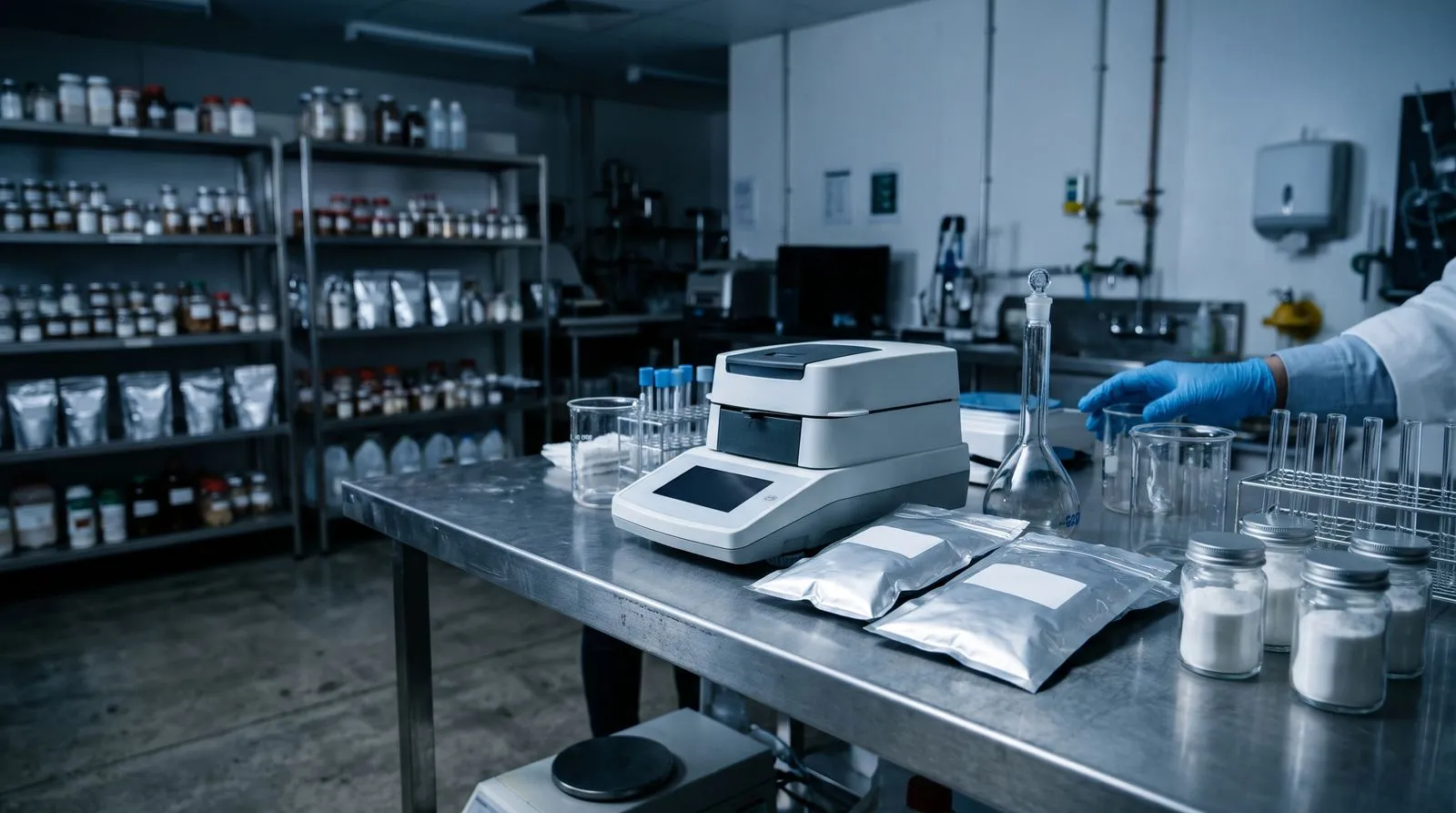
Free fatty acid (FFA) in coconut milk powder only moves in one direction. A lot that passes at release can fail the same specification months later in your warehouse, with no change in the paperwork. The spec has to cover the lot at the end of its shelf life, not only on the day it left the plant.
That matters in money and weeks. A rejected pallet found at mixing means a held production run, a claim against a supplier whose COA was accurate on the day it was issued, and a dispute about who stored what, where. The clauses below move that argument into the contract, before the container ships.
What is free fatty acid, and why does it rise in powder?
Free fatty acid is fat that has been split from its glycerol backbone. Coconut fat is a triglyceride, three fatty acids on one glycerol, and hydrolysis releases them one at a time. The released acids are what the nose and tongue pick up as rancid or soapy.
The Tetra Pak coconut handbook describes this pathway as lipolysis and notes that coconut milk contains lipase and lipoxygenase enzymes naturally, and that hydrolysis can be particularly rapid when lipase catalyses it. It names butyric, caproic, caprylic and capric acids as sources of strong off odours, and lauric and myristic acids as sources of a soapy taste. Coconut fat is rich in lauric acid, so the soapy note is the one buyers report first.
Water drives the reaction. The same source notes that oil in an emulsion or in contact with water breaks down easily, while pure oil does not. A powder is an emulsion that has been dried, so the residual moisture and the water activity of each particle decide how much hydrolysis can continue.
Is FFA the only way the powder goes off?
No, and the two routes are easy to confuse on a COA. Hydrolytic rancidity raises FFA. Oxidative rancidity raises peroxide value and leaves FFA flat.
A 1988 storage study of spray-dried coconut milk powder, held six months at 30°C and 80% relative humidity, concluded that lipid oxidation was the factor limiting stability. Its reported shelf life was about four months in air or vacuum packed aluminium laminate and about one and a half months in polypropylene. The abstract does not report FFA values, so read it as evidence on packaging and oxygen, not on lipolysis. The study used skim milk and dextrin in the formulation, so a clean-label carrier system will behave differently.
The practical reading: a spec that limits FFA alone leaves oxidation uncontrolled, and a spec that limits peroxide value alone leaves hydrolysis uncontrolled. Write both.
What do supplier specifications actually list?
Published technical data sheets give a starting range, not a standard. There is no Codex standard for coconut milk powder; as covered in our landed-cost comparison of powder and liquid, CXS 240 covers aqueous products and mentions powder only as an input.
| Parameter | Two supplier sheets reviewed (organic 60 and 65 grades) | What to add to your contract |
|---|---|---|
| FFA | Maximum 0.10% and 0.15% | State the basis (as lauric or as oleic acid) and the test method |
| Water activity | Maximum 0.5 | Test at shipment and at arrival |
| Stated shelf life | 36 months | Define the storage conditions it assumes |
| Peroxide value | Not compared here | Set a limit and a test date |
Source: supplier data sheets on Knowde, reviewed November 2026. These are one supplier’s sheets and are shown as examples of how the limits are written, not as market norms.
Notice the gap in the middle row. A 36-month shelf life next to a six-month laboratory study at tropical conditions tells you the sheet assumes cool, dry, sealed storage. Make that assumption a contract term.
Which clauses stop the drift from becoming a dispute?
Five clauses do most of the work. Each one converts an assumption into something a third party can check.
- FFA limit at end of shelf life. Write the limit as applying at expiry, with the basis and method named. A limit that applies only “at dispatch” gives the supplier no reason to care what happens next.
- Water activity ceiling at loading and at discharge. The difference between the two readings shows whether moisture entered in transit, which separates a supplier fault from a carrier fault.
- Packaging barrier. Specify the inner liner and whether the bag is sealed under vacuum or inert gas. Our note on bulk packaging, bags and nitrogen covers the trade-offs.
- Retained samples. Ask the supplier to hold a sealed sample from each lot for the full shelf life. If FFA is disputed, both sides test the same material.
- Process disclosure. Ask what heat treatment the milk received before drying. Lipase that survives the process can keep working in the powder, so this is a buyer question, not a curiosity.
One short point deserves its own line.
Test dates are part of the spec.
A COA with no test date for FFA is a number without a position on the clock. Require the date of analysis and the date of manufacture on every certificate, and read the gap between them. Our guide to reading a COA for desiccated coconut applies the same logic to a different product.
What should the buyer do about storage after arrival?
Storage is the part the buyer controls. Coconut powder pulls moisture from humid air, and each opened bag resets the clock on that lot.
Keep unopened bags off the floor, away from hot walls, and out of direct sun. Reseal partly used bags and use them first. Where a plant runs seasonal volume, rotate by manufacture date, not by delivery date, because a late delivery of an old lot is still an old lot. Our note on what degrades coconut ingredients on the shelf lists the other storage variables.
Run an incoming check and a mid-life check on a sample from each lot. Two FFA readings on the same lot, three months apart, give you a drift rate. A drift rate lets you set a use-by date from evidence instead of the supplier’s label.
What this means for buyers
- Procurement managers (A): put the FFA limit at end of shelf life, and name the basis and method. This is the single clause that prevents the most disputes.
- Importers and distributors (B): log manufacture date on every lot and sell oldest first. Store away from walls and floors, because your customers will test arrival, not origin.
- Brand owners (C): ask the co-packer for incoming FFA and water activity records. If they do not test, you carry the risk on every batch.
- Traders and brokers (D): an old lot with a clean COA is not a clean lot. Price age and test date into the offer.
FAQ
Does a higher fat powder drift faster? There is more fat available to hydrolyse, so the absolute FFA can rise further. We found no published comparison across fat grades. Test each grade on its own lot data.
Is nitrogen flushing necessary? It targets oxidation, not hydrolysis. Where peroxide value is the controlling risk, an inert atmosphere in a barrier liner helps. It does not remove the water that drives lipolysis.
What is a reasonable FFA limit? The two sheets reviewed list 0.10% and 0.15% maximum. Set yours from your own process tolerance and your sensory threshold, and confirm with the lab you will actually use.
Who pays when FFA fails after arrival? The contract decides. Without an end-of-shelf-life limit and stated storage conditions, the claim usually turns on storage records, so keep them.
Need an FFA and water activity limit locked into a milk powder contract? Send the desk an RFQ at /contact/, and we will write the clauses with you.