
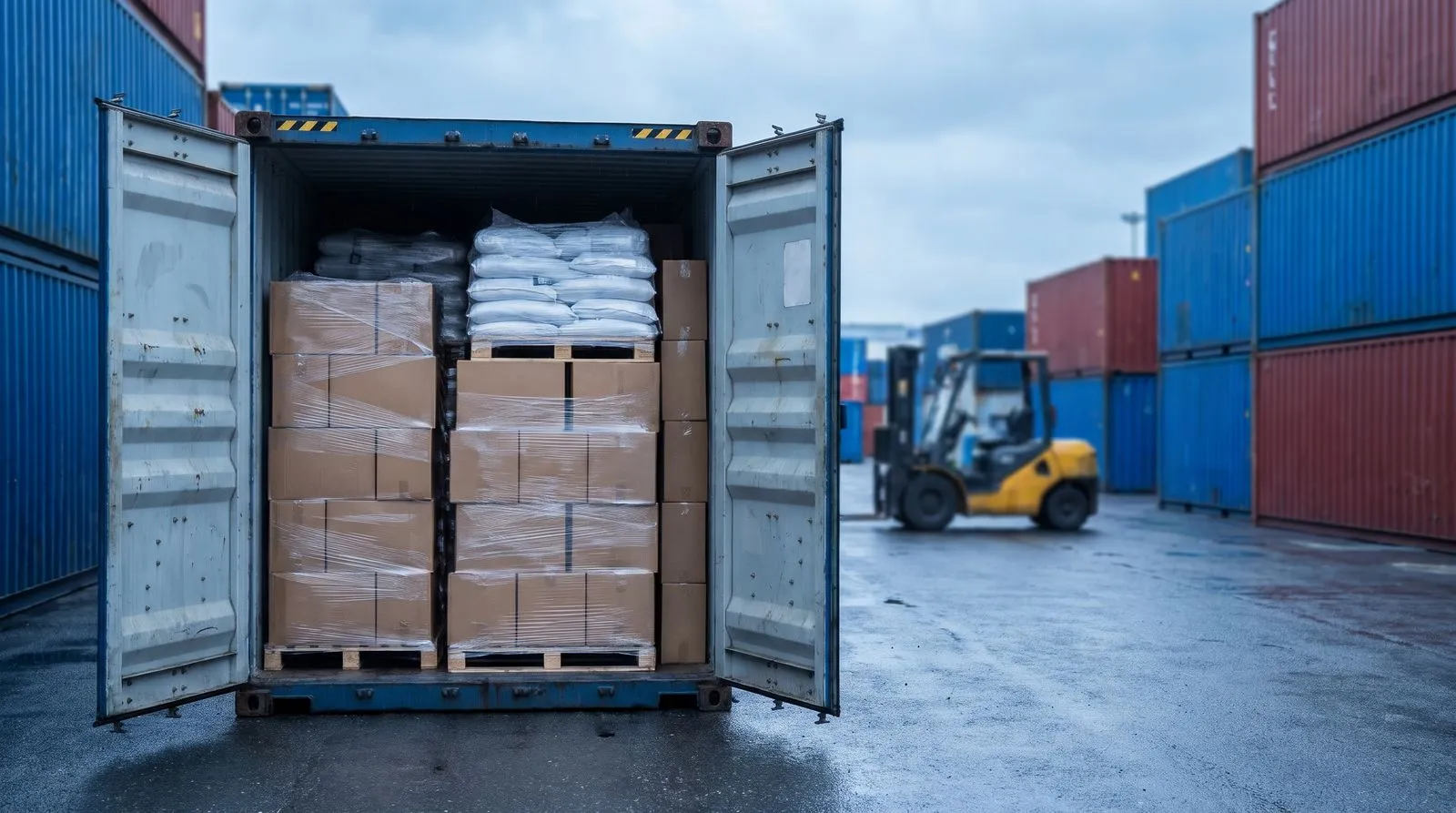
A container loading plan for coconut cartons and bags starts with one question: does this cargo run out of floor, height or payload first? Bagged ingredients usually hit payload. Cartons of retail-ready product usually hit volume. A plan that ignores the difference either ships air or ships an overweight box.
For an importer running regional programmes, the loading plan is a cost line. Each unused pallet position raises freight per tonne. Each overloaded or unbalanced box risks a stop at the terminal weighbridge, a re-pack at the importer’s expense, or a damage claim with no clear owner. This note sets out the arithmetic and the checks that belong in the purchase order.
What does a 20 ft and a 40 ft container actually hold?
Start with the box. A Hapag-Lloyd container specification sheet lists a standard 20 ft unit at 5,900 mm long, 2,352 mm wide and 2,393 mm high inside, with a payload of 30,200 kg. The 40 ft standard unit measures 12,032 mm by 2,352 mm by 2,395 mm, with payloads of 28,750 to 28,800 kg depending on tare weight. The door plate on the actual unit governs, not the brochure.
Payload is the cargo mass a container may carry: gross weight less tare, the empty weight of the box. Note that the 40 ft carries less than the 20 ft. It has twice the floor and a lower weight limit.
Floor is the first constraint. A 1,200 mm by 1,000 mm pallet covers 1.2 square metres. The 20 ft floor is about 13.9 square metres, so a simple grid fits 8 pallets and a pinwheel pattern can reach 10. The 40 ft floor fits 20 in a grid of two across and ten deep. That leaves roughly 350 mm of width spare, which is where dunnage and securing go.
Which limit bites first: weight or volume?
Bags bite on weight. Cartons bite on volume. The table below is a worked example, not a quotation. Replace the pallet weights with the supplier’s packing list.
| Pack plan | Net per pallet | 20 ft: pallets, net tonnes | 40 ft: pallets, net tonnes |
|---|---|---|---|
| 25 kg bags, 40 per pallet, one tier | 1,000 kg | 8-10 pallets, 8-10 t | 20 pallets, 20 t |
| Same pallet, two tiers | 1,000 kg | 16-20 pallets, 16-20 t | 28 pallets at most, 28 t (weight-capped) |
| Cartons at 12 kg gross, 60 per pallet, one tier (assumed) | 720 kg | 8-10 pallets, 5.8-7.2 t | 20 pallets, 14.4 t |
Two readings matter. A single tier of bags uses a third of the 20 ft payload and under three quarters of the 40 ft payload, so the box ships floor space it paid for. Two tiers fill the 20 ft on weight. In the 40 ft, a second tier would reach 40 pallets and 40 t, which is more than the box may legally carry. The cap is about 28 pallets, fewer once pallet and wrap weight are added.
Two tiers also need height. The internal height of roughly 2,390 mm allows under 1,195 mm per tier, less clearance. The bottom tier must carry 1,000 kg above it without bag deformation. That is a question for the packer, and the answer belongs in the spec. The existing note on bulk packaging formats covers liner and bag construction.
Cartons leave payload unused. A 20 ft with 8 to 10 pallets of 720 kg is a 6 to 7 tonne shipment in a 30 tonne box. That is where the FCL versus LCL decision comes back in: when the cube is full and the weight is low, consolidating SKUs into one container usually beats two part-filled ones.
How should the weight be spread inside the box?
Even distribution matters more than total weight. The IMO/ILO/UNECE CTU Code is the non-mandatory global code of practice for packing cargo transport units. Commercial summaries of its weight-distribution guidance, such as this one from Roth Schenk, describe a centre-of-gravity tolerance of about 5% of container length, up to 10% in special cases. Treat the figure as a planning rule and check it against the code text.
In practice: heavy pallets go in the middle, lighter cartons at the ends, and any mixed load is stuffed heaviest first. A partial load that sits entirely in the door half is the common failure. It shifts the centre of gravity toward the rear and stresses the container floor and the chassis.
Voids need filling. Gaps between pallet blocks and between the last row and the doors are filled with dunnage, which is the shipper’s name for any packing material used to brace cargo: airbags, boards or paper cushions. A stuffing photo set, taken at each layer and at the closed doors, is the cheapest evidence in a damage claim.
What does the carrier need to see before loading?
Since 1 July 2016 the shipper must give the carrier a verified gross mass (VGM) for every packed container before it is loaded. Maersk’s guidance describes the two accepted methods: weigh the packed and sealed container, or calculate it from cargo, packing and tare under an approved process. A pallet plan gives the expected number. A weighbridge ticket that differs by more than the pallet-weight tolerance is a reason to open the box, not to adjust the paperwork.
Pallet timber needs a check too. International shipments require treated and stamped wood packaging under ISPM 15. Wet or unseasoned wood also adds moisture to a sealed container, and the International Union of Marine Insurance lists it alongside temperature swings as a source of container sweat.
Where does condensation come in?
Coconut powders and flours are hygroscopic: they take up water from air. A dry container leaving a hot origin and arriving in a cold climate can form condensation on the roof and walls. The TT Club notes that a general purpose container cannot prevent the effects of ambient temperature swings, and points to the CTU Code annex on preventing condensation damage.
Two practical rules. Pack at the lowest moisture the spec allows; the moisture and water activity note sets out the limits. And be careful with plastic wrap over wet or humid inner packing: Mohawk Global warns that barriers around hygroscopic cargo can trap moisture rather than keep it out. Desiccant bags are an option where sweat risk is high.
One short rule for the PO: no container is stuffed in the rain.
What this means for buyers
- Importers (B): ask for pallets per container and net tonnes per container in every offer. Compare offers on freight per tonne, not per box.
- Procurement managers (A): put pallet height, tiers and wrap in the spec. A pallet that fails at destination on a crushed bottom layer is a claim, and the rejected container playbook shows what the evidence file needs.
- Brand owners (C): carton programmes usually leave payload unused. Ask whether a second SKU can share the box.
- Traders (D): confirm the 20 ft versus 40 ft payload before pricing a part-load. The larger box does not carry more.
- Everyone: require the loading plan and the VGM before the booking cut-off, not after it.
FAQ
How many pallets fit in a 40 ft container? Twenty pallets of 1,200 by 1,000 mm in a simple grid. With bagged ingredients at 1,000 kg per pallet, that is 20 tonnes in one tier. A second tier would exceed the container’s payload, so the practical cap is about 28 pallets.
Is a 20 ft or a 40 ft better for bagged desiccated coconut? For heavy bags the 20 ft often uses its payload better, particularly with two tiers. The 40 ft has more floor but a lower payload limit, so it suits lighter, bulkier packs.
Who is responsible for the container weight declaration? The shipper. Under the SOLAS rule in force since 1 July 2016 the packed container’s verified gross mass must reach the carrier before loading, or the box is not taken on board.
Does palletising stop condensation damage? No. Pallets lift cargo off the floor, but sweat forms on the roof and walls. Low packed moisture, dry timber and correct packing materials matter more.
Need a loading plan written into the spec? Send the desk an RFQ at the contact page and ask for the loading plan with the offer. The desiccated coconut page lists the standard pack formats.