
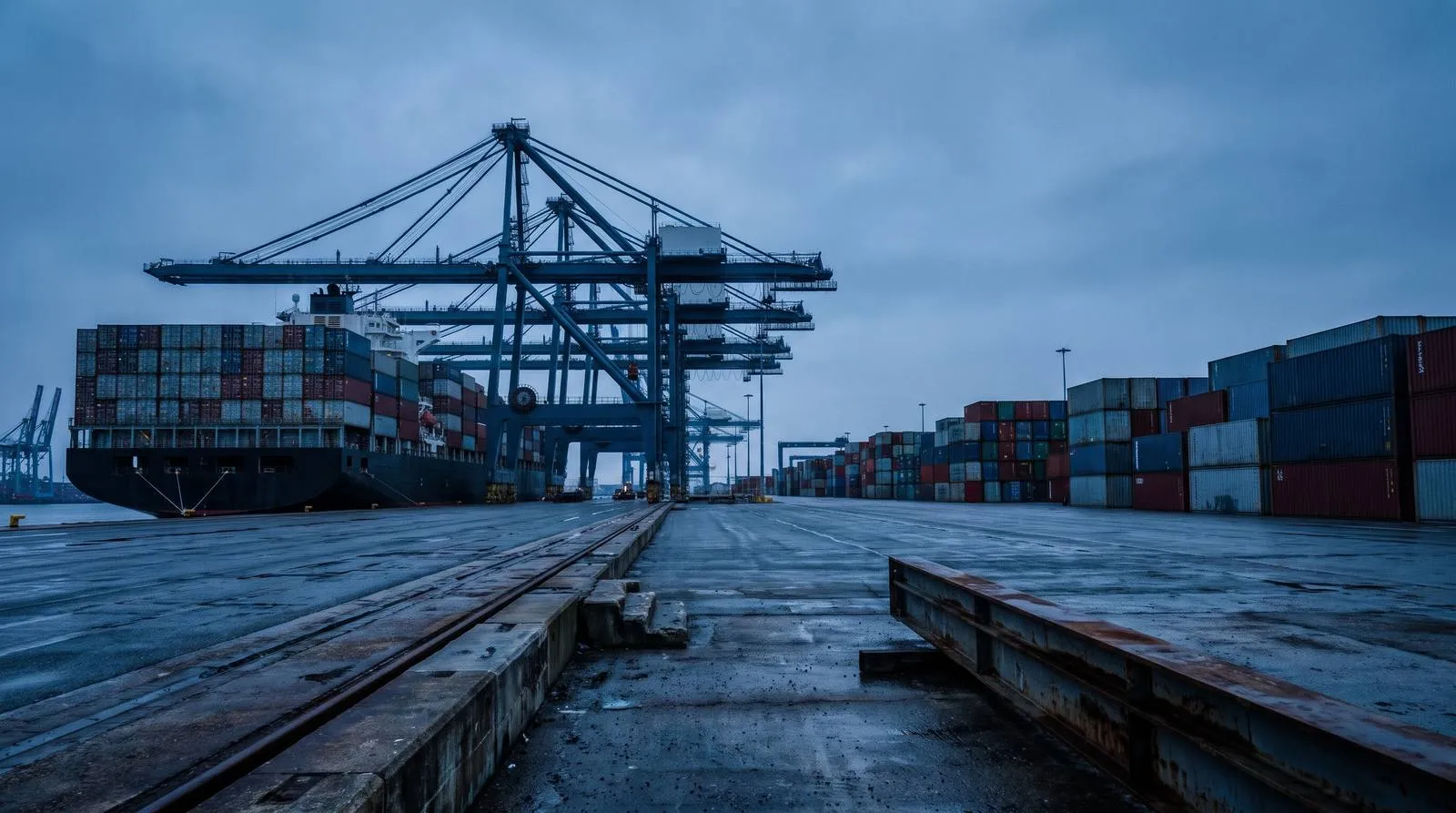
A blank sailing is a scheduled vessel call that a carrier cancels, removing that week’s capacity from a trade lane. For coconut importers, the effect shows up as a rolled booking, a later arrival and a higher rate on the next available slot. In peak season, blank sailings are one of the few levers carriers use to hold rates up, so they matter to anyone with a coconut programme moving in the next six weeks.
The cost is rarely the rate alone. A container that rolls by a week pushes the production slot, the warehouse booking and the payment date. This note sets out what the latest capacity data says, how blank sailings reach a coconut buyer’s landed cost, and what to put in a purchase order before the next announcement lands.
What do the latest capacity numbers show?
Drewry’s World Container Index for 22 October 2026 rose 2% to $4,585 per 40 ft container, a 15-week high. Shanghai to Rotterdam gained 3% to $3,632, and Shanghai to Genoa 5% to $4,152. Drewry’s capacity tracker showed eight Asia-Europe blank sailings announced for the following week, up from two. On the transpacific, announced blank sailings fell from six to two.
The same week, Drewry counted 55 Suez Canal sailings in week 42, up from 54. Capacity is returning to the shorter route. Alphaliner reports that 63% of Far East to Europe capacity used Red Sea services between 15 September and 15 October: 5.50 million TEU of the 8.70 million TEU deployed. The Suez route saves about two weeks against the Cape of Good Hope.
Read together, the two sets of numbers pull in opposite directions. Returning Suez capacity adds supply. Targeted blank sailings take some of it back out. The gap between the two is where a rate spike or a rate slide is decided, usually a few weeks before a buyer sees it on an invoice.
How does a blank sailing reach a coconut buyer?
Start with the booking. A carrier cancels a sailing and its confirmed bookings roll to the next vessel, or are re-routed through another service. The cargo is not lost. It is late, and the buyer often learns after the supplier has stuffed and gated in the container.
Three costs follow, and only one is freight.
- Storage and detention. Cargo already at the origin terminal waits on the carrier’s free time.
- Rate reset. Contract rates hold only for the volume the carrier is willing to lift. Rolled cargo can be re-priced on the spot market.
- Production and payment timing. A late vessel moves the arrival date and, with it, the balance payment and the customer delivery.
Take an illustrative case, not a quote. A $1,000 swing on a 40 ft box carrying 20 tonnes of desiccated coconut adds $50 per tonne. That is a visible slice of a commodity margin before any storage is counted.
Which coconut products feel it most?
Not all cargo reacts the same way. Dry, shelf-stable lines can sit a week at a terminal with limited damage. Temperature-controlled lines cannot.
| Product | Exposure to a rolled booking | Main pressure point |
|---|---|---|
| Desiccated coconut, flour | Moderate | Moisture pickup in a hot yard; see the moisture and water activity note |
| Coconut milk and cream | Moderate to high | Shelf-life clock starts at filling; the reefer versus dry decision changes cost per roll |
| Coconut oil (RBD, virgin) | Low to moderate | Flexitank and drum slots are tighter than box slots |
| Coconut water | High | Short life once filled |
The common thread is the origin side. A Sri Lankan, Indonesian or Philippine plant that packs to a vessel cut-off has finished goods waiting. The earlier note on Asia-Europe versus Asia-US coconut freight covers how the lanes differ.
How reliable are the schedules anyway?
Cancellations are one source of delay, not the only one. Sea-Intelligence put global schedule reliability at 64.7% for May 2026, the highest of that year at the time. Schedule reliability is the share of vessel arrivals within one day of the published date. At that level, about one in three arrivals is late, before any blank sailing is added.
That is a planning input, not a surprise. Build one week of slack into any delivery date that a customer commitment depends on, and two weeks if the cargo transships. The transshipment risk note explains why a Singapore or Colombo hub adds its own exposure.
A short rule for the desk: a confirmed booking is not a confirmed sailing.
What can a buyer do before the next announcement?
Carriers typically announce blank sailings a week or two ahead, so the useful window is the booking stage, not the week of sailing.
- Book early on the lane, and ask for the vessel, not just the week. A booking on a service that is already blanked is a rolled booking you have not been told about.
- Split a large programme across two sailings. Two part-loads on different weeks cost slightly more in paperwork and reduce the chance one roll stops the whole order.
- Write roll language into the PO. State who pays storage and detention if cargo rolls, and set a long-stop date after which the buyer may cancel. The force majeure note covers where a carrier action stops being an excuse.
- Check the rate basis. Know whether the contract rate survives a roll or reverts to spot.
- Compare sourcing windows. The Q4 buying calendar shows which months carry the most freight risk.
What this means for buyers
- Procurement manager (A): add a one-week buffer to delivery dates tied to production, and request vessel names with each booking confirmation.
- Importer or distributor (B): price rolled-cargo cost into each programme; the FCL versus LCL choice changes how many rolls you can absorb.
- Brand owner (C): keep buffer stock for lines with short shelf lives; a late box costs a launch date.
- Trader or broker (D): watch the weekly capacity count. A jump in announced blank sailings tends to come before a rate move.
FAQ
What is a blank sailing in container shipping? A blank sailing is a scheduled port call or whole voyage that a carrier cancels. Carriers use them to cut capacity when demand softens or to support rates. Cargo booked on the cancelled sailing rolls to the next vessel.
Do blank sailings raise coconut freight rates? They reduce available space, which supports rates. The effect depends on the lane and on how much capacity is returning elsewhere. Drewry’s 22 October 2026 data showed more Asia-Europe cancellations and fewer transpacific ones.
Who pays when a coconut container rolls? It depends on the contract. Under FOB terms the buyer usually bears freight and onward delay; under CIF the seller does until the risk transfers. Storage and detention should be set out in the purchase order.
How far ahead are blank sailings announced? Typically one to two weeks. Booking early reduces exposure but does not remove it.
Need freight risk written into a spec and a delivery date? Send the desk an RFQ on the contact page.