
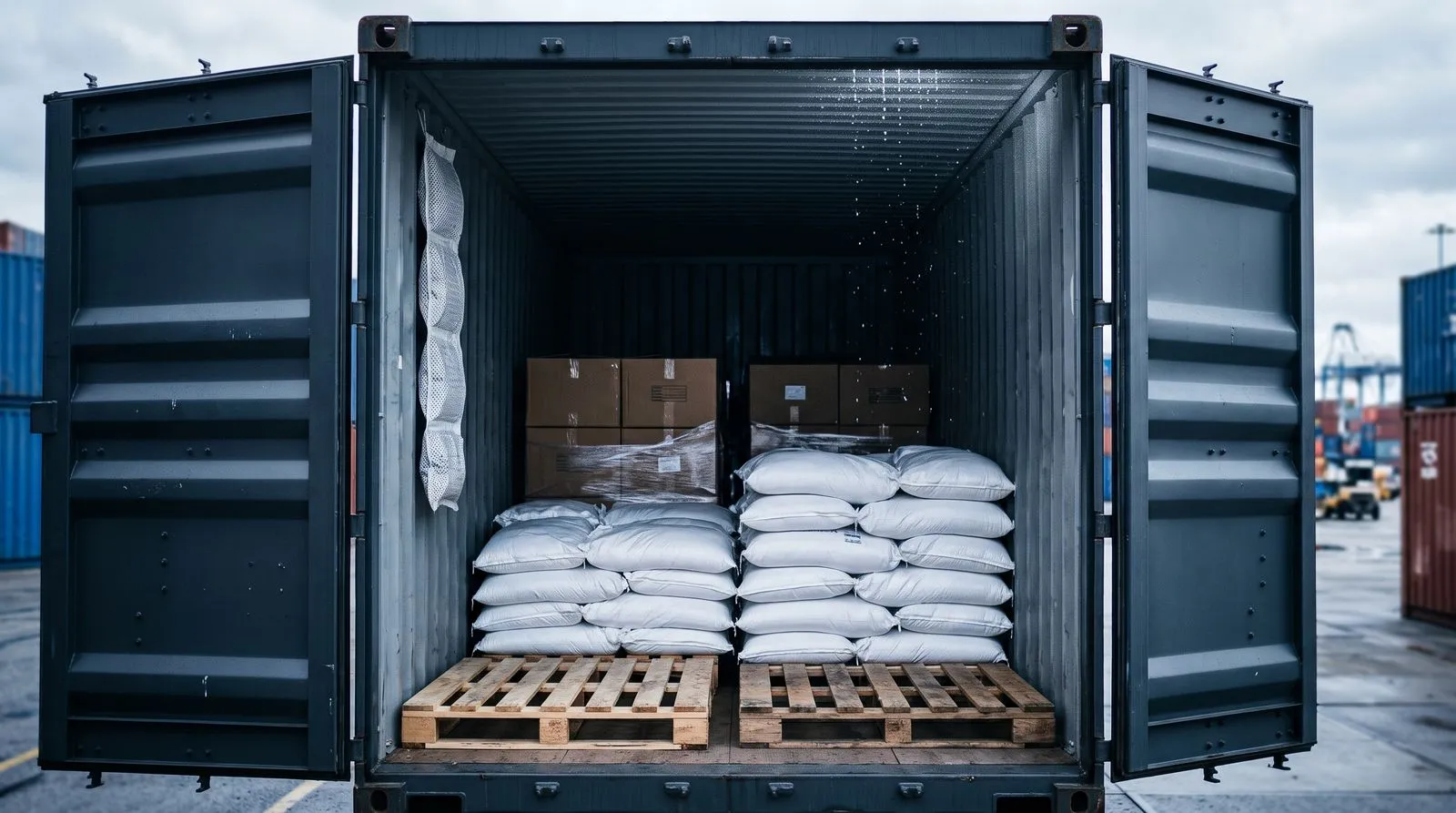
Moisture damage to coconut cargo in a container usually starts as water vapour, not as a leak. Dry product loaded in a hot port can arrive caked, mouldy or out of water-activity spec because the air inside the box cooled on the way. The fix is a loading plan plus a contract term, not a hopeful note on the booking.
That matters in money and weeks. A wet lot means a held discharge, a surveyor, an insurance dispute over whether the cause was packing, carriage or storage, and a replacement order that restarts the lead time. Below is how container moisture damage happens, what desiccants and liners do about it, and where the buyer’s contract should say so.
Where does the water in a sealed container come from?
Four places: the air, the packaging, the pallets and the product itself. A Virginia Tech packaging centre white paper on moisture in sea containers lists the same four and notes that organic goods, paper cartons and wood all absorb and release moisture until they match the surrounding air.
Coconut ingredients sit in that organic group. Desiccated coconut, flour and milk powder take on humidity from a damp box, and our note on moisture and water activity specs for desiccated coconut shows why a small rise in moisture matters to shelf life.
Pallets are the part buyers forget. The same paper reports that green-wood pallets can carry 50 to 100% moisture content and can hold more than ten pounds of water each, while kiln-dried pallets sit near 19% and will not release moisture into the container. Heat-treated is not the same as kiln-dried.
What is container rain, and what is cargo sweat?
Container rain is condensation that forms on the steel roof and walls and drips onto the cargo. Cargo sweat is condensation that forms on the cargo surface itself. Both happen when a surface falls below the dew point, the temperature at which the air can no longer hold its vapour.
The English edition of the German container handbook, Container Handbuch, describes the first case this way: when the wall is cooled by outside air below the dew point of the air inside, sweat forms on the wall. The intensity depends on the gap between inside air temperature and dew point, and on how far outside temperature drops overnight. Its second case is the reverse: a cold cargo surface meeting warm, humid air as the box moves into the tropics.
Coconut cargo moves both ways. A box loaded in Colombo or Surabaya at humid tropical temperatures can cool crossing to Europe in winter. A cold-stored lot discharged in Singapore meets warm air at the quay.
At which stage does the damage start?
Often at the ends of the trip, not on the vessel. The Virginia Tech paper cites a Xerox study finding that the fastest temperature and humidity swings occur before and after the vessel leg, during loading, short storage and unloading, when conditions change over hours rather than days.
The insurer data adds a second route. TT Club’s guidance on wet cargo damage reports that, in its 2020 claims data, 25% of wet damage came from water entering through container damage that should have been caught at packing, and 17% from impact damage in transit. The maritime leg accounted for 65% of wet-damage claims by mode, and storage 13%. Those figures cover all cargo, not coconut, but they show that many claims are packing-stage failures.
So the order of defence is: inspect the box, dry the load, then add a moisture control for the voyage.
Desiccants or liners: which does what?
They solve different problems. A desiccant absorbs vapour from the air in the box. A liner separates the cargo from the steel wall and roof.
| Measure | What it does | Limit | Ask for in the contract |
|---|---|---|---|
| Calcium chloride desiccant (hanging strip or bag) | Pulls vapour out of the air, lowering the dew point inside the box | Has a fixed capacity; dose depends on cargo, route and transit time. A leaking bag can contaminate cargo | Type, quantity per container and a statement that bags are food-safe and hung clear of product |
| Wall and roof liner (paper or fabric sheet) | Catches droplets and keeps cartons off wet steel | Does not remove vapour from the air | Material, coverage and fitted before cargo loading |
| Kiln-dried or plastic pallets | Removes a source of water from the box | Costs more than green wood | Pallet moisture or type stated on the packing list |
| Vent-aware loading (not sealing wet cargo in) | Lets vapour escape when the route allows | Works only if outside air is drier | Loading temperature and humidity recorded |
How many desiccant units? The Virginia Tech paper points to the DIN 55474 method, a calculation based on box volume, humidity, the weight of hygroscopic packing, and transit time. One desiccant maker’s guide gives about 6 kg of calcium chloride for a standard four-week temperate voyage in a 20 ft container and says tropical routes, longer transits and hygroscopic cargo raise the demand. That is a vendor figure, so treat it as a starting point and ask your supplier or surveyor to run the calculation for your lane.
Should the container be ventilated?
Only when the outside air is drier than the inside air. The rule quoted by the paper, attributed to the American Institute of Marine Underwriters, runs: hot to cold, ventilate bold; cold to hot, ventilate not. Ventilation moves moisture in both directions.
For sealed bagged coconut products the usual choice is a closed box with desiccant, rather than a vented one. If you cannot say which direction your lane runs, ask the forwarder for the loading and discharge climate before agreeing the setup.
What should the packing and contract say?
Put the moisture plan in the purchase terms, because that is where the later argument will be decided. Five items do most of the work.
- Container condition. Require a pre-loading inspection for holes, rust, repairs and water trails, with photographs. TT Club names these as the checks that prevent a quarter of wet claims.
- Dry load. State that product, cartons and pallets are dry at loading. Name pallet type.
- Moisture control. Name the desiccant type and quantity per container, and where it hangs.
- Records. Ask for loading photographs, the loading date and a data-logger reading for high-value lots.
- Water-activity test at arrival. Test a retained sample against the loading value. The gap separates a supplier fault from a transit fault.
One point is easy to overlook.
Insurance wording matters here.
Check with your broker how your policy words condensation and gradual damage before relying on cover, because it is a different event from a leaking box. Our note on cargo insurance, ICC (A) versus (C) covers what a claim needs, and the container rejected claims playbook sets out the evidence trail. For loading, see our guide to palletising and container loading plans.
What this means for buyers
- Procurement managers (A): add a moisture-control clause with desiccant type, quantity, pallet type and an arrival water-activity test. It turns a disputed cause into a measurable gap.
- Importers and distributors (B): ask the forwarder for the climate at both ends of each lane and set the vent or closed-box choice from that. Photograph every container on arrival, before it leaves the quay.
- Brand owners (C): if the co-packer is at the receiving end, require arrival checks on every lot, because you carry the production loss.
- Traders and brokers (D): price winter northbound and monsoon-season lanes with the extra control cost included. A cheap offer with no moisture plan has moved the risk to you.
FAQ
Does a desiccant guarantee no moisture damage? No. It has a fixed capacity and does nothing about a leaking box or wet pallets. It lowers the dew point inside a sound, dry-loaded container and works best with the other measures.
Are desiccant bags safe near food? A ruptured bag can contaminate cargo and packaging. Hang bags clear of product, specify the type, and check them at discharge.
Do liners replace desiccants? No. Liners stop droplets reaching the cargo. They leave the water vapour in the air, so many programmes use both.
Who pays when condensation damages a lot? The contract and the evidence decide. With inspection records, loading photographs and an arrival test, the claim usually reaches the right party. Without them it stalls.
Need a moisture-control clause written into a coconut contract? Send the desk an RFQ at /contact/, and we will set the terms with you.